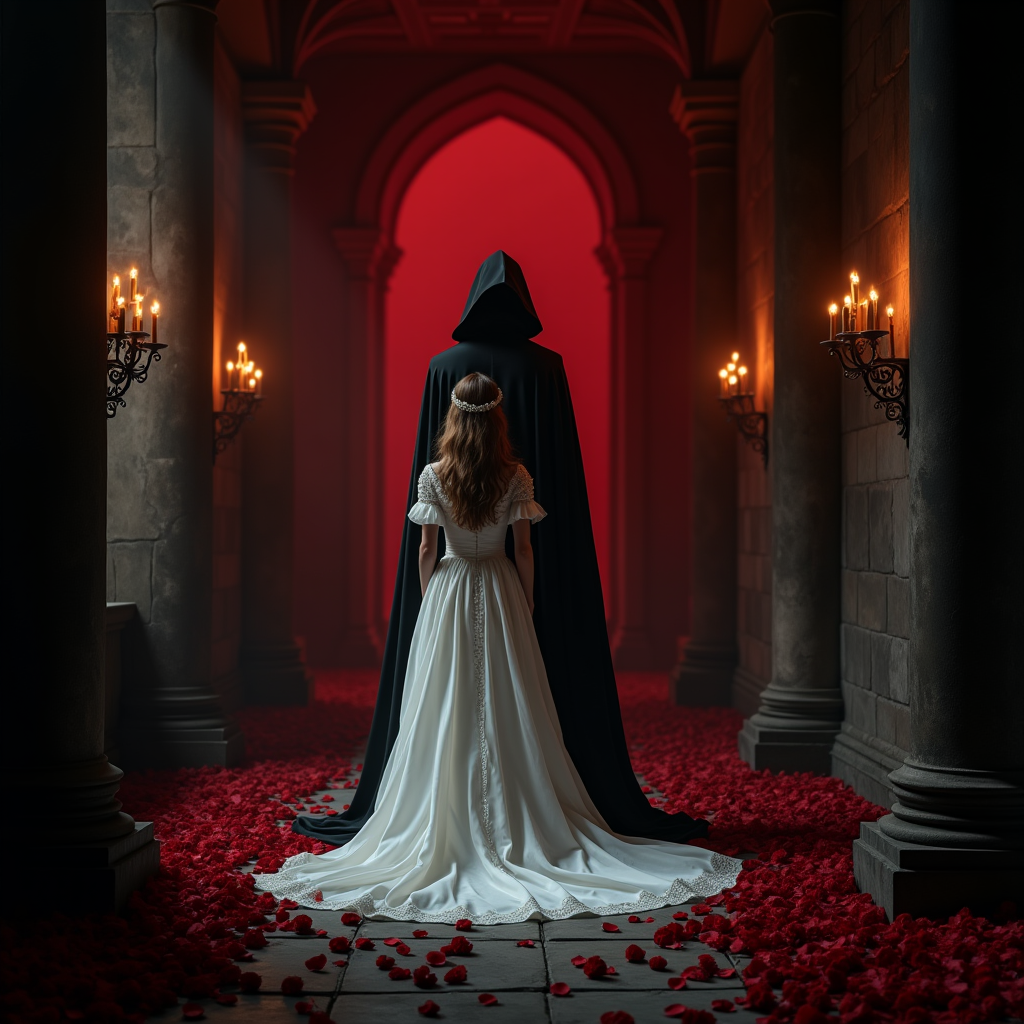
A Bride for the Hollow
The carriage had no wheels. Elara realized this only after she had already stepped inside, only after the door had closed behind her with a sound like a coffin lid, and the vehicle began to move without any mechanism she could identify. There was no horses. No engine. Only the dark country road and the sensation of being carried, swiftly and with great certainty, toward something she could not see.
She had answered the advertisement fourteen days ago. Wanted: A bride of sound health and steady nerves for a gentleman of considerable property in a remote location. Discretion is paramount. Generous compensation. The agency had been reputable enough, or had seemed so. They had matched her with a man named Lord Ashworth Vale, whose photograph showed a face she would have called handsome if it had shown any evidence of warmth. The photograph had not shown the hollows beneath his eyes. It had not shown the way his fingers — visible at the edge of the frame, gripping a chair’s armrest — were too white, too taut, like something pulled too tight over bone.
She was twenty-four. She had no family, no prospects, and a small amount of debt that had begun accruing interest at a rate that would swallow her within three years. This was not a love match. She understood that. She had made her peace with it before she packed her single trunk.
The house was a Victorian structure that had been designed, it seemed, to discourage visitors. It sat at the end of a gravel drive so long that the road disappeared behind the treeline before you ever reached it. The windows were tall and narrow, and every curtain was drawn, and the stone façade had the quality of something that had been waiting so long for something that it had forgotten what it was waiting for.
Lord Vale met her at the door. In person, she saw that the photograph had been accurate after all — he was handsome, in a severe and aristocratic way. His hair was black and thick, his jaw cleanly carved. But the hollows were real, and so was the pallor, and when he spoke, his voice had a quality she could only describe as rehearsed. As if he had learned to speak from books rather than from people. He showed her to her room — the largest she had ever occupied, with a bed that could have held four people — and left her alone with a dinner bell she was to ring when she wished to eat. She was not allowed in the east wing. She learned this from a housekeeper who appeared on her second morning, silent and gray, and who answered no questions except to say: “The master has his reasons.”
A week passed. Then two. Lord Vale dined with her each evening at eight o’clock, articulate and thoughtful and utterly without warmth. He spoke of history and architecture, of the estate’s former grandeur, of the gardens his mother had maintained before her death. He never spoke of himself. She began to explore the house at night. She found the library, with books in languages she could not identify. She found the solarium, converted into what appeared to be a small chapel, though the altar faced away from the light. She found, at the end of a hallway she had been told not to enter, a door that was always locked, and behind which she could hear, on quiet nights, a sound like breathing that was too slow and too deep to be human.
She did not ask him about the east wing. She did, however, begin to notice things that the daylight dinner table concealed. He did not eat. After three weeks she had never seen him lift a fork to his lips. He did not blink the way other people blinked — his eyes stayed open too long, as if the act of closing them was something he had to remember to do. And on the night of the full moon, she passed his study door and found the room empty, and through the window she saw a figure in the garden below, standing motionless among the overgrown roses, not moving despite the wind that bent the grass around it.
She confronted him on the twenty-third night. She told him she knew what he was. She had pieced it together slowly — the isolation, the agelessness, the locked wing, the breath that was too slow. She did not say the word vampire, because the word seemed too crude for what she suspected. He listened without interruption, and when she finished, he closed his book and looked at her for a long moment.
“You are correct. I have not been human for one hundred and thirty-seven years. The marriage is a technicality. I require a legal spouse to manage the estate’s human-facing affairs. The last one died forty years ago. You may leave. I will clear your debts regardless.”
Elara had read the contract. She had known what he was before she arrived. She had chosen this with her survival instincts, not her heart, and she found she did not regret it.
“I will stay,” she said. “For the year.”
Lord Vale looked at her with an expression she could not read. Then, for the first time since she had arrived, he smiled. It changed his face completely — revealed something beneath the severity that was not cold at all, but rather a loneliness so vast he had forgotten what it felt like to be otherwise.
“Then we understand each other,” he said. “Which is more than most who have shared this house can say.”
He did not ask her to love him. He did not ask her for anything at all. That, she would later realize, was the most romantic thing about him.