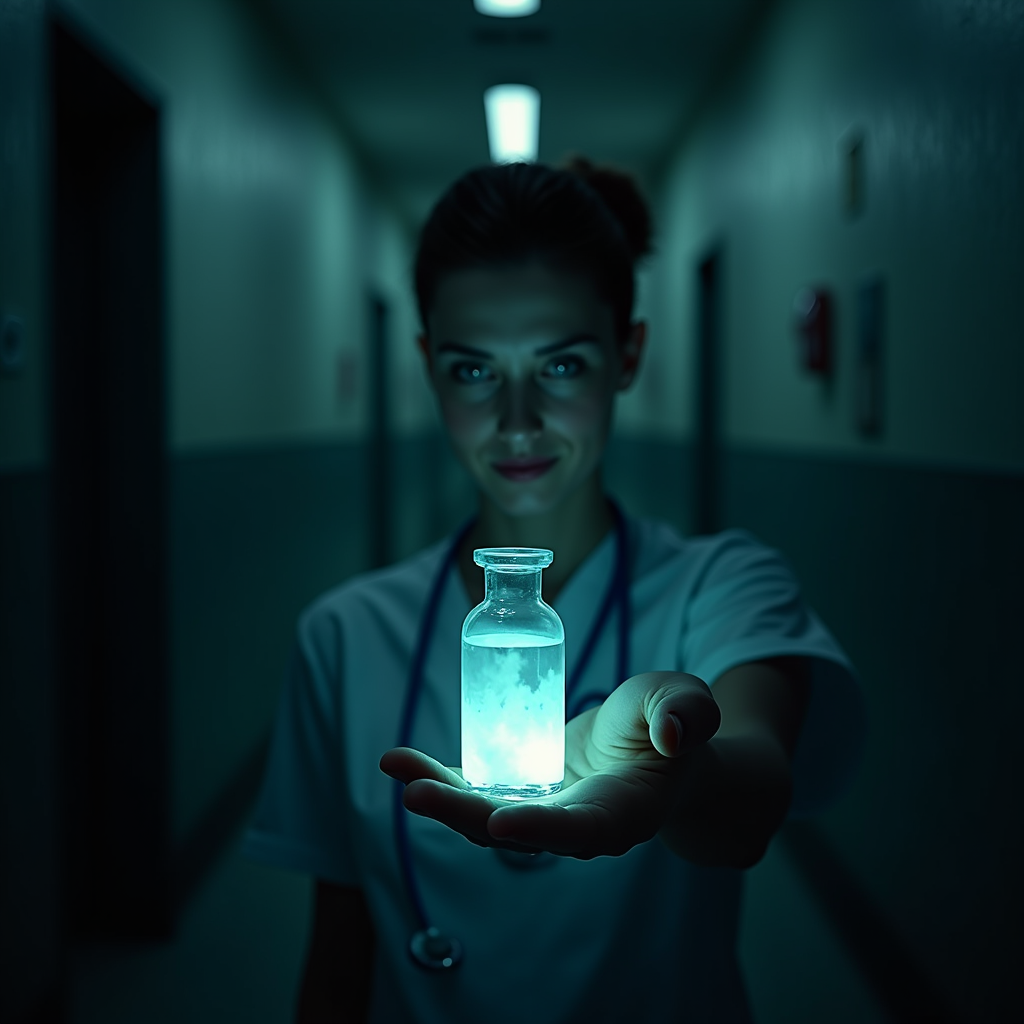
The Collector of Last Breaths
Nora had been a hospice nurse for eleven years, and she had learned to read death the way sailors read weather. It came in signs. A cooling of the extremities. A lengthening of the pauses between breaths. The subtle shift in the smell of a room — something between copper and wet earth.
She had been on shift at Ashworth Palliative Care when Mrs. Castellanos died at 3:47 in the morning. It was quiet. Peaceful, if any death could be called that. Nora had held the woman’s hand as the last breath left, and she had noticed something she could not explain. A faint luminescence, like phosphorescent plankton, rising from the old woman’s lips. It lasted less than a second. Nora blinked, and it was gone.
She told herself it was a trick of the overhead fluorescents. She filed her report. She moved on to her next patient. Three weeks later, she found the first vial.
The housekeeping staff had been complaining about the old supply closet in the basement. Something was growing behind the shelving — a fuzzy white mold that spread despite their efforts. When Nora volunteered to help clear it out, she was not sure why. The closet had not been touched in decades. Dust lay thick on every surface. Behind a collapsed stack of expired saline bags, her flashlight found a small glass vial, no larger than her thumb, sealed with a calcified cork. Inside, something caught the light — not liquid, not solid, a faint spiraling luminescence that moved without wind or current.
She should have reported it. Instead, she found herself turning the vial in her fingers, watching the light move, and feeling something she had not felt in eleven years of holding dying hands. Grief. Not for any particular patient. For all of them. The vial grew warm in her palm. She pocketed it.
By the end of the month, she had seventeen. They came from the closet — dozens of them, hidden behind walls that should not have had spaces behind them, tucked into ceiling tiles that predated the building’s last renovation. Each one contained that same spiraling light. Each one, when she held it, delivered a wave of grief so specific she could taste the patient’s last meal on her tongue.
Mrs. Castellanos tasted of black coffee and regret. A young man named David — twenty-three, leukemia — tasted of summer grass and unfulfilled promises. An eight-year-old boy named Oliver tasted of birthday cake frosting and the fear he had not been able to hide. She began having conversations with them. In the supply closet after her shifts. Then in her car in the parking garage. Then at her kitchen table in the blue hours before dawn. She was not losing her mind. She was processing. The vials were a conduit, a way to finally release what she had absorbed from three hundred and sixty-two deaths without ever being allowed to grieve.
The new facilities director was a man named Theodore Marsh, and he had no patience for superstition. When the maintenance team reported strange readings in the basement — temperature fluctuations, electrical anomalies, a persistent organic smell — he ordered a full investigation. They found the hidden spaces behind the walls. They found hundreds of empty cork holes where vials had once rested. They found notes, written in a cramped hand on paper so old it crumbled at the edges, documenting a practice maintained at this location since 1887.
The previous hospice had been a private estate. The groundskeeper, a man named Aldric Venn, had served three generations of the family as keeper of the dying. His notes described his work in clinical, almost reverent terms. He collected the final breath of each departing soul. He believed the breath contained something essential — the last residue of a life, the final proof that a person had existed. He sealed it. He stored it. He promised the dead that he would not let them be forgotten.
Marsh ordered the remaining vials destroyed. The custodial team set them in a basin in the courtyard and tried to burn them. The fire made no difference. The corks did not char. The lights inside simply burned brighter, and the smell of copper and wet earth spread across the property like a fog. Nora watched from the fourth-floor window as her patients’ last moments ignited in the courtyard. She felt each one go — not gradually, not gently, but all at once, like a hundred hands releasing grips they had held for decades.
She went to the supply closet for the last time. She found one vial remaining, hidden in a gap she had somehow missed. It was brighter than all the others. When she held it, she heard a voice that was not a voice — more a pressure, a certainty — say the word she had needed to hear for eleven years: Enough.
She set it down. She walked out. She did not look back. The closet door closed behind her with the soft finality of a chest lid lowering into earth.