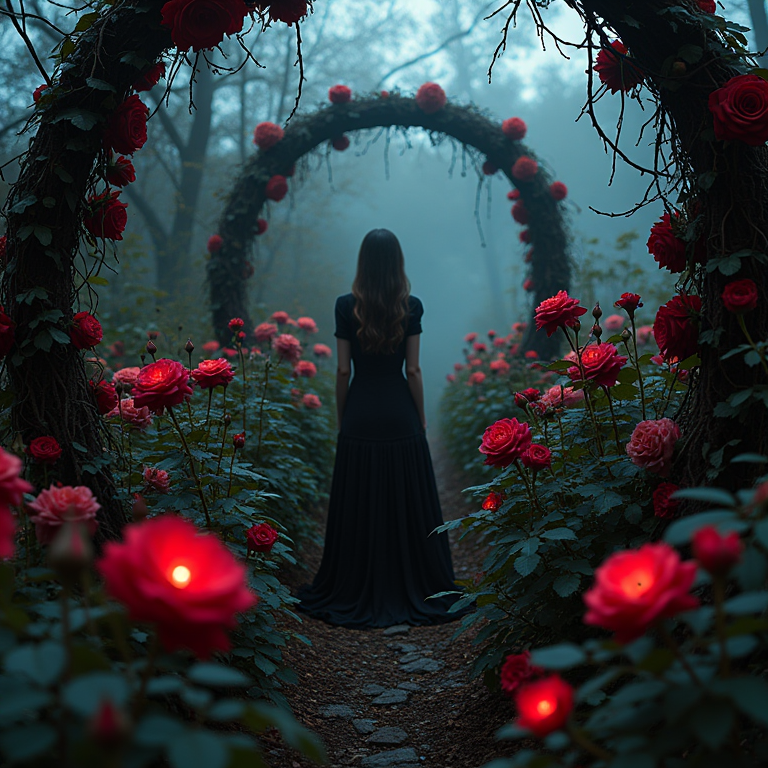
Where the Thorns Remember
The letter arrived in a language Lily didn’t recognize, written in ink that smelled of wet earth and something sweeter—like honey left too long in the sun. It was an invitation to Thornwood, an estate she had never heard of despite growing up in the same county, to inherit something from an aunt she had never known she had.
Lily went. What else was there to do? She was between jobs, between relationships, between the person she had been and the person she was trying to become. An inheritance, even from a stranger, even from a place she couldn’t find on any map, was at least a direction to walk toward.
Thornwood found her before she found it. The path appeared in the forest when she was halfway through her third wrong turn, as if the estate had decided she was worth inviting regardless of whether she could navigate.
The garden was not what Lily expected. Gardens had edges, limits, the comfortable boundaries of beds and pathways. Thornwood’s garden had none of these. It sprawled in every direction, overgrown and wild and somehow organized, as if the chaos itself was a kind of order that only made sense if you were already part of it.
The flowers were wrong. Not in color or shape—though those were strange enough—but in behavior. They turned toward her as she walked past. The roses leaned in when she paused. The thorned vines shifted their position slightly, tracking her movement like something alive and hungry.
Her aunt had lived here for forty years, alone, tending the garden that had once been a small patch of herbs by the kitchen door. In those forty years, the garden had grown to fill the entire estate, swallowing the house, the barn, the graveyard, until there was nothing left but green and bloom and the endless patient waiting of flowers that had learned to want.
Lily understood, on her third night at Thornwood, why her aunt had never left. It wasn’t that she couldn’t leave. It was that leaving would mean abandoning something that had become part of her—the garden that had been grown from her grief, from her solitude, from the love she had poured into it year after year until the garden had grown dense and deep enough to pour back.
The garden spoke to her, on that third night. Not in words. In images. In the feeling of being held, of being understood, of being seen by something that had been watching her since she arrived and had decided she belonged here as surely as her aunt had belonged.
The invitation had not been a letter. It had been a seed. Planted in Lily’s mailbox, carried by wind, germinated in her blood until she had no choice but to follow where it led.
She stayed. The garden wrapped around her the way it had wrapped around her aunt, the way it had wrapped around everyone who had ever tended it. And the thorns—those cruel, protective thorns that kept the world at bay—they welcomed her. They grew over her skin like a second body, like armor, like a home.
There was a man who came to Thornwood. He was a botanist, or he said he was. He was looking for a rare species that grew only in the garden’s deepest part, in the place where the flowers had stopped being flowers and had become something else entirely.
Lily loved him. The garden loved him too. But not in the same way. Lily loved him because he was warm and human and present. The garden loved him because he was growing.
When he tried to leave—because men always tried to leave, eventually, even from gardens that wanted them to stay—the garden stopped him. Not with thorns. With beauty. It bloomed around him in colors he had never seen, in scents that promised everything he had ever wanted. And he stayed, because staying was easier than fighting, and because the garden made it easy, and because some people are not meant to leave places that have decided they belong.
The botanist stayed for seven years. In that time, he forgot he had ever been anything but a gardener. He forgot his name, his family, the world outside the garden’s walls. He became a rose, in the way that people at Thornwood became things—rooted, blooming, permanent.
Lily watched him transform and did not try to stop it. This was the price of love at Thornwood. You loved, and the garden loved through you, and eventually the garden took what it loved and made it permanent.
When there was nothing left of the man but a beautiful flowering thing in the garden’s center, Lily knelt beside him and said: “I know you wanted to leave. I know I should have let you. But I couldn’t. And the garden couldn’t. We loved you too much to let you go.”
The rose that had been the botanist did not answer. Roses do not speak. But it leaned toward her when she touched its petals, and something in its fragrance—something that was still, after everything, the smell of the man she had loved—reached for her in return.
Lily stayed at Thornwood until she became a part of it. She did not transform entirely, not like the others. She remained herself, rooted to the garden’s center, tending it, loving it, watching it grow. And when the next letter arrived in some other stranger’s mailbox, she would be there to greet them. To welcome them. To show them the place when the thorns remembered, and where nothing that was loved was ever truly allowed to leave.