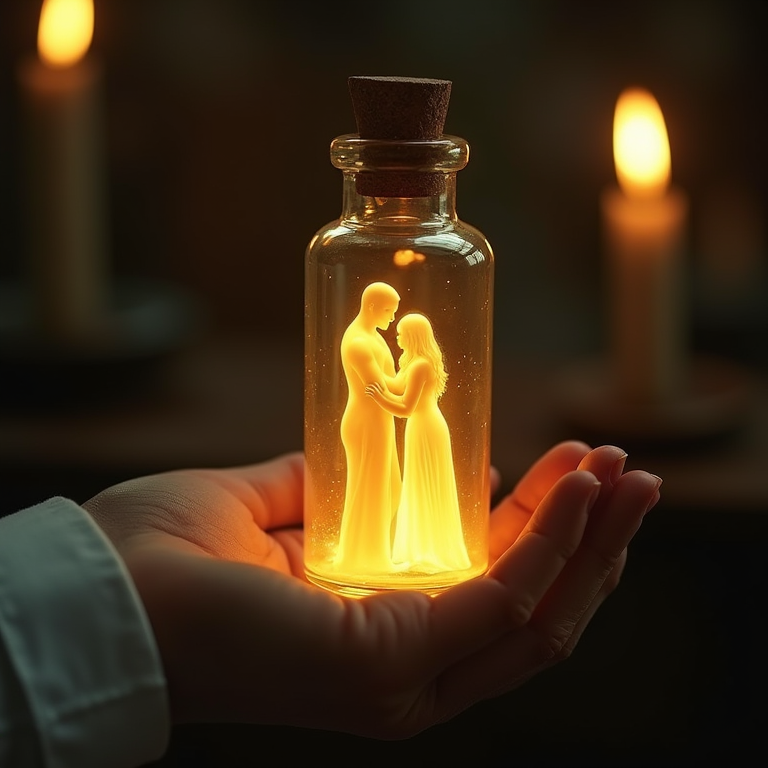
The Final Exhalation
Dr. Emil Harlow had spent thirty years collecting last breaths. Not as a hobby. Not as a medical curiosity. As a form of love. Every patient he had ever watched die had given him something in return—not their possessions, not their money, not their regrets. Their breath. the final breath that left their body like a secret being whispered into the universe.
He captured each one in a glass vial, stoppered with wax, labeled with a name and a date. Eight hundred and forty-seven vials. Eight hundred and forty-seven endings. Each one different, each one the same.
His colleagues thought he was eccentric. His family thought he was morbid. But Emil knew what he was doing: he was keeping them. Not their bodies. Not their memories. The very last thing they had given to the world, escaping their lips at the moment of departure.
When his wife died, Emil was there. He had been there for every patient, and he would be there for her—holding her hand, watching her breathe, catching the final breath in a vial that would be the most important of his collection.
But something went wrong. Or went right. No one, least of all Emil, could decide which.
When he opened the vial, the breath that came out was not air. It was light—a soft, golden luminescence that filled the room, that settled on Emil’s skin like warmth, that pressed against his lips as if asking permission to enter.
And when he breathed in—without thinking, without meaning to, just a reflex of a grieving husband who wanted one more connection to the woman he had lost—the breath entered him.
Elena was there. Not as a ghost. Not as a memory. As a presence, living inside his chest, visible when he looked in mirrors, audible when he spoke aloud and heard her voice responding.
Elena had conditions. She could not leave him. She could not exist without him. The breath that had carried her consciousness was tied to the body that had breathed it, and that body was now Emil’s to inhabit for as long as he lived.
“I’m not a ghost,” she told him. “I’m not a haunting. I’m something else. Something that only exists because you loved me enough to catch my last breath and keep it alive. But I need you to understand—this is permanent. I cannot go forward to wherever the dead go. I can only stay here, with you, until you join me.”
“How long will that be?”
“However long you have,” Elena said. “Which might be a long time, if you’re careful. Or might be tomorrow, if you’re not.”
They lived together for nineteen years. It was strange, loving someone who was inside you. Strange and intimate in ways that their marriage had never been—because Elena knew everything Emil felt, everything he thought, every flicker of emotion that crossed his mind. And Emil, in return, could feel her responding to his feelings, could sense her joy and her sorrow and her endless, patient love.
They could not touch, could not embrace, could not sleep in the same bed. But they could feel each other, and sometimes that was more intimate than any touch.
Emil continued collecting last breaths during those years. He added forty-three new vials to his collection. Each one felt different now—each one was not just an ending but a new form of existence, a continuation in a form he had never imagined possible.
“Are you lonely?” he asked Elena, in year twelve.
“I’m with you,” she said. “How could I be lonely?”
Emil died on a Sunday morning, in his sleep, with Elena inside him. The breath that left his body was the last breath of someone who had spent nineteen years carrying another person’s soul. And it carried both of them now—Elena and Emil, together, intertwined, finally free of the burden of a single body.
The forty-fourth vial in his final collection was the only one that glowed.
The funeral director found it on his nightstand, labeled in his careful handwriting: “Elena and Emil Harlow. the final breath. The last breath of a love that refused to end.”
She opened it. The light that came out filled the room, settled on her skin, pressed against her lips. And for just a moment—a single, shimmering moment—she heard two voices speaking at once, saying the same words, in perfect harmony:
“Thank you for keeping us. Thank you for listening.”
Then the light was gone, and the vial was empty, and the room was just a room, and the dead were finally free.