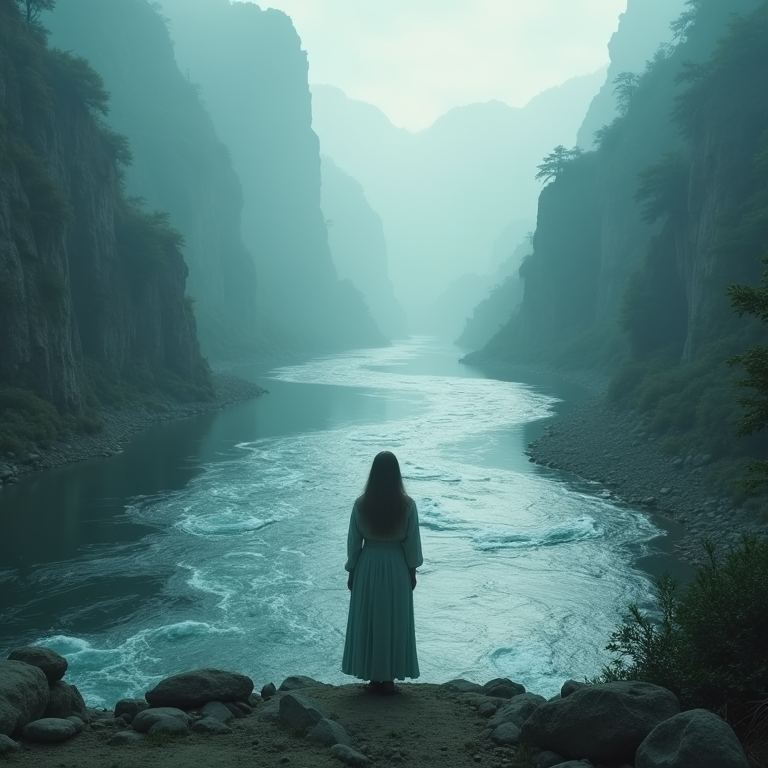
The River That Remembered Everything
The River of Endings began at the top of the world and ended at the bottom of it, flowing through every landscape that had ever existed on its way to whatever waited at the bottom of everything. It remembered every foot that had ever waded in it, every leaf that had ever fallen onto its surface, every storm that had ever emptied itself into its current. It was, by any measure, the oldest river in any world that had ever been.
Sora found it by accident. She had been hiking in the mountains—a solo trip, three weeks alone on trails that barely existed—when she followed a tributary up and up until the water turned from white to silver to something that had no color at all but was somehow still visible. And there, at the place where the tributary ended, she found the River.
It was wider than any river had a right to be. It moved slowly, as if it had nowhere urgent to go. And along its banks, she saw things that couldn’t be real—visions of people and places and moments that had happened long ago and might never have happened at all.
The River spoke to her on the third night. Not in words, exactly. In impressions. In images that formed in her mind when she looked at the water long enough. It told her she could have anything she wanted. It told her she could remember anything she had forgotten. It told her it had been waiting for someone like her for a very long time.
“What do you want in return?” Sora asked. She wasn’t naive enough to believe anything was free.
The River showed her: a memory. One memory, taken from the countless billions it carried. If she agreed, the River would give her one memory from its collection—any memory, from any time, from any life that had ever touched its waters. And in exchange, she would give the River one of her own memories. A fair trade. A memory for a memory.
“Which memory would I give?”
The River showed her: the memory she had come here to forget. The reason she was hiking alone in mountains she had never seen before, for trails that went nowhere she needed to be. The memory she had been trying to outrun for months.
“If I give you that,” Sora said, “I won’t remember it anymore.”
“No,” the River agreed. “But you will remember that you chose to let it go. And sometimes that is enough.”
Sora chose the memory she wanted: the last time she had seen her grandmother, before the dementia took everything, before the woman she had known became a stranger living in a body that no longer worked. Her grandmother had been making bread. She had been telling a story about a river—a story Sora had never heard before or since, about a woman who could walk on water and a man who could turn his tears into rain. And she had been happy, genuinely happy, in a way that Sora had rarely seen in the years before the diagnosis.
The River gave her that memory. It flowed into her like cold water, like coming home, like the feeling of waking up from a dream you didn’t want to end. Her grandmother’s hands kneading dough. Her grandmother’s voice telling stories. Her grandmother’s smile, which had always been too big for her face, which had always seemed to contain more joy than one person could hold.
And in exchange, the River took the memory Sora had been trying to forget. The phone call. The hospital. The moment when she had been told that nothing more could be done, and the way the world had gone silent, and the sound of her own voice saying “okay” over and over because she didn’t know what else to say.
It was gone. Not suppressed. Not buried. Gone. The River absorbed it completely, and Sora felt it go—a lightness, an absence, a space where the weight had been.
The River was not finished with her.
Over the next year, Sora noticed things. Small things at first—a face she didn’t recognize in an old photograph, a name she couldn’t place attached to a feeling she did remember. Then larger things. A scar she didn’t know the origin of. A fear of hospitals that she couldn’t explain. A persistent sense that something was missing, something important, something she had lost without knowing she was losing it.
The River had given her a memory from someone else’s life. And that memory had come with context—a whole life attached to it, a web of connections and consequences that Sora hadn’t asked for and couldn’t give back.
She went back to the River. It was farther than she remembered—farther and harder to find, as if it had moved while she wasn’t looking. But she found it eventually, on a trail that seemed to exist only when she was walking on it.
“You took something that wasn’t just a memory,” she said. “You gave me someone else’s life.”
The River rippled. It had no words, but it had something like apology. It hadn’t meant to harm her. It had simply been so long since anyone had asked for anything from its collection that it had forgotten how to be careful.
“Can you take it back?” Sora asked. “Can you undo the trade?”
The River showed her: no. The memory had already become part of her. It had woven itself into her neural pathways, her emotional responses, her sense of self. Taking it back now would be like taking back a piece of her own bone.
Sora lived with the foreign memory. She learned its contours, its weight, its places where it fit and its places where it rubbed against who she had been. It belonged to a woman named Elara, who had lived three hundred years before Sora was born, who had been a healer in a village that no longer existed, who had loved a man who had died in a war that had been forgotten even before the River was old.
Elara’s memory came with debts Sora hadn’t asked for—griefs for people she had never met, loyalties to places she had never seen, habits of thought that felt foreign in her own mind. But it also came with gifts: knowledge of herbs that modern medicine had forgotten, ways of seeing that the rational world had trained out of itself, a sense of connection to something larger than any individual life.
She visited the River once more, years later, when her grandmother finally died and Sora found herself standing at the funeral without the grief she expected to feel. She didn’t need the River to take this one. She needed the River to help her understand why she felt nothing.
“You took my grief,” she said. “That day on the mountain. You took my grief and you gave me someone else’s. But you didn’t tell me that grief is not a debt we owe—it’s a gift we give ourselves.”
The River said nothing. Rivers rarely do. But it showed her something: her grandmother, in the memory she had received from the River, making bread, telling stories, smiling her too-big smile. And Sora realized, finally, that the memory had never been about the bread or the stories. It had been about the love underneath them—the love her grandmother had put into every loaf, every tale, every moment of presence she had offered to a granddaughter who hadn’t known how to receive it.
Sora stood by the River for a long time. She didn’t trade anything. She didn’t bargain. She just let the water move past her, carrying its countless memories, its countless endings, its countless beginnings that were also endings. And when she finally walked away, she carried nothing with her but the knowledge that some things are too big to hold and too important to let go.
Some rivers remember everything. And some people, standing at their edges, learn to remember alongside them.