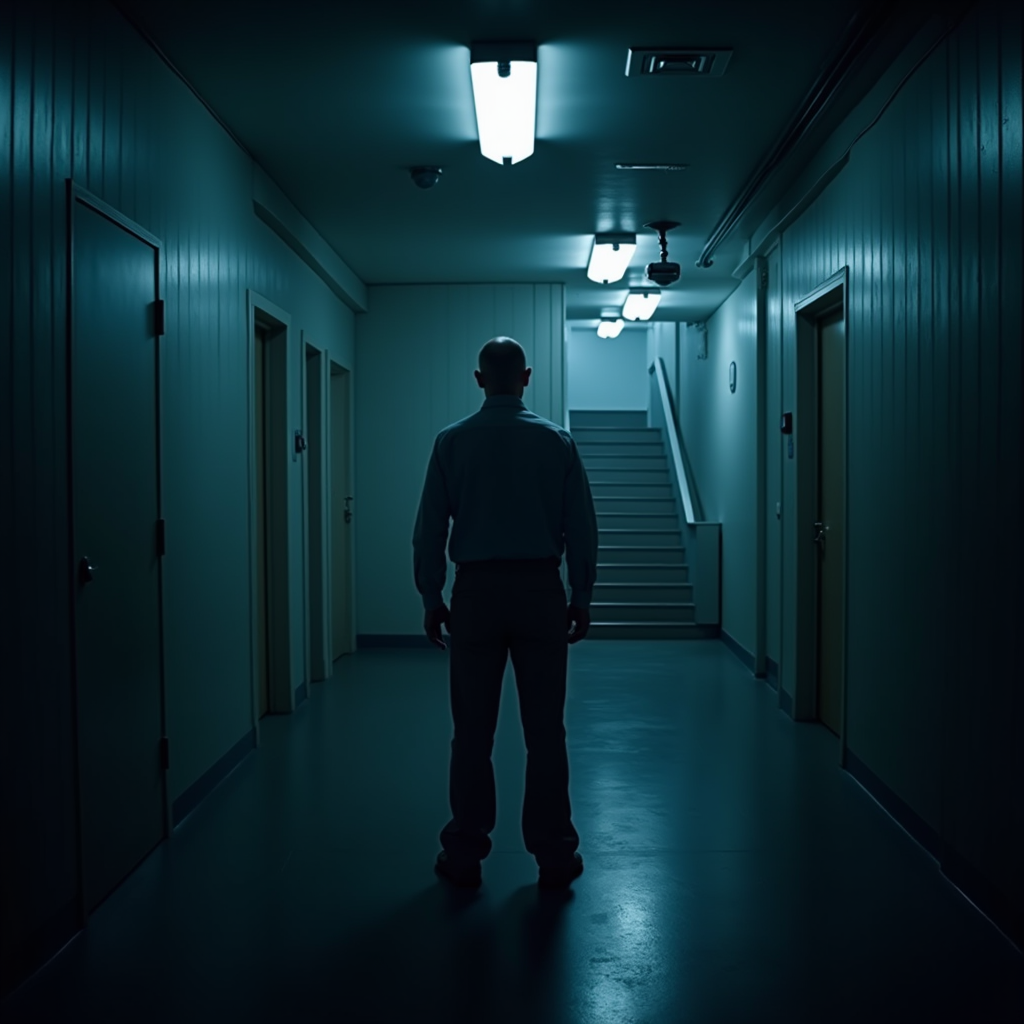
The Witness They Buried
Daniel Vance was not supposed to be on the forty-seventh floor at 6:14 in the morning. He was supposed to be in his apartment in Queens, eating toast and watching the morning news before his commute into Midtown. He was supposed to be a mid-level compliance analyst at Hartwell & Associates, a man whose name appeared on no important documents and whose face appeared in no important meetings.
He was in the building because he had forgotten his laptop. He had turned his car around on the Williamsburg Bridge and driven back downtown and taken the service elevator to avoid the security desk, because he was embarrassed about the forgotten laptop and did not want his colleagues to know he had left it at home like a forgetful child.
The forty-seventh floor was the executive level. He never went there. He had been to the floor exactly once, three years prior, for an orientation tour that had not included the details he now could not stop seeing. The door to the stairwell had been open. He had not meant to look. But the sound — a dull, wet impact, followed by silence — had drawn his eye before his mind could process what he was hearing and decide not to investigate.
Raymond Essing, the firm’s CFO, was on the floor of the stairwell. He was not standing. He was not unconscious. He was arranged on the concrete in a way that Daniel’s brain, after three seconds of refusing to understand, finally could not avoid.
Daniel ran.
The police file would later say that Raymond Essing died at 6:47 AM, cause of head trauma consistent with a fall down a stairwell. The file would note that the building’s security footage from the forty-seventh floor had been experiencing a “server malfunction” during the relevant window, and that no footage was available. The file would conclude that the death was accidental.
Daniel had been standing in the hallway when the security guard found him. Pale, shaking, unable to articulate what he had seen. The guard had assumed he was having a medical emergency and called an ambulance. By the time the paramedics arrived, the stairwell door was closed and Raymond’s body had been discovered by the building manager, who had been called to the scene by someone Daniel did not recognize and could not later identify.
They gave him a sedative. They took him home. They told him, kindly but firmly, that he had not seen what he thought he had seen. Grief did strange things to people. Trauma was well documented. He should consider speaking to someone.
He was not a stupid man. He understood what had happened in that stairwell, and he understood what was happening now — the quiet, efficient machinery of a cover-up operating at the level of a firm that employed four hundred people and managed client assets worth eleven figures. He understood that his version of events would not be believed, and more importantly, that believing it would not be safe for him.
He went home. He did not go to work for three days. On the third day, he began keeping records.
His records were meticulous. He wrote down everything he remembered — the time, the floor, the angle of Raymond’s body, the specific quality of the silence that had followed the impact. He noted the names of everyone who had spoken to him that morning: the security guard, the building manager, the two paramedics, the ER doctor whose report he later obtained and whose language was careful in a way that suggested she had been coached. He noted that the building’s security system logs showed a gap of exactly eleven minutes in the recording from the executive floor — a gap corresponding precisely to the window between 6:14 and 6:25 AM. He noted that Raymond had been preparing documents for an emergency board meeting that morning — documents that were missing from his office by the time building management opened it for the police. He noted that the board meeting never happened. He noted that the firm’s public communications described Raymond’s death as sudden and unexpected, and that the word “accident” appeared in the third paragraph, before any investigation could have reached conclusions.
On day five, he received a visit from the firm’s general counsel. Howard Tsao sat in Daniel’s living room and drank the coffee offered and said, with apparent sincerity, that the firm wanted to support him during this difficult time. He mentioned that Daniel’s performance reviews had always been excellent. He mentioned that a promotion was being considered. He mentioned, without ever quite saying it directly, that it would be unfortunate if Daniel’s memory of the morning in question were to become confused in any way, given how unreliable trauma memories were known to be.
Daniel thanked him. He closed the door. He started sleeping in his car.
The documents reached the journalist eleven months later, after Daniel had lost his apartment, his job, and most of his friends. The journalist was named Priya Chandrasekaran, and she had been investigating financial irregularities at Hartwell & Associates for two years without sufficient evidence to publish. Daniel’s records changed that.
The story broke on a Sunday evening. By Monday morning, three executives had retained personal attorneys. By Wednesday, the firm’s board had called an emergency meeting. By the following Monday, Raymond Essing’s death had been reclassified as a homicide investigation, and the gap in the security footage had become the central piece of evidence in a case that would eventually implicate four members of the executive team and result in two indictments.
Daniel did not watch the coverage from any fixed location. He had learned, over eleven months, how to move. He had learned that the most dangerous thing a witness could do was stay still.
On the morning the first indictment was announced, he sat in a diner in Flagstaff, Arizona, drinking coffee that was too bitter and reading a newspaper someone had left on the stool beside him. He did not feel vindicated. He did not feel safe. He felt like a man who had looked through a door he was not supposed to open and had paid for that look with everything he owned.
But he also felt, for the first time in a year, that his name was his own again. He finished his coffee. He paid his bill. He moved on.