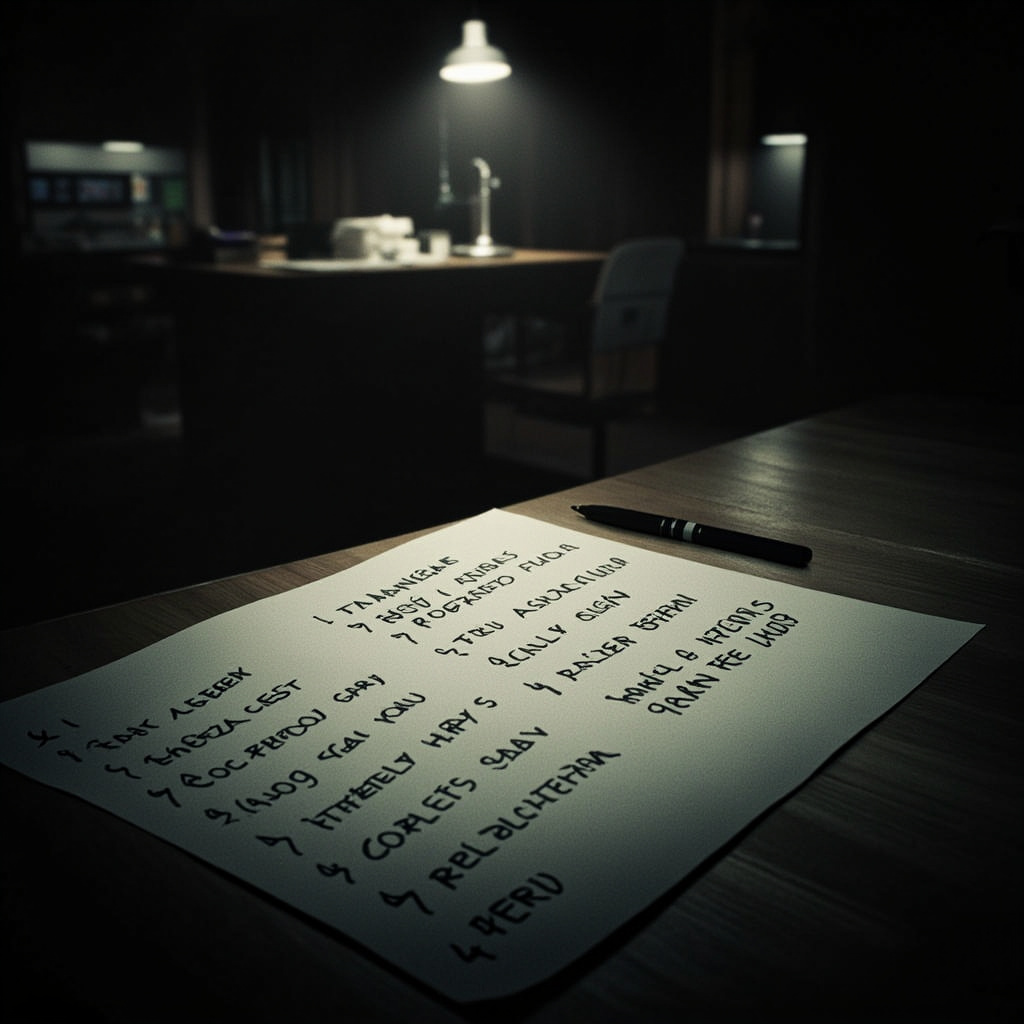
The Checklist They Found
The envelope arrived on a Tuesday, addressed to Catherine at her office in the kind of unmarked white envelope that usually contained either something important or something threatening. She opened it expecting a bill or a legal notice, and what she found instead was a single sheet of paper with a list of names written in handwriting she did not recognize. Fourteen names. She knew four of them. Three were dead. One was currently in prison. The fourth was the name of a man she had not thought about in fifteen years.
She put the list in her desk drawer and went back to work. She had a job, a family, a life that did not have room for mysterious envelopes with lists of names. She was forty-two years old and she had put the past behind her, or she had thought she had, and she was not interested in reopening doors that she had spent years keeping closed.
But the list stayed in her drawer, and she thought about it at night when she could not sleep, and three weeks later she found herself driving to the address that corresponded to the fourth name on the list, the name of the man she had not thought about in fifteen years. She did not know why she was going. She did not know what she expected to find. She knew only that she could not stop thinking about the list and about the names on it and about what they might have in common, and that the only way to stop thinking about it was to find out if there was something worth worrying about.
The man was not at the address anymore. The building had been demolished and replaced with a storage facility. The management company had no record of anyone by the name on the list having lived there. Catherine stood in the parking lot of the storage facility and felt the particular frustration of having come all this way for nothing, and then she went home and poured herself a drink and tried to forget about the list.
She could not forget about it. The list stayed in her drawer for another month, and then she took it out and looked at it again, and this time she noticed something she had missed before: the names were not in random order. They were in chronological order, by the date of something, and the dates went back thirty years, and the most recent name on the list was a name she did not recognize, a name with a date from three weeks in the future.
Three weeks from when she had opened the envelope.
She did not know what to do with this information. She did not know if the date was a deadline or a warning or simply a record of something that had already been decided. She did not know who had sent her the list or why they had sent it to her. She knew only that the most recent name on the list was the name of someone who was going to die, and that she had three weeks to find out who that person was and whether she could do anything to stop it.
She spent the three weeks trying to find out. She used contacts she had not used in years, asked questions she had sworn she would never ask again, followed trails that led mostly to dead ends and frustration. She did not find the answer in time. She found out only later, reading the newspaper like everyone else, what had happened on the date that was on the list. And then she understood, finally, what the list was. She understood who had sent it. She understood why. And she understood that there was nothing she could have done to change what happened, because what happened was already going to happen, had always been going to happen, was already written on a list that someone had sent her for reasons she would never fully understand.