The Skin Mask
The flyer promised a costume dance the following Saturday night.
Masks encouraged.
Formalwear optional.
Prizes for originality.
That last line mattered more to Evan Cole than it should have.
On Saturday afternoon he went downtown with a few guys from his dorm to look for something to wear. They drifted from shop to shop through the commercial district, poking through bargain bins of plastic vampire fangs, glitter horns, rubber scars, cheap devil capes, and racks of grotesque masks painted in red, green, and corpse gray.
His roommate Milo found the whole thing hilarious.
He kept pulling masks off the wall and trying them on one after another—bloated zombies, skeletal demons, horned beasts with bulging eyes—turning to the mirror each time with the solemn focus of a man choosing a wife.
The others joined in.
Evan didn’t.
He studied the wall, one mask after another, and felt only contempt.
Too obvious. Too ugly. Too easy.
He didn’t want to look like every other idiot in the room. If he was going to show up, he wanted people to stare for the right reason.
When the others finally burst back out onto the street wearing their ridiculous monster faces, girls on the sidewalk laughed and pointed as they passed. Milo seemed to enjoy the attention. Evan trailed behind them with both hands in his coat pockets, thinking they looked like escaped children.
Milo waited for him at the corner.
“You didn’t buy anything?”
“They were all the same.”
“It’s Halloween,” Milo said. “That’s kind of the point.”
Evan shrugged. “I’m not wearing some rubber ghoul face like everybody else.”
Milo smirked. “What, then? Going as a prince?”
“Better than going as one of a hundred bargain-bin demons.”
Milo laughed. “And who exactly is supposed to be the princess?”
The others eventually headed back to campus, but Milo stayed with Evan a while longer, following him from block to block while he searched for something different.
The afternoon slipped away.
By dusk, Milo was starving and increasingly less impressed by Evan’s standards.
“If you can’t find what you want,” he said, “just buy anything and call it irony.”
“I’d rather wear nothing than wear something stupid.”
“That sounds exhausting.”
By then they were both hungry enough to give up temporarily and duck into a noodle shop near an intersection where the windows had fogged over from the heat inside.
They sat at a small table by the glass.
It took forever for their food to arrive.
Evan, distracted, kept staring out through the window at the row of shops across the street.
Then suddenly he stood.
“Be right back.”
Milo watched him cross the street and disappear into a narrow little storefront he hadn’t noticed before.
A few minutes later their noodles arrived, and hunger overcame loyalty. Milo dug in, burning his mouth and not caring.
He had just started on the second mouthful when someone slid into the seat across from him.
Without looking up, Milo snapped, “Taken.”
Then he glanced up and almost dropped his chopsticks.
“Jesus Christ—what the hell?”
The man sitting opposite him had the most ordinary face Milo had ever seen.
That was precisely what made it so unsettling.
Nothing about it stood out. Male, late teens or early twenties, average features, average nose, average mouth, faintly handsome in a forgettable sort of way. But the skin looked too real, too alive, too exact. It wasn’t a costume-shop face. It looked like a face removed from someone else and fitted over a skull.
The stranger reached up, hooked his fingers under the jawline, and peeled it away.
Underneath was Evan, grinning.
Milo swore and snatched the thing from his hand.
It was astonishing.
Not molded plastic. Not latex. Something thinner, more elastic, almost like real skin. The brows were detailed hair by hair. The eye openings curved naturally. The cheek texture, the shallow folds beside the mouth, the subtle lip shape—everything had been crafted with grotesque precision.
“Where did you get this?”
Evan pointed across the street. “That little shop.”
Milo turned the mask over in his hands again. “This is insane. Expensive?”
“About twice what you idiots paid for yours.”
“That’s still a bargain.” Milo looked up, instantly determined. “I’m getting one.”
“No, you’re not.”
“Why not?”
“It was the last one.”
Milo stared at him in disbelief.
“The owner said they sell fast,” Evan added, though he was smiling in a way that suggested he enjoyed the disappointment.
“That’s criminal.”
Evan took the mask back. “You can borrow it after the dance.”
“Why after?”
“Because I’m wearing it tomorrow.”
Milo groaned.
Then, after another look at the thing, he leaned in and said, “Honestly? If you wear a turtleneck and cover the edge at the neck, nobody will know it’s a mask.”
That, Evan decided, was exactly what he’d do.
⸻
He got dressed after everyone else had left for the dance.
White turtleneck. Dark jacket. Clean shoes.
Then he pulled on the mask.
In the tiny warped mirror hanging by the dorm room sink, the effect was disturbingly perfect. The high collar hid the seam—or should have hidden the seam—so well that the face seemed to belong to him. Not his face, but someone’s face. Someone real.
He stared longer than he meant to.
For a moment he had the odd sensation that the reflection was studying him back.
Then he laughed at himself, killed the overhead light, and went out.
The department auditorium was glowing purple by the time he arrived. Music pulsed through the doors, low and theatrical, full of fake menace.
At the entrance, a cluster of girls from the department were checking costumes and handing out drink tokens. One of them, Julia—dressed as a witch in black velvet with a pointed hat and an owl-feather mask—stepped in front of him with a prop broom.
“This is a costume dance,” she said. “You can’t just walk in like that.”
Evan smiled. “What makes you think I’m not in costume?”
Julia folded her arms. “Because you look normal.”
“That’s the point.”
She rolled her eyes.
“Fine,” he said. “But if I show you, you don’t scream.”
“I’m not going to scream.”
He reached up and peeled one side of the mask just enough for her to see.
Julia let out a shriek so sharp her broom clattered to the floor.
By the time her friends rushed over asking what happened, Evan was already walking inside, grinning.
The mask worked better than even he had hoped.
For the rest of the night he was the most talked-about man in the room.
Girls came over in twos and threes, pretending they wanted to dance when really they wanted to stare. Seniors who had ignored him all semester suddenly wanted introductions. Even girls who had turned him down before now accepted dance invitations just for the chance to inspect his face up close.
No one could quite believe it was a mask.
No one could stop looking.
His dancing was mediocre at best, but it didn’t matter. He had become a spectacle, and that was enough.
By the time the party passed its peak, a circle of girls had gathered around him, all trying in different ways to persuade him to remove the mask completely.
“You and Julia planned this,” one of them said. “This is some kind of trick.”
Evan laughed and, without thinking, reached back to touch the base of his skull.
The moment his fingers brushed the back of his neck, his entire body went cold.
Something was wrong.
Not visibly. Not immediately. But wrong in the way a floorboard can be wrong under your weight a split second before it gives way.
He touched the back of his neck again.
No seam.
No edge.
No lifted border where the mask should begin.
Nothing.
His laughter faltered.
A nervous pressure started growing behind his ribs.
He left the dance before it ended.
⸻
Back in the dorm, he locked the door, went straight to the mirror, and froze.
The face staring back at him was still the mask.
He grabbed at his throat, his jawline, the line behind his ears, the hair at the nape of his neck—anywhere the edge should have been.
Nothing.
No join.
No peel.
No difference in texture between his own skin and the thing he had worn.
He pulled at his hair until his eyes watered.
It hurt.
He scratched his neck until he left red marks.
Still nothing.
Somewhere outside in the corridor, students returned from the dance in loud, drunken clusters. Evan heard Milo’s voice among them and immediately threw himself under the blanket, face turned to the wall, pretending sleep.
He barely slept at all.
Again and again, he told himself the same thing:
This is a nightmare.
You’ll wake up.
It’ll be gone.
Morning proved otherwise.
Milo shook him awake just before class and shouted, “What is wrong with you? Did you sleep in that thing?”
Evan said nothing.
He waited until the room was empty, then ran barefoot to the mirror.
The face was still there.
His own face was gone.
⸻
For several hours he wandered campus in a state close to panic, sticking to quieter paths, avoiding groups, avoiding windows, avoiding anyone who might know him too well.
At one point he sat alone in a neglected little garden near the back of the humanities building, trying to think.
Eventually a heavyset girl came down the path, glanced at him, stopped dead, and stared.
Then she let out a small sound and ran.
Evan rose immediately.
That was worse than being recognized. It meant something else entirely.
He made it almost to the garden gate before she returned with another girl—thin, long-haired, pale, looking as though she had seen a resurrection and wasn’t sure whether to pray or run.
The second girl stared at him for several seconds in silence.
Then she whispered, “It really is the same face.”
Evan looked between them. “Whose face?”
The long-haired girl’s eyes filled with tears.
“My boyfriend’s,” she said.
He said nothing.
“He disappeared last Halloween,” she went on, voice shaking now. “At the department dance. He was wearing a face like that. Afterward no one ever saw him again.”
Something in Evan’s gut seemed to turn over.
The girl swallowed. “His name was Sean. You look exactly like him. Even the mole under the left ear…”
Evan didn’t hear the rest.
He was already thinking of the shop.
⸻
The owner was exactly where he had been before, sitting behind the counter under jaundiced light, thick-bodied and smug, ledger open in front of him.
Evan began, “I bought a mask here two days ago—”
Then he stopped.
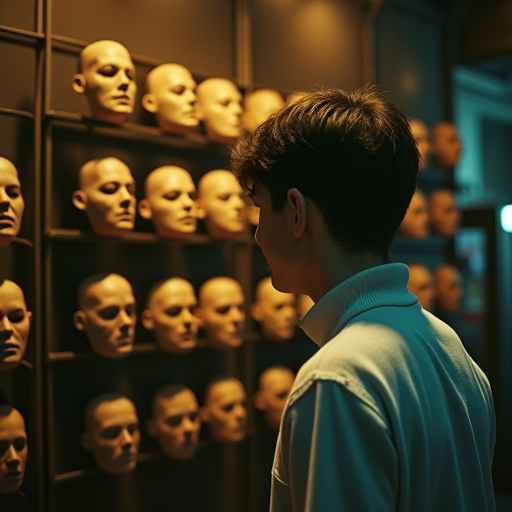
Because hanging on the wall behind the owner was another special mask.
A familiar one.
His own face.
Not the face he had been born with.
The one he used to have.
The shop owner followed his gaze and smiled with irritating calm.
“Looking for something?”
Evan pointed at the wall. “That one.”
“Popular style.”
“What is this place?”
“A store.”
Evan stepped forward, rage finally cutting through fear. “What did you sell me?”
The owner kept smiling. “A mask.”
“That isn’t a mask.”
“It is if you only wear it for a little while.”
Evan demanded answers.
The owner refused.
Evan threatened police.
The owner laughed.
Evan threatened to start shouting right there in the store until a crowd gathered.
At that, the owner’s expression changed.
He sat back heavily, exhaled, and said, “All right. Since you’ve noticed this much, you may as well hear the rest. No one ever believes it anyway.”
Years ago, he explained, an old woman had brought in a single mask and asked him to sell it on commission. When it sold, she returned the next day—not only to collect her money, but to leave another mask.
The face of the customer who had bought the first one.
Soon he learned the pattern.
Anyone who bought and wore one of her masks would, within days, begin to take on the face they had purchased. Meanwhile, their original face—somehow, impossibly—would appear in the shop as a new mask.
If the customer came back in time, the old woman instructed him to sell them their original face. Expensive, of course. If they wore it long enough, they would change back.
Most customers returned.
Some didn’t.
Those abandoned faces remained hanging on the wall, waiting for the next buyer.
“The one you bought,” the owner said, nodding toward Evan’s reflection-face now hanging behind him, “belonged to someone who never came back.”
Evan thought of the long-haired girl. Of Sean. Of last Halloween.
The owner shrugged. “I tried one myself once. Just to see. For half an hour. The next day, my own face was hanging on that wall. That old woman never even asked me for money. Just laughed.”
“Who is she?”
“If I knew where she was, I’d have asked more questions too.”
Evan stared at him for a long time.
Then he paid for his real face.
He got his watch back as well—the expensive one he had pawned in desperation to cover the outrageous price.
Before he left, he looked once more at the wall.
At his own borrowed face.
At the dozens of others.
And he thought: Maybe there are worse things than becoming someone else.
⸻
By winter break, the whole episode had become less terrifying than fascinating.
That alarmed him more than he liked to admit.
He and Milo went downtown again one night to buy gifts to bring home for the holidays. They ended up, by accident or habit, in the same noodle shop by the same window.
Their food hadn’t arrived yet when Evan said, “I’ll be right back.”
This time he crossed the street smiling.
He stepped inside the little shop and called out, “Busy tonight?”
The owner turned around from the register.
Only it wasn’t the same face anymore.
The body was the same—thick, compact, familiar.
But the face now sitting on it belonged to a different man entirely: darker skin, square jaw, broad nose, large honest-looking eyes. It didn’t fit the body at all, and that mismatch made the sight somehow worse than anything else Evan had experienced.
On the wall behind him hung a new face.
Round.
Pale.
Fat-cheeked.
Smiling with sly amusement.
The shop owner’s old face.
He caught Evan staring and grinned.
Or rather, his new face grinned.
“Can I help you?” he asked.
Evan smiled back.
For a moment, in that narrow shop full of waiting faces, he understood exactly what temptation had taken hold of the man behind the counter.
A new face when you were tired of the old one.
A new life for the price of curiosity.
A chance to disappear without dying.
Evan glanced at the wall and thought, with a flicker of unease that felt dangerously close to desire:
Maybe one day, I won’t want mine back either.