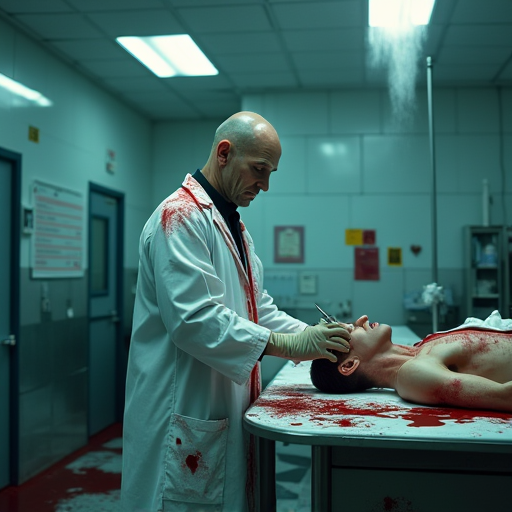
Anatomy Lab
Years of sleepless exam prep, family expectations, whispered comparisons to other people’s children, and the slow death of adolescence under fluorescent lights had finally paid off. I had made it. I was going to be a doctor. My life, I told myself, had officially begun.
That first autumn on campus, I bonded fast with the women in my dorm.
There were five of us in the room, all first-years, all survivors of the same merciless educational machinery, and that gave us a kind of instant intimacy. We knew what it meant to drag yourself across an impossible finish line. We knew the smell of caffeine and panic and failure postponed by half a point.
By the second week of classes, everyone was buzzing about our first anatomy lab.
Half of us were excited because it was new.
The other half were excited because it was horrible.
Mina belonged to neither group.
She sat on the edge of her bed that evening with a look on her face usually reserved for funerals and root canals.
“What’s wrong with you?” one of the others teased. “You look like you’ve been dumped.”
Mina glared. “Not funny. I’m scared.”
“Of what?” I laughed. “A cadaver?”
“That’s kind of the whole major,” someone else added.
Mina folded her arms. “It’s not blood. It’s not even death exactly. It’s just… the idea of opening someone. Of cutting into someone who used to be alive.”
That sobered us for all of five seconds.
“Give it time,” I told her. “After a while it’ll feel normal.”
“Nothing about that sentence is comforting,” she muttered.
Still, she seemed a little calmer by the time lights-out rolled around.
Then the department office made things worse.
Just before bed, a student runner came by with a message: the professor wanted the class rep to help prepare the lab for the next morning.
Mina was our class rep.
That meant she had to go to the anatomy building alone and help set up the room—including, as everyone immediately pointed out, the body.
No one envied her.
But Mina was responsible in the exhausting, doomed way some people are. If there was a task to be done properly, she would rather suffer doing it herself than trust anyone else.
So she went.
By the time she came back, she looked as if she had already seen tomorrow’s nightmare and found it insufficiently bad.
We tried to comfort her. She said almost nothing, crawled into bed, and went to sleep facing the wall.
After that, the rest of us stayed awake talking about the anatomy course and, more importantly, the man who would be teaching it: Professor Ward.
We had heard about him for days.
A specialist brought in from another city. Brilliant. Severe. Famous. One of those cold, gifted men who sliced through professional gossip the way scalpels moved through skin. None of us had seen him yet, and because we were nineteen and still believed intellect and mystery were inherently attractive, we talked about him far longer than we should have.
Mina, who had apparently met him while helping in the lab, slept through all of it.
At the time, I almost woke her just to ask what he looked like.
I’ve often wondered what would have happened if I had.
⸻
The next morning, anatomy was our first class.
Students filtered into the dissection room in groups of two and three, shoes squeaking faintly on the polished floor, voices hushed in that false-casual way people use when they know they are about to see something that might change them.
The room smelled exactly as every anatomy room smells: preservative fluid, cold metal, rubber gloves, and something underneath it all that no chemical can fully erase—the quiet authority of the dead.
Mina wasn’t there.
That was the first thing we noticed.
No one knew why. No message, no excuse, nothing.
We whispered among ourselves that maybe she had panicked. Maybe she’d been too rattled by the previous night. Maybe medical school wasn’t for her after all.
Then the door opened, and Professor Ward entered.
He was tall, gaunt, and dry-faced, with the expressionless stare of a man who had lived too long among things that could not answer back.
He didn’t ask about Mina.
He didn’t smile.
He simply walked to the front, put on gloves, and began.
The body lay on the steel table beneath a white sheet.
He took hold of the edge and pulled it back.
A dead man.
Large-framed, broad-shouldered, the body of someone who had probably looked imposing in life. Now he was only pale weight and anatomical opportunity.
Professor Ward began his introduction—terms, structures, procedural sequence, the expected tone of professional detachment. He spoke smoothly, and soon enough the initial shock of the corpse gave way to the strange focused curiosity anatomy labs are designed to impose.
We weren’t looking at a person anymore.
We were looking at systems.
Then the door flew open.
Mina stood there, hair disordered, breathless, one hand still on the frame.
“Sorry,” she said. “I’m late.”
She took one step inside.
Then she saw the professor.
The sound she made was not a scream at first. It was something smaller and worse—a breath catching on the edge of disbelief.
Then she screamed properly.
Loud. Raw. Full-throated.
She backed away, shaking so hard her whole body seemed to rattle.
Everyone turned toward her at once.
“Mina, what’s wrong?”
She didn’t answer.
She pointed.
Not at the body.
At Professor Ward.
He turned slowly toward her.
Her face had gone white.
“That’s him,” she choked out.
Nobody understood.
She was crying now, almost unable to form words.
“That’s him. That’s the one from last night. He’s the one I helped move. He was dead.”
No one said anything.
No one laughed.
There are moments when a room becomes so silent you can hear belief shifting from one possibility to another.
This was one of them.
I was the first to move.
I grabbed her by the shoulders and tried to calm her. “You’re confused. You were scared last night, that’s all. You must have seen someone else.”
The others chimed in quickly, too quickly.
“Yes—exactly.”
“You were nervous.”
“You probably barely looked at him.”
Mina shook her head violently, tears flying. “No. No. I saw him. I saw his face. He was the one on the table.”
Then, from inside the anatomy room, Professor Ward laughed.
It was a thin, dry sound with no humor in it.
He spoke loudly, clearly, and every word sliced through the corridor.
“What’s there to be afraid of?”
We all turned toward the open door.
Professor Ward was standing beside the cadaver, scalpel in hand, eyes glittering strangely under the fluorescent lights.
“If the living can dissect the dead,” he said, his voice rising, “why shouldn’t the dead dissect the living?”
A few people screamed.
A few more simply froze.
He lifted the scalpel high.
Then, with a violence none of us were prepared for, he drove it down into the corpse on the table.
At the exact instant the blade plunged in, the body arched.
Not twitched.
Not spasmed.
Arched.
The dead man let out a scream so terrible that even now I hear it sometimes in my sleep—a full, agonized human cry ripped out of a chest that should never have held breath again.
Blood erupted across the steel table.
Across the professor’s white coat.
Across the tiled floor.
Across all of us standing in the doorway, rooted in absolute horror.
Then the body collapsed back into stillness.
No one moved.
No one thought.
The room had become something else entirely—not a place of learning, not a laboratory, not even fully real.
Only red.
Steel.
The smell of opened flesh.
And Professor Ward standing there with the scalpel in his hand, smiling as though he had finally been given the chance to correct a terrible imbalance.
⸻
I don’t remember who ran first.
Probably me.
Or maybe Mina.
Or maybe everyone at once.
Memory after that breaks apart into flashes: footsteps pounding the corridor, someone vomiting into a sink, a girl sobbing that she wanted to go home, one of the boys slamming his shoulder against an exit door that wasn’t locked, just difficult, because panic rarely makes us smarter than ordinary handles.
Later, administrators tried to control the story.
There had been an incident, they said.
A medical episode.
A severe stress reaction among first-year students.
A misunderstanding involving lab preparation and a substitute instructor.
But students talk.
Students always talk.
Within a week there were seven versions of what had happened in Anatomy Lab One, and every version was worse than the official one.
Some said Professor Ward had never existed and had only been hired on paper.
Some said the cadaver had been delivered without documentation.
Some said Mina disappeared after that and was quietly transferred.
That part wasn’t true.
Mina stayed another month.
Long enough to stop sleeping.
Long enough to stop eating.
Long enough to start waking up screaming.
Then she withdrew.
I never saw her again.
As for me, I stayed.
Not because I was brave.
Just because leaving would have meant admitting there are some doors you cannot close once opened.
And medicine, like horror, teaches you very quickly that once you’ve seen what’s under the skin, you never really go back.
Years later, I still remember one detail more vividly than any other.
Not the blood.
Not the scream.
Not even the scalpel.
It was the look on Mina’s face when she saw Professor Ward standing alive beside the body she had helped carry the night before.
That expression told me something before the professor ever spoke.
She wasn’t afraid because she thought she had seen a ghost.
She was afraid because she knew exactly what she had seen.
And it had come back.