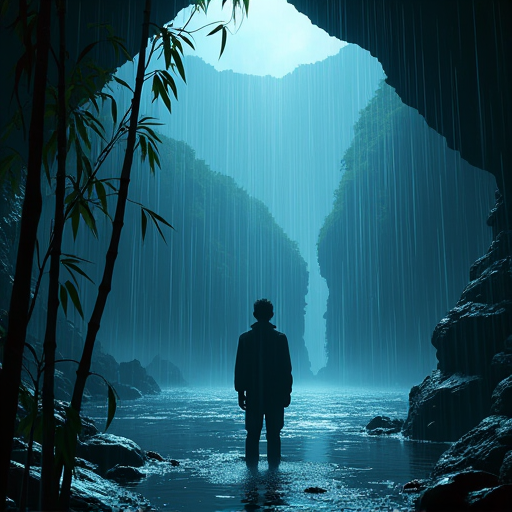
The Water Bride
That was the strange thing.
The dream itself was hideous enough to leave a man screaming, yet the first feeling that followed it was relief—relief so sharp it almost felt like joy.
In the dream he was floating in water.
Not swimming. Not drowning. Drifting.
His body had swollen from long immersion, the skin puffed and waxy, the places nearest the bank stained green by algae. Fish had pecked out his eyes and left two dark sockets, and now small silver shapes slipped in through the emptiness, circling inside his skull before darting back out through his nose. He turned slowly in the current, caught at times against rocks, then battered loose again, his bloated limbs knocking against stone with the dull weight of dead meat.
On both sides of the river rose empty ravines and thin stands of bamboo bending in the wind.
The whole scene carried the special stillness of a world in which he no longer belonged.
Then he woke.
His bed. His ceiling. His own room.
Alive.
He sat there with sweat pouring down his neck and whispered aloud, over and over, “It was only a dream. Just a dream.”
Outside, moonlight washed the window white.
His mouth was dry. He decided to get up for water.
The moment his foot touched the floor, he recoiled.
Ice-cold water.
He stared.
The room was flooded.
A thin sheet of water covered the floorboards from wall to wall. One slipper floated upside down near the dresser. The other was nowhere in sight.
“What the hell—”
He splashed into the bathroom.
The faucet was running. His hand towel hung over it, redirecting the stream neatly into the bathtub. The drain had been plugged with the same towel, and the tub had overflowed silently for who knew how long, spreading water into every room of the apartment.
Miles stood there dripping from the knees down, heart pounding.
He lived alone.
No one else had keys.
And he had absolutely no memory of leaving the water running.
⸻
It took nearly an hour to mop up enough of the mess that he could stop hearing the soft slap of water under every step.
He blamed exhaustion.
That was easy to do. He had been working too much. Sleeping badly. Living on caffeine and takeout and the low-level panic of a city life forever one bad phone call away from collapse. Strange things happened when people pushed themselves too hard. That was what he told himself.
Then the dreams returned.
Each night they worsened.
Sometimes he was the corpse in the current. Sometimes he watched from the riverbank as the body turned slowly past, face bloated beyond recognition but somehow still unmistakably his. Sometimes the river seemed to be waiting for him, broad and dark and full of patience, as if it had already claimed him and was merely allowing him a few extra days out of politeness.
By the fourth morning he had begun to dread sleep.
And on the fifth, water began turning up where it shouldn’t.
A damp footprint in the kitchen.
A trickle beneath the bedroom door.
A wet handprint on the window from the inside.
By then even his friends had started to notice something was wrong.
At lunch his coworker asked why he smelled like pond water.
Another joked that he looked as if he hadn’t been out of the river in weeks.
Miles laughed along because that was easier than admitting that every time he closed his eyes he heard water moving through rock.
That evening, on the way home, it began raining.
He took a shortcut through a district he barely knew—a half-developed stretch of road near the edge of the city where concrete gave way to scrub, and beyond the scrub rose the dark folded shapes of hills.
The rain intensified.
Within minutes, water was running in shallow channels along both sides of the road.
A figure stood ahead of him.
A boy.
Barefoot. Thin. Soaked through. Standing in the rain without moving.
Miles slowed.
The boy turned his head and smiled.
There was something wrong with the smile. Not inhuman. Not monstrous. Simply wrong in the way a photograph is wrong when you realize, too late, that the subject had already died before it was taken.
“Are you lost?” Miles called.
The boy said nothing.
Then he stepped off the road and into the weeds.
Without thinking, Miles followed.
Later he would not be able to explain why.
Only that in the rain, with the sound of water everywhere around him, it had felt less like a decision than obedience.
⸻
The boy led him through brush, then through a stand of bamboo, then down into a shallow ravine where the runoff had already become a narrow, rushing stream.
By then Miles should have turned back.
Instead he kept going.
The boy remained always a little ahead, never hurrying, never looking back, his pale shirt visible between the stalks whenever lightning flashed.
At last the ravine widened into a rocky basin where the swollen stream plunged into a dark opening in the hillside.
A cave.
The boy stood at its mouth and looked at Miles with mild expectation, as if waiting for him to notice something obvious.
Then he stepped inside.
Miles stood in the rain, soaked and shivering.
He should have left.
Every sane instinct told him to leave.
But something older and less negotiable had begun moving inside him since the first dream, something that heard the water and understood itself as summoned.
So he entered.
The cave was narrow at first and smelled strongly of mineral cold, wet stone, and the stale breath of trapped water. He had to brace himself with one hand against the wall to keep from slipping.
Behind him the rain roared.
Ahead of him the dark seemed almost liquid.
He called out once.
No answer.
Then his foot plunged abruptly to the ankle into freezing water.
He cursed and jerked back, but there was nowhere to go. The cave floor dipped lower and lower, and a stream flowed down its center as if the mountain itself were drinking.
Lightning flashed faintly through the opening behind him.
Too far now, he realized.
Farther than he had meant to come.
He turned to retrace his way—
and saw that the water had risen in the few moments since he’d entered.
The stream behind him was already deeper, faster, swollen by runoff. Loose debris spun in it: leaves, twigs, bits of mud and foam.
Panic sharpened his breathing.
He started climbing back, but the water surged harder, pushing against his shins, then his knees. The tunnel that had seemed merely wet now felt like the throat of something tightening.
He scrambled forward instead, deeper into the cave, driven not by courage but by the stupid animal logic of escaping whichever death was closest.
The passage narrowed. The ceiling dropped. He had to crawl.
Water chased him through the rock.
At one point he thought he heard someone crying ahead.
At another he thought he heard laughter.
Once, very clearly, he heard a child’s voice say:
You took your time.
Miles froze.
“Who’s there?”
Only the water answered.
He crawled faster.
⸻
By the time he reached the higher tunnel, his arms were shaking so badly he could barely hold himself up.
The water was still rising below him. He could hear it hammering through the lower passage, searching for room, filling whatever hollow it could find.
The tunnel bent sharply left.
A weak, strange light came from somewhere ahead—not daylight, not artificial light, only a dim greenish pall reflected from stone and water.
Miles dragged himself around the bend.
Then he saw the dead boy.
The body sat curled at the dead end of the passage as if it had simply given up there and gone still.
The skin was pale and water-bleached, beginning to rot. The clothes clung to the corpse in strips. The eye sockets were dark hollows.
And the face—
The face was the same one that had smiled at him in the rain.
Miles screamed.
The sound tore at his throat and broke apart in the cave.
He clawed backward, hit the stone wall, slipped, slammed his shoulder, and began sobbing without even knowing it.
The corpse did not move.
Of course it did not move.
But the black hollows where the eyes had been seemed fixed on him with an attention worse than life.
Then the water surged into the chamber.
It hit his legs like an animal.
Something in it seized him—not hands, not exactly, but pressure with intention—and yanked him sideways off the ledge.
He plunged under.
The cold was total.
He thrashed blindly, swallowing muddy water, striking rock with his knees and shoulder, dragged along the submerged floor while the current battered him from every side.
In that chaos he saw things.
Not clearly.
Fragments.
A child slipping from slick river stones.
A body vanishing into floodwater while someone on shore kept walking, never turning around.
A swollen river carrying a small pale form into darkness.
And beneath all of it, a feeling not of hunger, but grievance.
You saw.
You did nothing.
The thought entered him like ice.
Miles burst to the surface choking.
He found purchase on a ledge by sheer luck and hauled himself half out of the torrent, coughing so violently he thought he would tear something loose inside his chest.
The water kept climbing.
The cave kept narrowing.
There was no way back.
Only the dead boy’s chamber and the rising flood.
And then—through the roar of water—he heard the boy again.
Not from behind him.
From inside his own head.
Stay.
Miles looked up.
The corpse was no longer at the dead end.
It was standing knee-deep in the water a few feet away.
Rotting. Pale. Steady.
The dark sockets aimed straight at him.
Stay, it said again.
Miles screamed and lunged upward toward a crack in the rock wall he had not noticed before, a narrow fissure barely wide enough for his shoulders. He scraped skin from both arms forcing himself into it. The stone tore at his back. Water slammed at his legs from below, trying to pull him free.
But terror makes tools of the body.
He climbed.
Slid.
Climbed again.
Until at last the fissure widened and he spilled out onto wet gravel under open sky.
It was dawn.
Gray, bitter, rain-washed dawn.
He lay there on the hillside vomiting cave water and crying like a man reborn against his will.
Below him, the ravine wound away through the bamboo.
There was no sign of the boy.
No sign of the cave entrance either. Only a muddy scar where runoff streamed through broken stones.
⸻
They found him two hours later wandering near a service road barefoot and incoherent.
At the hospital he told them he had slipped while hiking in the rain.
No one believed the full story because he never told it in full.
What would have been the point?
A week later, local police recovered the body of a missing boy from a mountain washout after a landslide opened part of an old drainage channel in the hillside.
The newspapers called it tragic.
A child drowned years earlier, body lost to floodwater, remains displaced by recent storms.
No one connected it to Miles.
No one could.
Except Miles knew the name the moment he saw it printed.
The boy had gone missing the previous summer.
Miles remembered him then.
Not clearly at first, but enough.
A rainy day by a river outside town.
A smaller boy on slick stones.
A cry for help.
Miles, seventeen and impatient and desperate not to get involved, seeing the slip, seeing the fall, seeing the current take him—
and running for an adult instead of going in.
By the time anyone returned, the river had already claimed what it wanted.
He had spent years telling himself there had been nothing he could have done.
Maybe that was even true.
It changed nothing.
Because guilt does not care what was possible.
Only what was done.
Or not done.
⸻
After that, the dreams stopped.
Mostly.
But he never fully escaped water.
He could not stand overflowing sinks. Could not leave taps running. Could not bear the sound of a bathtub filling in the next room. Rain at night woke him instantly. Rivers became impossible. Even deep puddles made his chest tighten with primitive dread.
Once, months later, he visited the boy’s grave.
He brought flowers.
It felt grotesque and insufficient, which is to say it felt honest.
As he turned to leave, he noticed someone had left a child’s toy boat on the stone—cheap painted wood, the sort sold in market stalls by streams.
He stared at it for a long time.
Then, from the trees below the cemetery, he heard water moving over rocks.
And under it—just for a second—the sound of laughter.
He did not run.
That was the difference now.
He simply stood there in the damp afternoon air and listened until the sound faded, leaving only wind in the bamboo.
Some debts are never forgiven.
Only collected.