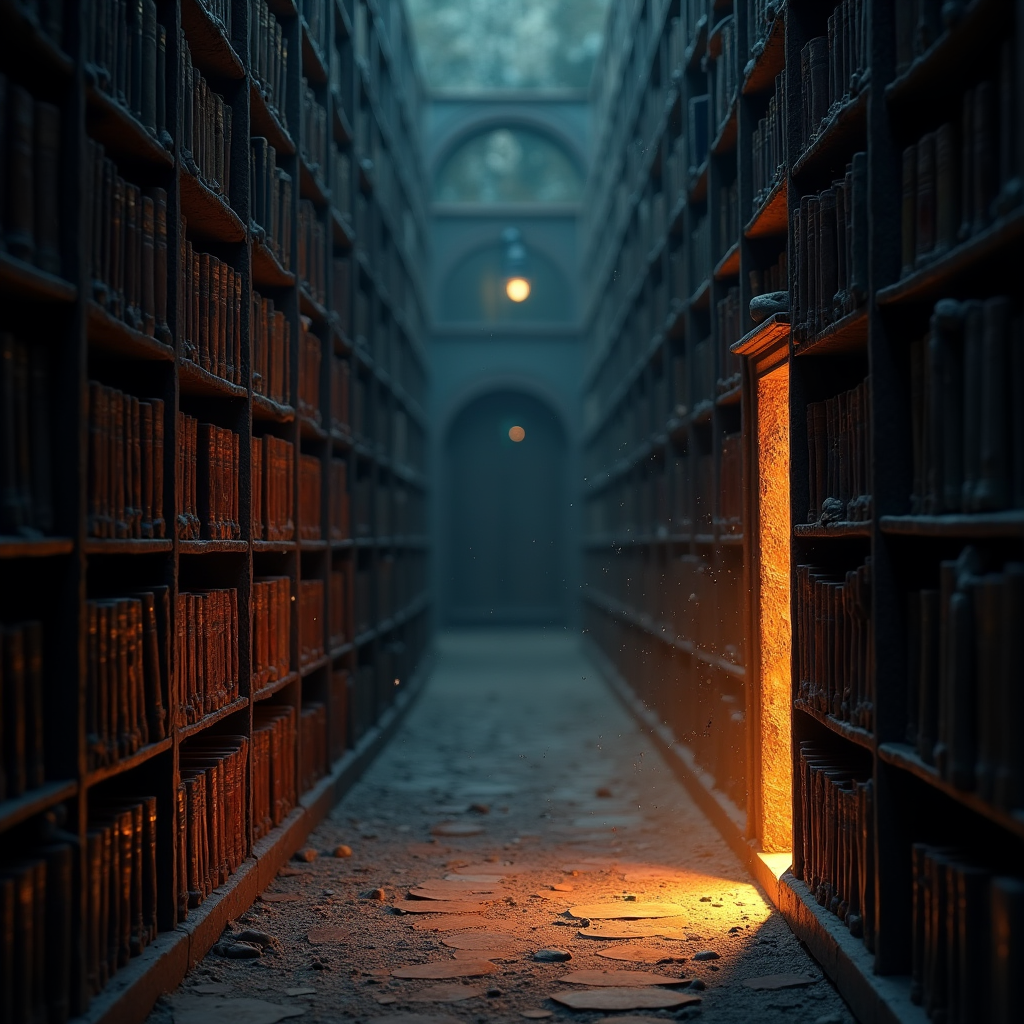
The Library of Unfinished Worlds
The librarian who found the ledger was not looking for it. She was looking for an invoice from 1987, buried somewhere in the archive room’s fourteen thousand boxes of uncatalogued material. The archive room had been accumulating since the library’s founding in 1923, and no one in living memory had attempted to impose any kind of order on it. This was the official position of three successive library directors, all of whom had cited the archive room in their annual reports as evidence of the institution’s commitment to preservation, which was technically accurate and also, everyone understood, a polite way of saying the problem was too large to address.
The ledger was small, roughly six inches by four, bound in leather that had the particular deep brown color of very old books. It was filed — if filing is the word — inside a box labeled “Hydraulic Maintenance Records, 1962-1978.” The librarian, whose name was June, opened it out of professional habit and found not maintenance records but a handwritten catalog of objects.
The entries were written in a precise, economical hand. Each entry occupied one line. The first entry read: World 1,417 — abandoned at second sentence — contained one sun, three moons, sentient tidal pattern, no language. Location: Archive Room, east wall, shelf 7, slot 3.
June read the entry twice. Then she walked to the east wall, counted to shelf seven, and looked at slot three. There was nothing there. The slot was empty, as were all the surrounding slots, which held only dust and the faint residual smell of paper that had been sitting undisturbed for decades.
She returned to the ledger. She read entry after entry. World after world, cataloged with locations in the building that she began, against her better judgment, to check. A world abandoned at its climactic scene, stored in the HVAC duct above the main reading room. A world abandoned before its protagonist was named, stored in a box of donated encyclopedias in the basement. A world that had been finished and then, for reasons the catalog did not explain, destroyed — the entry noted simply that the world had been “withdrawn from circulation” and its shelf location had been “cleared.”
The catalog contained four hundred and twelve entries. June read all of them before she called her director, and by then she had begun to suspect that the building was not a building so much as a storage facility for things that had been started and not finished, and that the things, given sufficient time and the particular quality of stillness that libraries provide, had begun to notice each other.
The director, a man named Callahan who had held the position for twenty-seven years, listened to June’s summary of what she had found and said nothing for a long time. Then he said: “The person who wrote that ledger. Did they give a name?”
June had not checked. She went back to the archive room and found the ledger and opened it to the first page, where she had not thought to look before. The first line, above the first catalog entry, read: This ledger is a record of the library’s most significant acquisitions, 1923–1987. Compiled by Arthur Fenwick, Head Archivist, 1923–1961.
Arthur Fenwick. The name was familiar — there was a reading room on the second floor named after him, and a small brass plaque that described him as “the architect of the library’s foundational collection.” June had walked past that plaque two hundred times and had never read it.
Callahan knew the name. His face changed when June said it, in a way she had not seen in the three years she had worked at the library. “Arthur Fenwick,” he repeated, as if confirming something he had long suspected. “He retired in 1961. He died in 1965. He was eighty-seven years old and he had been coming back to the library every week until he died, to work in the archive room, even after he was no longer employed here. My predecessor told me about him. He said Fenwick was the kind of person who started things and couldn’t stop starting things and eventually the things he started started to accumulate around him.”
“What does that mean?” June asked.
“I don’t know,” Callahan said. “But I think the ledger is part of it.”
June did not stop reading the ledger after her conversation with Callahan. She read it every evening after her shift, sitting in the archive room after the building had closed, working her way through four hundred and twelve entries and the locations they described. She found empty slots where worlds had been stored. She found the HVAC duct above the main reading room, which was sealed and had presumably not been opened since Fenwick’s time, and which she did not attempt to access. She found the box of donated encyclopedias in the basement, and inside it, in a gap between volume seventeen and volume eighteen of a 1947 edition of the Britannica, a piece of paper no larger than a postcard on which someone had written, in handwriting she did not recognize: I am sorry. I did not know it would take this long.
She showed it to Callahan. He read it and handed it back and said, “Keep working. But be careful about the ones that are marked withdrawn from circulation. I looked those up in the board meeting minutes from 1965. They were removed by Fenwick himself, in the last week of his life, and the board voted not to replace them. Whatever he was doing, I don’t think he wanted anyone else to know about it.”
The withdrawn entries were numbers 1 through 9. They appeared at the top of the ledger’s index, before World 417. The index gave only the world number, the date of withdrawal, and a single word: dissolved.
June asked no more questions after that. She finished cataloging the four hundred and twelve active entries, created a proper finding aid for the ledger, and filed it in the administrative records where it should have been all along. Then she went back to shelf seven, slot three, where World 417 had been noted as stored, and found — still, after all these years — an empty space that smelled faintly of salt air, as if the world that had been kept there had been somewhere near an ocean, and the ocean had evaporated, and only the smell remained.