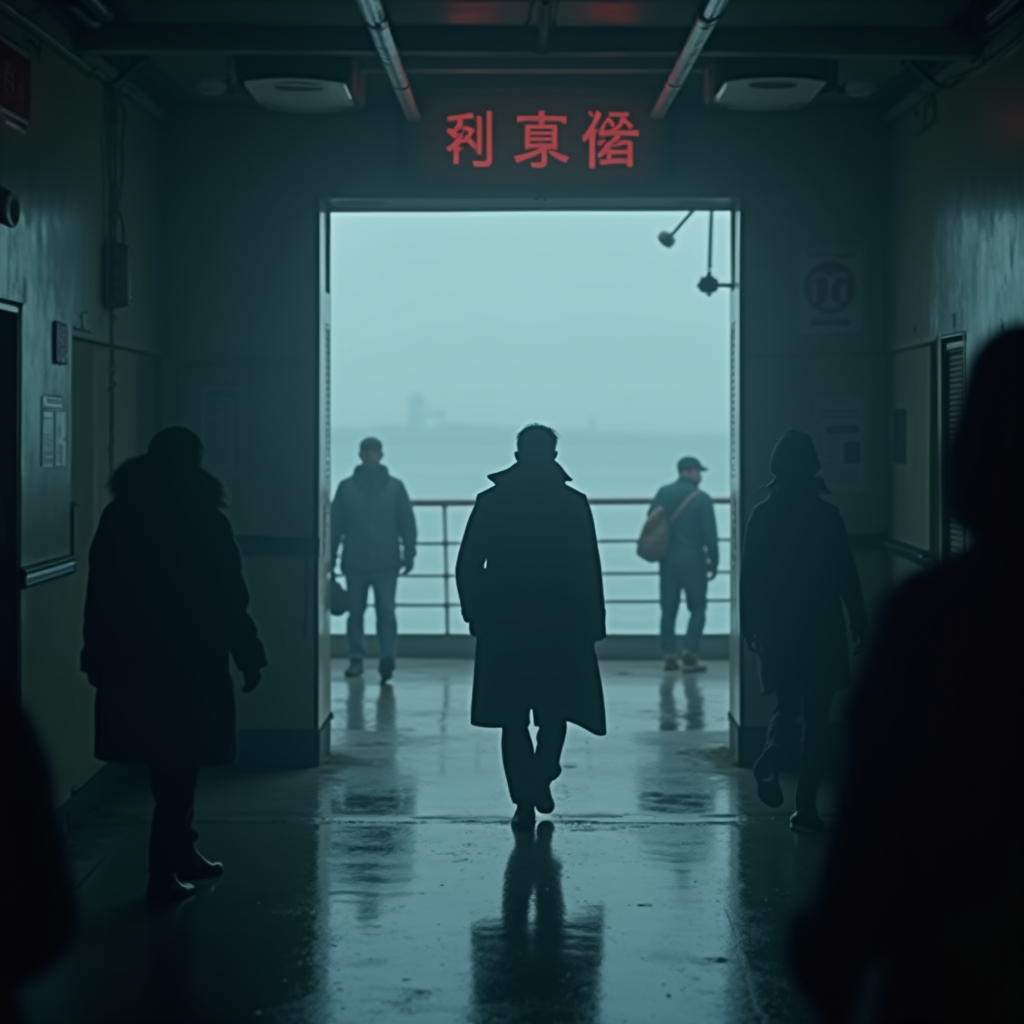
The Passenger Who Disappeared
The ferry from Oakland to San Francisco departs fourteen times a day. It runs on a schedule precise enough that the departure boards at the terminal update in real time, showing the gate number, the estimated arrival, the current passenger count. On the 4:15 crossing on a Thursday in October, the manifest showed forty-seven passengers. The vessel carried forty-eight. This was not a malfunction of the counting system. This was confirmed by the fact that the ticket collector at Gate 4 had sold forty-seven tickets, and the deck officer had counted forty-eight people boarding, and the difference was a woman that no one could describe in detail afterward, because no one had looked at her directly.
The discrepancy was noted at 4:47 PM, when the ferry was fourteen minutes out of San Francisco and the deck officer conducted his second count of the crossing. Forty-eight. The manifest said forty-seven. He reported this to the captain, who checked the manifest himself, confirmed the count, and ordered a full sweep of the vessel.
The sweep took eleven minutes. They found forty-seven passengers in seats, in the cafeteria, in the restrooms, in the outdoor deck areas. They found no one unaccounted for, and they found no woman matching the description — vague as it was — that the deck officer eventually provided: tall, dark coat, white hair, appeared to be in her seventies. She was not in the terminal building, which had been checked by the time the ferry docked at 5:02. She was not on the passenger manifest. She had not, as far as anyone could determine, existed.
The ferry terminal’s security cameras are positioned at the gates, the platforms, the ticket counters, and the main entrance. The footage from the 4:15 crossing is stored for ninety days, and the investigators — there were investigators, eventually, because this became a story — requested it on a Monday, three days after the crossing, when the missing woman’s absence had become a matter of public record.
The cameras at Gate 4 showed forty-seven passengers boarding between 4:08 and 4:14. The deck officer’s count was accurate. Forty-seven tickets. Forty-seven faces. No woman matching the description in the deck officer’s statement.
But the platform camera, which is positioned above the gate area and angled toward the boarding walkway, showed something the gate cameras did not. At 4:11 and thirty-seven seconds, a figure appears at the far end of the platform, walking toward the gate. The figure is tall. It is wearing a dark coat. It is not moving at the speed of the other passengers, who are walking briskly because boarding is imminent. It is moving slowly, deliberately, as if it has all the time in the world and is aware of this.
The figure reaches the gate at 4:12. The ticket collector, who is visible in the frame, takes a ticket from the figure’s hand. The figure walks through. The ticket collector does not look up. The camera, at this angle, shows the collector’s face in profile, and his expression is one of absolute blankness — not confusion, not inattention, but a specific absence, as if the part of his perception that would register what he had just seen had been temporarily offline.
The figure boarded the ferry. The figure was not seen again.
The investigators — there were eventually four of them, working out of the Coast Guard office in San Francisco — spent three weeks building a timeline of anomalous crossings. They found four other ferries in the past eighteen months where the manifest count and the physical count had disagreed, each time by exactly one person, each time in the direction of an excess. All four had occurred on the Oakland-San Francisco route. All four had occurred on afternoon crossings. All four had been noted in the ship’s logs and then, apparently, forgotten.
The investigators pulled the security footage from the four previous crossings. Three of the four showed a figure matching the description from the October crossing — tall, dark coat, white hair, slow movement, the same quality of uncanniness in the way the ticket collectors reacted to it without appearing to react. The fourth crossing’s platform camera had been malfunctioning. Only the gate cameras survived, and those showed nothing unusual.
The investigators filed their report in January. The report concluded that the most likely explanation was systematic miscounting, possibly related to the particular way passenger flows were measured during peak hours, and recommended procedural changes to the boarding count protocol. The report did not mention the platform footage. The lead investigator, a woman named Patti Okonkwo who had worked maritime safety for eleven years, told her supervisor that she was recommending procedural changes because procedural changes were what the situation warranted, and that if anyone wanted to discuss what the platform footage actually showed, they could do so in a meeting that would not be minuted.
The meeting was not held. The report was filed. The ferry service continued on its fourteen-daily schedule, and the 4:15 crossing on the following Thursday operated exactly as the others had, and the deck officer counted forty-nine passengers instead of forty-eight, and this time the investigators were not called, because by then it had been decided that the counting discrepancies were a procedural matter and not a question requiring answers.
The extra passenger on the March crossing was tall, wearing a dark coat, with white hair. She boarded at Gate 4. She did not appear on the gate camera footage. She was not reflected in any of the mirrors installed throughout the terminal for passenger wayfinding. She was not seen by the forty-eight other passengers who boarded the same crossing. She was counted once, by the deck officer on duty, and then not counted again, because after the first count, she was simply part of the vessel, and one does not count the vessel itself as a passenger.