The Collector of Last Breaths
Dr. Nathaniel Cross had spent twenty years in hospice care, holding the hands of the dying as they took their last breaths. It was the most intimate work a person could do—witnessing the final moment, the threshold between being and not being. Most doctors looked away. Nathaniel never did.
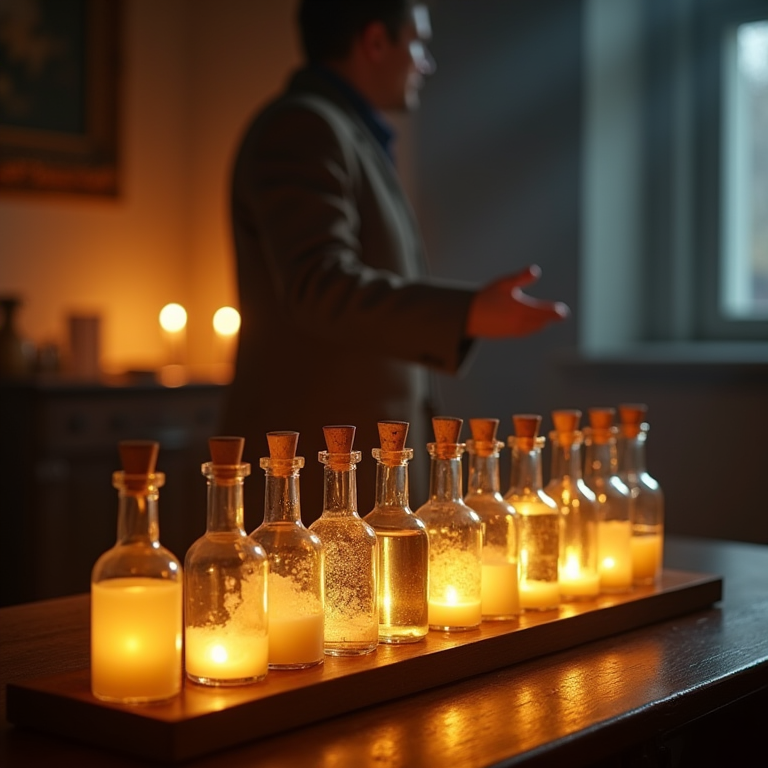
What no one knew—what Nathaniel had told no one—was that he collected something from each death. Not objects. Not money. Not stories. He collected the breath itself. The last exhalation, captured in a small glass vial he kept in his coat pocket, stoppered with cork, labeled with the date and the name of the person who had breathed it out.
He didn’t know why he did it. He didn’t know what he intended to do with them. But he knew he couldn’t stop.
There were 847 vials in his collection when she arrived. 847 last breaths, 847 final moments, 847 tiny expirations that his patients had exhaled into the universe without knowing anyone was listening. He kept them in a wooden cabinet in his study, arranged by date, like a library of endings.
Her name was Margot. She was forty-three. She had six months, maybe less. The cancer had spread beyond any intervention that could help her. She was a painter, she told him during their first meeting. She painted the way she breathed—naturally, compulsively, with complete devotion to the act of creation.
“I want you to promise me something,” she said. “When I go, I want my last breath to mean something. I want someone to remember that I was here. That I made things. That I mattered.”
Nathaniel promised. He didn’t tell her about the collection.
Margot died on a Thursday evening, with rain against the window and her hand in his. She went quietly, the way some people do—as if death was a relief, a release, a final unburdening. Her last breath left her body in a long, slow exhalation, and Nathaniel caught it in his vial without thinking, the way he always did.
But this time was different. This time, he felt something as the breath entered the glass. Not just air. Not just the chemistry of a dying body. Something else. Something that hummed against his palm like a living thing.
That night, he opened the vial. The breath had changed color—it was no longer invisible but faintly luminescent, a pale gold light that pulsed once, twice, and then settled into stillness. And when he breathed it in, just slightly, just enough to taste, he saw her.
Margot. Not dead. Not alive. But present. Standing in his study, between the cabinet and the window, looking at the collection with an expression he couldn’t read.
“You collect us,” Margot said. “The breath of the dying. You keep us in bottles like specimens.”
“I don’t know why I do it,” Nathaniel said. “I never have.”
“It’s a kind of love, isn’t it? The only way you know how to love the dead is to keep them. To possess their final moment. To make sure they’re not completely gone.”
“Yes,” he said. “I suppose it is.”
Margot smiled. It was the same smile she had worn in her last hours—tired, knowing, unbearably sad. “I don’t want to be kept. I want to be released. But I’m willing to make a deal. You let me go—not into nothing, but into something. You open every vial, you breathe out every soul you’ve collected, and you let them move on. And in return, I will be the last one. I will stay. I will keep you company in this study for whatever time you have left. And when you die, we will go together.”
Nathaniel looked at the cabinet. At 847 vials. At 847 souls he had unknowingly trapped in glass, each one waiting for exactly what Margot was offering.
“It will take time,” he said. “A lifetime, maybe.”
“Good,” Margot said. “Then we have a lifetime together.”
It took him eleven years. He opened each vial in order, from the first to the last. With each one he breathed out a soul—the breath of an old man who had died thinking of his wife, the breath of a child who had died asking for ice cream, the breath of a woman who had died laughing at a joke her son had told. He released them all. And with each release, he felt lighter, emptier, more free.
Margot stayed. She was there every night in his study, sitting in the chair by the fire, watching him write in his journal about the things he had learned from the dying. She never aged. She never tired. She never asked for anything except his company.
When Nathaniel finally died—old, peaceful, in his own bed with Margot beside him—his last breath was the brightest of all. It filled the room with gold light and the sound of voices, 847 souls welcoming him home, and Margot holding his hand the way he had held hers all those years ago.
The vials were empty. The cabinet was just a cabinet. But the room smelled of lavender and turpentine and something else—something that might have been closure, or might have been the beginning of something that had no name.