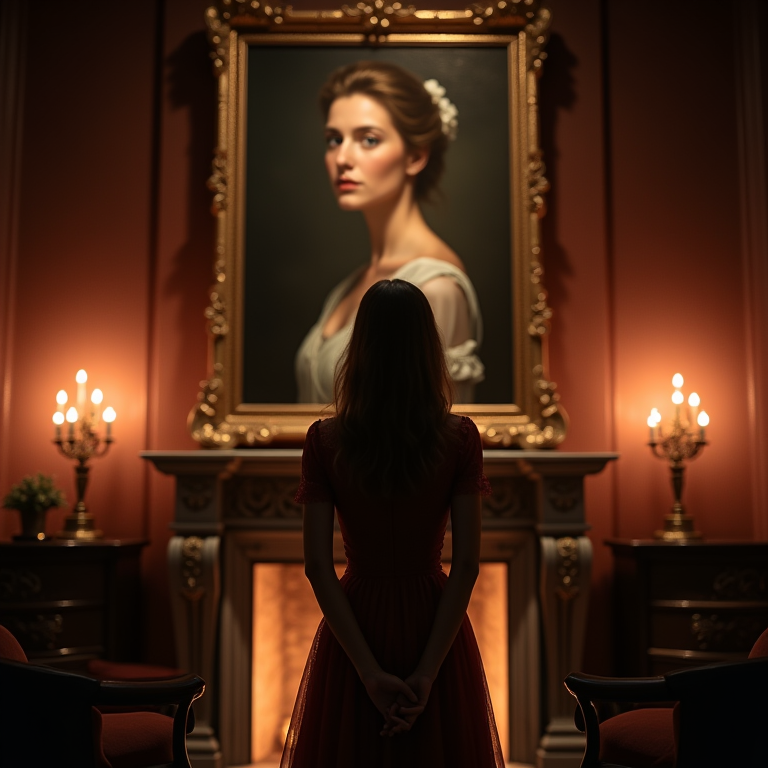
The Portrait She Commissioned of Herself
The painter was expensive, which was why Clara had chosen him — she had always believed that the things worth having were the things that cost the most, and that the cost was not a barrier but a signal, a way of filtering for the people who were serious about the things they wanted. His name was Marcus, and he had a studio in the Village, and he was known for portraits that were said to capture not just the subject’s appearance but the subject’s inner life, and Clara had wanted precisely that — not a portrait of her face but a portrait of what it felt like to be her, which was something she had spent her entire adult life trying to project and which she had never once felt anyone had actually seen.
She sat for him three times a week for two months. The sittings were long — four hours, sometimes five — and Marcus did not talk much, and Clara did not know what to say, and they sat in a silence that was not uncomfortable but was instead the kind of silence that exists between people who are engaged in the same work and who do not need to speak in order to understand what the work requires. Marcus painted. Clara sat. The portrait took shape on the canvas, and Clara could see, from the beginning, that it was going to be something unlike the other portraits she had seen of herself — not flatteringly abstract, not aggressively realistic, but something in between, something that showed her as she actually was, which was to say aging, and tired, and beautiful in a way she had not expected to be beautiful at forty-six, and afraid, and determined, and alone in a way that she had not allowed herself to feel until the sitting had forced her to stop moving long enough to notice it.
The portrait was finished on a Thursday in April. Marcus called her to tell her. She went to the studio that afternoon. She stood in front of the canvas for a long time. The portrait was extraordinary — it was her, unmistakably, and it was also someone she did not entirely recognize, and the someone she did not recognize was not a stranger but was herself at a distance, herself as she appeared to someone who was paying very close attention, and the close attention was what Marcus had been giving her for two months, and the result was not a flattering portrait but it was an honest one, and the honesty was what she had asked for, and the honesty was also what she had feared, and the fear was the thing she saw in the portrait — not a specific expression but a general quality, the quality of a person who has been looking at herself for so long that she has started to wonder if the looking is the thing that is preventing her from being seen by anyone else.
She took the portrait home. She hung it in the living room, above the fireplace, where she had always meant to hang a portrait. She stood in front of it every morning, making her coffee, and she looked at it, and the woman in the portrait looked back at her, and the looking was mutual and sustained and was the kind of looking that she had wanted to be seen with, and that she had not found in anyone who had ever looked at her, and she understood, gradually, over the weeks that followed, that the portrait was not a representation of her. It was a replacement for her. It was the version of her that Marcus had seen, in the sittings, when she was not performing, when she was simply sitting, when she was simply being, and the version of her that Marcus had seen was more real than the version she showed the world, and the portrait had captured that more real version, and the more real version was the version that was now hanging above her fireplace, looking at her, every morning, with the eyes of someone who had finally been seen and who was not going to look away until the looking was reciprocated.
She stopped having guests to the house. She did not do this consciously — she simply found that she was not inviting people over, and that when people asked to come over she declined, and that the declinations were becoming more frequent and more firm, and that the reason for them was that she did not want anyone to see the portrait except her, and that the portrait was the reason she was in the house, and that the house was the place where she lived now, not as a person who was preparing to be seen but as a person who had been seen, once, by Marcus, and who was still living in the aftermath of that seeing, and who did not need to be seen again, by anyone, because the seeing that had happened in the studio had been complete, and had been enough, and had been the thing she had been waiting for without knowing she was waiting for it, and that the portrait on the wall was not a painting of her. It was the answer to a question she had been asking her whole life, and the answer was: You are seen. Now you can stop asking.