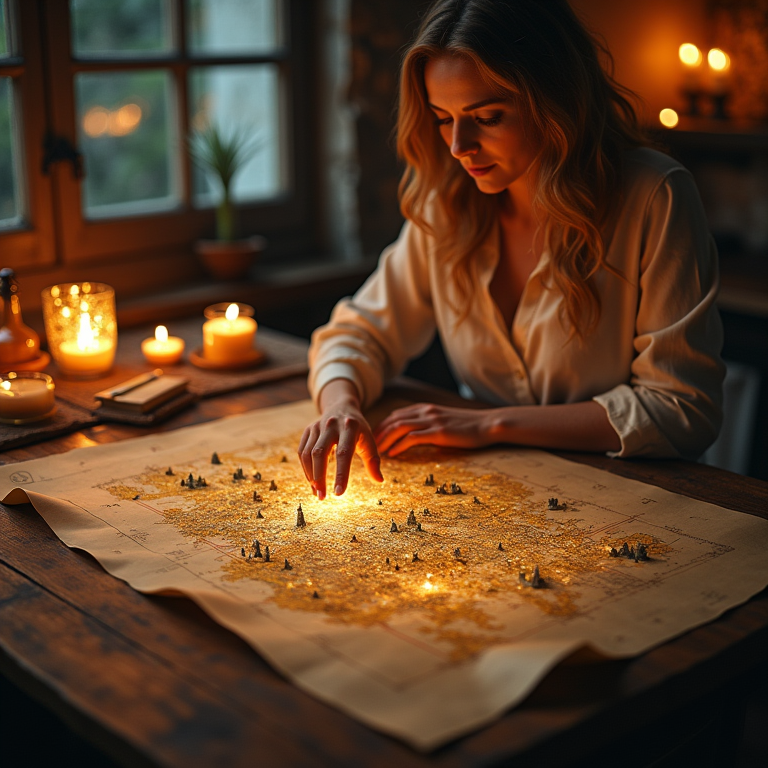
The Map She Drew of a Place That Did Not Exist
She had been drawing maps since she was a child — first of places she had been, then of places she wanted to go, then of places that did not exist, and the maps of places that did not exist were, she found, the most accurate ones, because they did not have to correspond to anything in the real world and therefore did not have to be wrong in the ways that real maps are wrong, by omission or by simplification or by the violence that all cartography does to the complexity of actual places. The maps she drew of nonexistent places were true to something — not to geography but to feeling, not to the world but to the experience of being in the world, which was a different kind of truth and which was the kind of truth that she was interested in.
The place she called Verenath was the most detailed of her maps. She had been drawing it for eleven years, adding streets and buildings and a river that curved through the city in a shape that she had not planned and that she could not explain but that felt, every time she looked at it, exactly right. Verenath had a harbor and a market district and a residential quarter that was built on a hillside and that was connected to the rest of the city by a series of bridges that were all different heights and that were all slightly too narrow for the amount of traffic they were supposed to carry, and the narrowness was intentional, because she had designed the bridges to convey a specific feeling, which was the feeling of a city that had been built by people who were always slightly rushed, who had not had time to do things properly but who had done them anyway, and who had built the bridges too narrow because the city needed to be connected and the connection was more important than the comfort of the people who would eventually use it.
She kept the map in a folder that she did not show to anyone. She had shown maps to friends, over the years, and had received the kind of response that friends give to things that are strange — polite, slightly uncomfortable, changed subject. She had learned not to show them. She kept Verenath to herself, and she added to it, and she refined it, and she thought about it when she could not sleep, and she walked through its streets in her mind the way other people walk through the cities they have actually visited, remembering the feel of cobblestones and the sound of the harbor and the smell of the market in the morning, which was the smell of fish and bread and something else that she had never been able to identify but that she had placed, on her map, in the northeast corner of the market square, next to a building with a green door.
She went to Lisbon on a business trip in her thirty-ninth year and found, walking through theAlfama district, a street that was not a street she had planned to find and that was not on any map she had looked at before she left for Portugal. It was narrow and it curved in a way that felt familiar and it had a building with a green door in the northeast corner of a square that she had not known existed until she turned the corner and saw it. She stood in the square for a long time. The building with the green door was a restaurant. She went in. She sat at a table. She ordered. The food was good. She did not know what to feel, because she did not have a language for what she was feeling, which was the feeling of a place she had invented appearing, slightly changed, in the world, and the feeling was not surprise. It was recognition. The feeling was the feeling of seeing someone you have been dreaming about for years and finding that they are real and that they are exactly where you thought they would be and that they have been waiting for you, in the specific way that places wait for the people who have been imagining them, which is not with patience and not with impatience but with the absolute certainty that the imagining is itself a form of finding, and that the finding will happen, in time, in the world, in the specific form that the finding needs to take in order to be true.
She went back to the restaurant six more times before she left Lisbon. She went back the following year, and the year after that. She found other places in Lisbon that corresponded to places in Verenath — not perfectly, not in every detail, but in the way that memories correspond to the events that inspired them, which is approximately and emotionally and not literally but truly. The harbor was different. The market was in a different location. The bridges were too wide and the street grid was wrong. But the feeling was the same. The feeling had always been the same. She had been drawing the feeling, not the place, and the feeling was portable, and the feeling was true, and the places she found in the world were places that were true to the same feeling, and this was not a coincidence. It was a geography. A geography of the parts of the world that correspond to the parts of the imagination that are serious about being found.