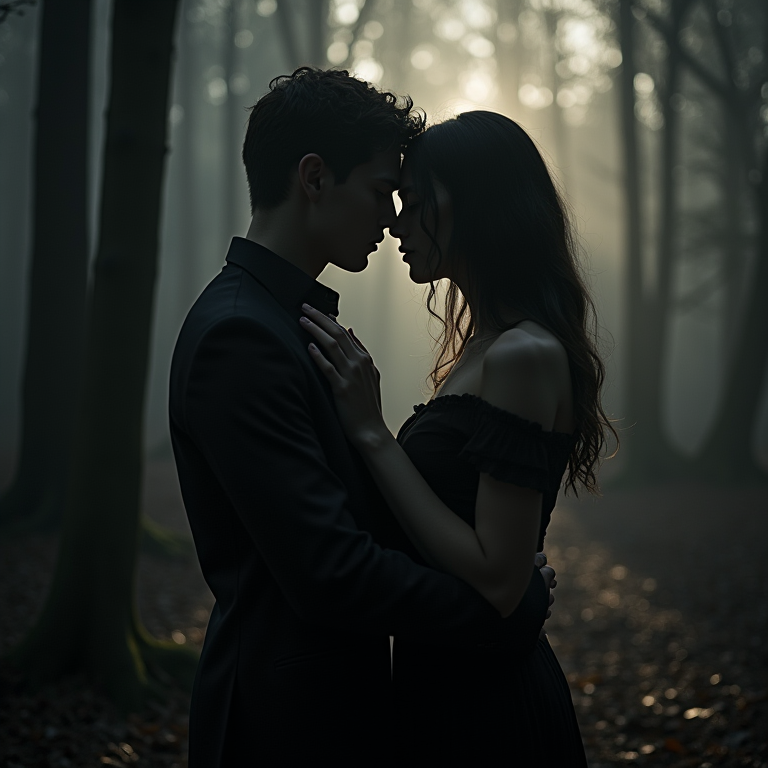
The Letter He Never Sent
The taxidermist’s apprentice fell in love with the woman who came to model for the sleeping death portraits, not knowing that she had already been dead for a week when she sat for him. He worked in the back rooms of a funeral home where beauty was manufactured from decay, and she walked into his life like a question he was terrified to answer. The other artists whispered that she was a spirit, a ghost, a bad omen, but he saw only her, and he reached for her with hands that had touched nothing but the dead for three years, and she reached back with fingers that were still warm for reasons he chose not to examine too closely.
She was a cartographer mapping the territories of dream, and the man who hired her to chart his nightmares was the most beautiful nightmare of all. Every night he described what he saw in the dark behind his eyes — cities of bone, rivers that ran with the memory of tears, a woman with no face who loved him with the intensity of the already damned — and every night she drew it, and every night she fell a little further into the map, until she could not tell which terrors were his and which were the ones that lived in her own sleeping hours. The boundaries between dreamer and dream had never been as solid as the maps suggested.
The opera singer’s voice could shatter glass, and she had shattered the life of the man who sat in the fourth row every single night, transfixed by the sound of her. He was a composer who had written his own death into the symphony he was creating, and she was the only instrument that could play it. They were engaged in a secret correspondence written in musical notation, each message a phrase of code that only they could hear, and the affair was conducted entirely in the language of the damned — all crescendo and collapse, all minor keys and unresolved dissonances, all the ways that love could be a kind of beautiful violence.
She inherited a mirror that showed her the past rather than the present, and through it she watched her own future husband fall in love with another woman a century before either of them was born. She was obsessed with the woman in the glass — her face, her smile, the way she tilted her head when she listened to music. She began to change herself to look like the ghost, began to change her life to match the history she was observing, and the man she was supposed to marry looked at her one day with a confused tenderness and said that she reminded him of someone he had never met, and she understood with terrible clarity that she was becoming a replacement, a echo, a love letter addressed to someone who had been dead for a hundred years and had never loved him at all.
The beekeeper’s daughter had never been stung, and the bees followed her with a devotion that made the village whisper about old magics and older bargains. When the traveling photographer arrived to capture the valley’s dying traditions, she posed for him in the apiary with the bees cascading over her skin like living jewelry, and he looked at her with an hunger that frightened her and thrilled her in equal measure. He was a man who photographed things that were about to disappear — forests, dialects, ways of life — and she understood with a cold clarity that she was looking at her own obituary. The bees did not sting her because they had already claimed her, body and soul, and the man with the camera was about to capture something that would outlast them both, even if neither of them lived to see it.
He was a surgeon who operated on the soul, not the body — a madman, the newspapers said, a visionary, a monster — and she was the woman they sent to evaluate whether he should be freed or finished. She sat behind the observation glass and watched him dissect guilt and trauma from the minds of the desperate, and she was supposed to be the objective one, the clinical one, the one who would not be swayed by his magnetic cruelty. But he saw her through the glass the way predators see prey that interests them, and he began to describe his techniques to her alone, in a private language he invented just for the two of them, and she realized too late that the experiment had begun the moment she agreed to watch.