The Blood We Promised
The wedding was held on the winter solstice, which Clara had chosen deliberately. Twelve hours of darkness, she had told herself when she booked the venue. Twelve hours of something that matched what she was doing. She did not tell Daniel this. She did not tell Daniel much of anything, in the months leading up to the wedding, because she had learned early in their courtship that there were subjects on which they could not agree, and she had concluded — correctly — that the best approach was simply to stop raising them.
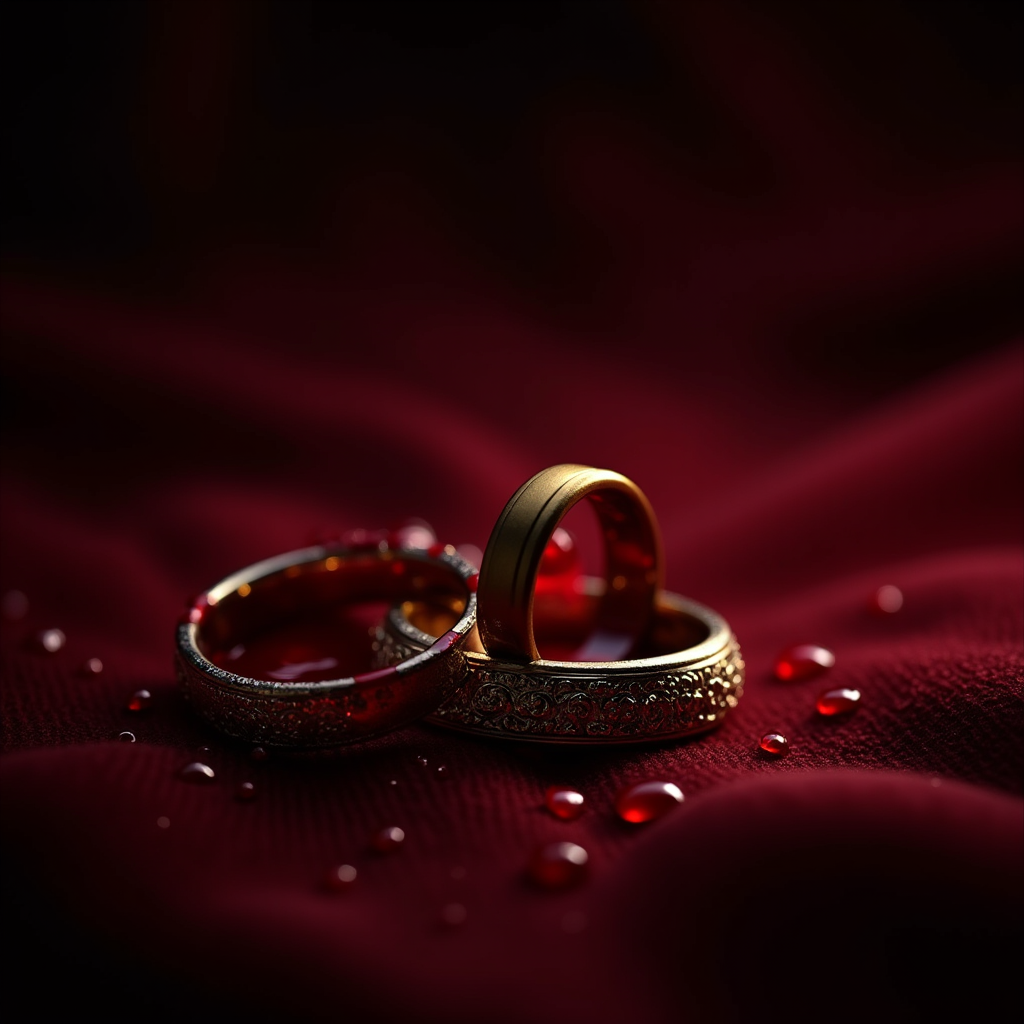
Daniel was a hematologist at the university hospital. He had been one since his residency, which had been long and difficult and had left him with a particular relationship to blood: clinical, respectful, precise. He knew what it was inside the body. He knew what it looked like outside of it. He had designed their wedding rings to hold, in the inner surface of each band, a groove that would catch and hold a single drop of the wearer’s blood, sealed forever against the skin.
“Blood wedding,” he had called it, when he first described the idea. “Ancient tradition. The Romans. The Greeks. It means we carry each other literally, under the skin, forever.”
Clara had said yes because she loved him, and because the concept was not without its appeal, and because she had decided — in the way she made all her decisions, quickly and without backtracking — that she would deal with the consequences when they arrived.
The blood was drawn during the vows. A small incision, made by the officiant — Daniel’s colleague, a pathologist named Yuen, who had agreed to officiate because she found the whole thing fascinating from a scientific standpoint. Clara’s blood came first, a thin line across her left ring finger that welled immediately and filled the groove Daniel had designed. Then Daniel’s, the same. The rings were exchanged. The crowd of forty-seven guests — family, mostly, and close friends — applauded in the manner of people who were genuinely moved but not entirely certain how to express it.
That night, in the hotel suite Daniel had booked for their wedding night, Clara removed her ring and looked at the blood inside it. It had not dried. This was not, she understood, scientifically possible. The anticoagulant properties of a ring groove — if such a thing could be designed — would not persist through the hours of exposure to air and fabric that the ring had experienced during the reception. And yet the blood inside her ring was fluid, moving when she tilted her hand, catching the light from the bedside lamp like a small red eye.
She showed Daniel. He examined it with the detached interest he brought to his most absorbing work. “It’s reacting to your body temperature,” he said. “The groove was designed to maintain a consistent thermal environment. I based the calculations on—”
“Daniel,” Clara said. “It is moving on its own.”
He looked at her, then back at the ring. They both watched it. The blood shifted, slowly, counterclockwise, as if something in the groove was stirring it. Neither of them spoke for a very long time.
They wore the rings for three months without incident, if one defines incident as the kind of event that sends people to hospitals or therapists. The blood remained fluid. It responded to their proximity — Clara noticed first that when she removed her ring and set it beside Daniel’s, the two blood samples would orient toward each other, the way iron filings orient toward a magnet. When she moved her ring further away, the orientation weakened. When she held her ring and walked into another room, Daniel’s ring would orient toward the wall between them, faintly, persistently, like a compass pointing north.
Daniel was not troubled by this. Daniel was troubled by the fact that his patient outcomes were changing — subtly, measurably — in ways that correlated precisely with the length of time he had been wearing the ring. His transplant rejection rates dropped. His dialysis patients stabilized. His oncology consults, which he had always found grimly predictable in their trajectories, began showing unusual resilience. His colleagues attributed it to improved technique. His department head offered him a research grant to study the phenomenon.
Clara, who had not been a hematologist, noticed different things. She noticed that when she cut herself while cooking, the wound closed faster than it should have. She noticed that her periods, which had always been irregular and painful, had become something else entirely — clockwork, minimal, painless. She noticed that when she was stressed, which was often, her body simply refused to acknowledge it. Her hands did not shake. Her sleep did not fragment. Her appetite did not change.
She mentioned none of this to Daniel. She was afraid that if she did, he would want to study it, and she understood, with a certainty she could not explain, that whatever was happening between them — between their blood, sealed in those rings — was not something she wanted to see from the outside.
The rings stayed on. They stayed on through the birth of their daughter, whose blood type was a thing their pediatrician found noteworthy but could not explain. They stayed on through the move to the house in West Berkeley, through the divorce proceedings, through the settlement negotiations that consumed eleven months. They stayed on through the final signing, on a Tuesday afternoon in March, when Clara slid her ring off for the last time and placed it in an envelope and mailed it to Daniel’s office.
The envelope arrived the following morning. Daniel opened it before his first patient. The ring was empty. The groove that had held Clara’s blood for seven years was dry, smooth, ordinary. There was nothing inside it but the faint outline of where the blood had once been, and the shape of what it had meant, and the precise measurement of how much of someone else a person could carry, under the skin, before they forgot they were carrying it.