The Door That Would Not Open
The real estate listing said the house had been vacant for eleven years. It did not say why the previous owner had left, or why the door to the basement had been sealed from the inside with four inches of brick and two coats of plaster. Marcus noticed this only after he had already paid the deposit.
The sealing was precise. No builder’s work — this was something done carefully, methodically, by someone who wanted the door to remain closed and had calculated exactly how much material would be required to ensure it. Marcus found this interesting rather than alarming. He was, after all, a man who had spent twenty years in construction defect litigation, and he recognized meticulous craft when he saw it.
He hired a contractor to open the basement. His contractor, a man named Owen who had worked with him for twelve years, got three courses of brick down before he called Marcus and said, “You need to come look at this.”
The door behind the brick was not wood. It was metal — industrial steel, the kind used in bank vaults — and it was covered, entirely, in scratch marks. Not random damage. Not the degradation of age. The marks were grouped in clusters of five, arranged in parallel lines, as if something had been dragged across the surface with five fingers, over and over, in the same direction, for years.
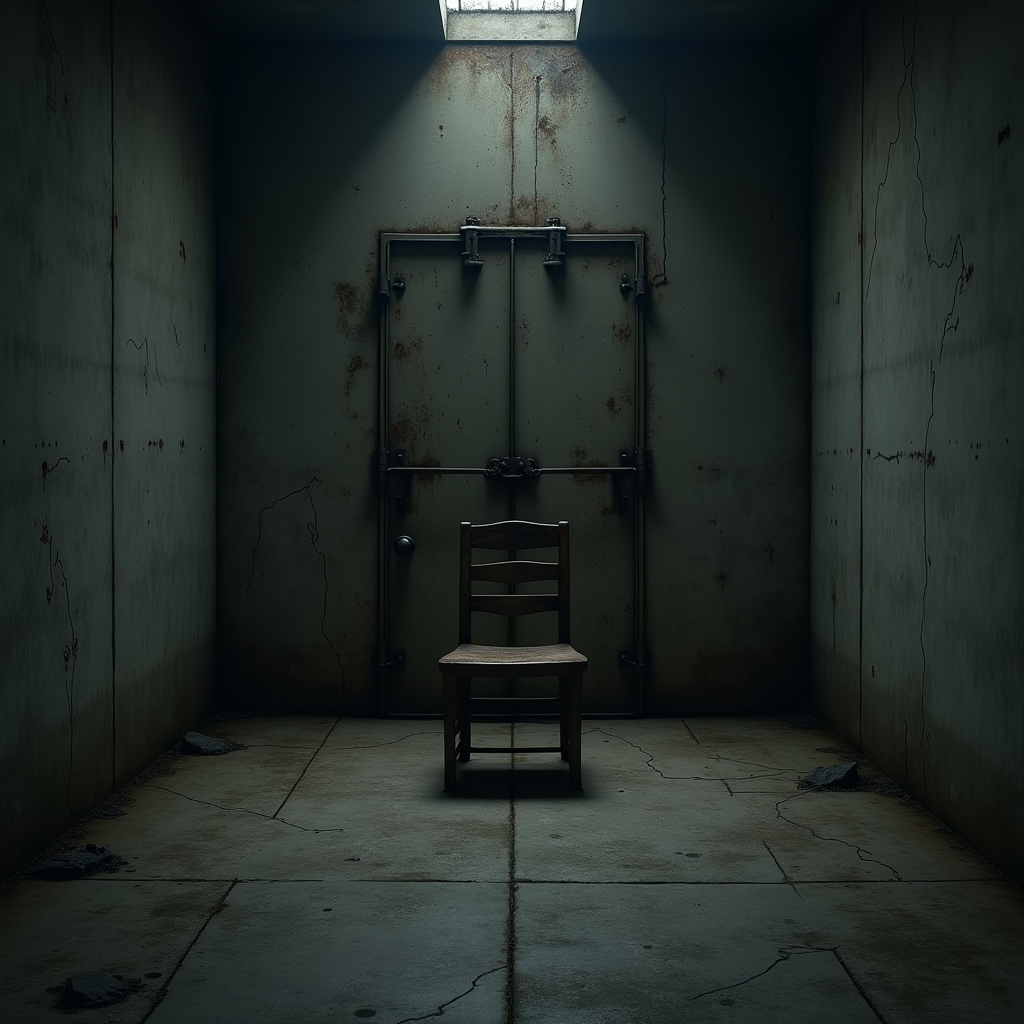
The room behind the door was small. Twelve feet by twelve feet. Concrete floor, concrete walls, no windows. The air was not stale, as empty rooms air tends to be after long vacancy. The air was fresh. Continuously fresh, as if something were breathing it.
In the center of the room there was a chair. An ordinary wooden kitchen chair, the kind found in millions of American homes. On the seat of the chair there was an indentation in the exact shape of a human body — the back pressed into the wood, the arms resting on the sides, the legs extended forward. The indentation had been worn deep enough that the wood had compressed permanently.
The walls were covered, floor to ceiling, in writing. Not graffiti. Not random scratching. The writing was in a careful, precise hand, in ink that had faded but not disappeared, covering every surface including the ceiling, in sentences that repeated and varied and returned and repeated again. Marcus read for forty minutes before he called the police.
The first sentence, written at the bottom of the north wall, read: I have been in this room for eleven thousand, six hundred, and twenty-three days. I have counted every one. The door does not open from the inside.
The police report said the house had been built in 1952 by a man named Harold Vess, who had lived alone in it until his death in 1989. The coroner estimated Vess had been dead for approximately three weeks before his body was found by a utility reader who had been sent after Vess failed to pay his gas bill. The body was found in the upstairs bedroom. There was no indication of foul play. The case was closed as natural causes.
Marcus hired a structural engineer to examine the sealed door. The engineer reported that the door and its frame had been installed from the inside — meaning the room had been sealed while someone was inside it. The scratch marks on the door’s surface, the engineer noted with clinical detachment, were consistent with fingernails, human or near-human, dragged with significant force across industrial steel.
Marcus listed the house for sale six months later. The listing description did not mention the basement. He was not a dishonest man. He was simply a practical one. The room had been empty when he opened it. The chair sat in its center, still bearing the shape of its long occupation. If someone had once lived in that room — if something had once lived in that room — they had found their way out.
The new owner moved in on a Tuesday. Marcus heard nothing for three weeks. Then, on a Thursday evening, his phone rang. The voice on the other end said, very calmly: “The door to the basement. The one you bricked back up. I need you to come explain something to me.”
Marcus did not go. He also did not answer his phone for the next several weeks, until the voice messages stopped, and the property records showed the house had sold again, to a family with four children who had been told, by the listing agent, that the basement was simply unfinished storage.