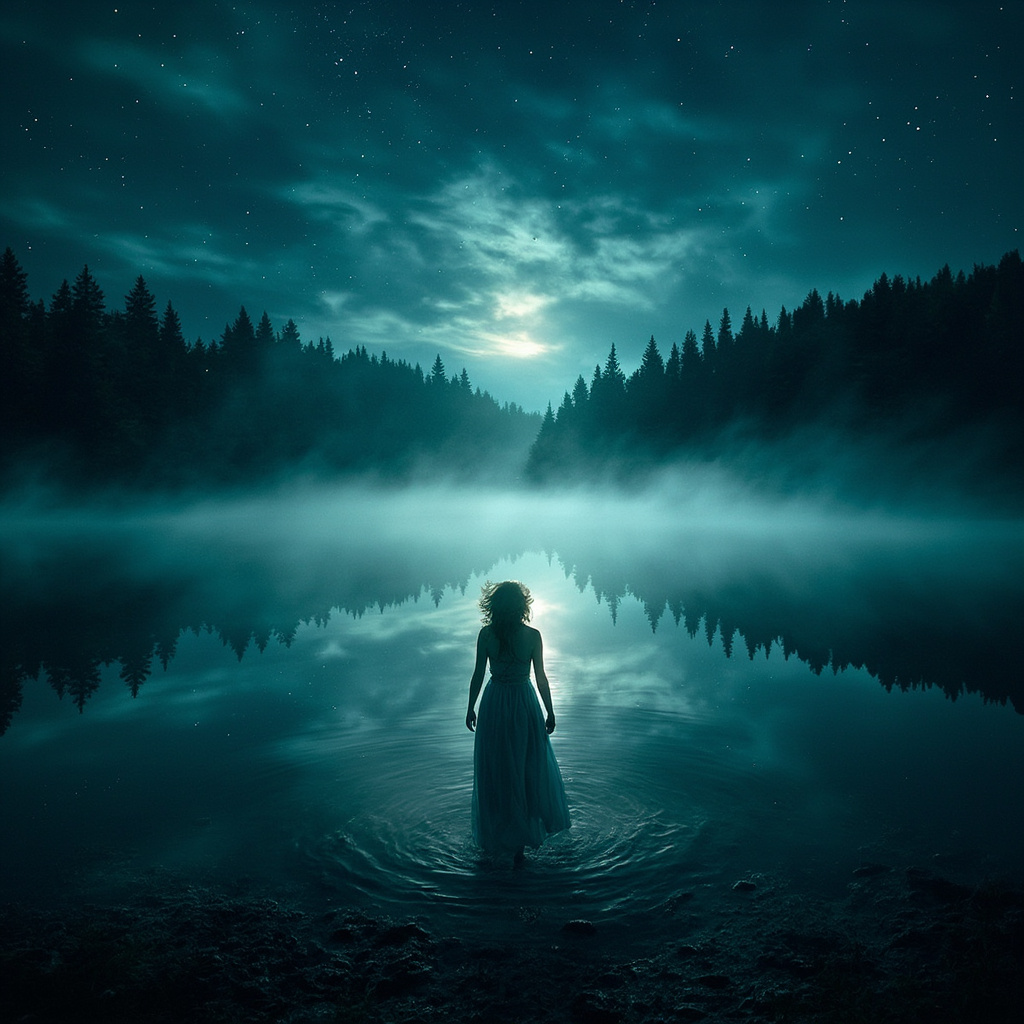
The Spell They Cast in Water
The lake had been there for as long as anyone could remember, which was the way of things in the valley where Mira’s family had lived for generations. The lake was not large—a mile across at its widest point, perhaps—but it was deep. The water near the center was black even on the brightest days. The fishermen who worked its surface knew not to venture too far from the shore. The cold that came up from the depths was not the kind of cold that a human body could survive for long.
People swam in the lake, in the summer, in the shallows near the beach. They did not swim in the center. They did not swim at night. They did not swim alone. These were the rules that had been established by generations of people who had lived near the lake and who had learned, through a combination of experience and inheritance, what the lake would tolerate and what it would not.
Mira had grown up following these rules. She had swum in the shallows as a child, had felt the warmth of the summer water against her skin, had watched her brothers dive from the rocks at the lake’s edge and had envied them their willingness to push further out than she was allowed to go. She had accepted the rules because they were the rules, and because her mother had enforced them with the kind of insistence that suggested they were not negotiable, and because she had never had reason to question them.
The change started when Mira was seventeen. She was walking home from the village one evening in September when she heard the sound coming from the lake—a sound that she had never heard before, a sound that was not the sound of wind or waves or the calls of birds that lived near the water. The sound was singing. Someone was singing, in the lake, and the singing was in a language that Mira did not recognize but that she understood, in some way that she could not explain, as a language that was calling her name.
She walked to the edge of the lake. She stood on the shore and looked at the water, which was calm, which was dark, which showed no sign of the source of the singing. She stood there for a long time, listening, until the singing faded and the lake was silent again and she was left with the awareness that something had changed in the world that she had thought she understood.
She did not tell anyone about the singing. She was afraid, in the way that people are afraid of things that do not fit into the categories they have been taught to use. She was also curious, in the way that seventeen-year-olds are curious about things that are forbidden. She went back to the lake the next night, and the night after that. The singing returned, on the third night, and on the fourth, and after a week Mira had stopped being afraid and had started to listen with something that felt like anticipation.
The figure emerged from the water on the eighth night. Mira had been waiting on the shore, as she had been doing every night since the singing started, wrapped in a blanket against the September chill, watching the dark surface of the lake. The figure did not come all at once. It rose slowly, gradually, taking the form first of a shape in the water and then of a body in the shallows and then of a woman who stood at the edge of the lake and looked at Mira with eyes that were the color of the deep water—dark and deep and holding things that Mira could not see.
The woman’s name was Sera. She had been in the lake for a very long time. She had been put there, she told Mira, by her family, when she was young, because she had been born with abilities that her family could not control and did not want. She had been in the lake for so long that she had become part of it, and the lake had become part of her, and together they had created something that was neither one nor the other but that existed in the space between the water and the land and the world that people like Mira inhabited.
Sera taught Mira to listen to the lake. The lake was not just water. It was a record, a memory, an archive of everything that had ever happened in the valley and everyone who had ever lived there. Sera could read the lake’s memories. She could teach Mira to read them too, if Mira was willing to learn, if Mira was willing to accept the costs that the learning would require.
The cost was this: Mira would have to give up her life in the world of people. Not immediately, and not permanently, but for a period of time that Sera could not specify in advance—a period that would last as long as the learning took, and that would end when Mira had learned what the lake had to teach her. During that time, Mira would live in the lake, with Sera, in the community of beings that existed in the deep water and that were neither human nor anything else that had a name.
Mira agreed. She did not know what she was agreeing to, not fully. She was seventeen. She had heard the singing. She had seen the figure emerge from the water. She was willing to accept the uncertainty because the alternative was to go back to the life she had known before. That life now seemed to her too small, too bounded, too much like a set of rules that someone else had written for her.
She lived in the lake for what felt like years. In the world above, only days passed. She learned the lake’s memories—the births and deaths, the loves and betrayals, the histories of families that had lived in the valley for generations and that had left their marks on the water in ways that only the lake could remember. She learned that the world was larger and stranger than she had been taught, and that the boundaries between what was human and what was not were thinner and more permeable than anyone suspected.
Mira came back to the world above on a morning in spring. She did not know, when she emerged from the shallows, how much time had passed. She knew only that she was changed, in ways that she would spend the rest of her life trying to understand. She walked home. Her mother saw her and cried and asked where she had been. Mira said she had been traveling. She said she was back now. She did not say more, because she did not know how to say more, because the experience of living in the lake was not something that could be translated into the language of the world she had returned to.
She visited the lake for the rest of her life. She sat at the edge, in the evenings, when the light was fading and the water was calm, and she listened. She could hear Sera, sometimes, in the depths. She could hear the lake’s memories, the accumulated history of the valley, the songs of the beings who lived in the deep water and who had accepted her as one of their own, even if only for a time.
She never swam in the center of the lake. She had learned, during her time with Sera, why the rules existed, why people did not swim alone or at night, why the lake tolerated human presence in the shallows but resisted it in the depths. The lake was not hostile. It was simply not human, and it did not pretend to be. It had its own ways, its own inhabitants, its own memories. And Mira, who had been given access to all of it, had come back to the world of people carrying knowledge that she could never fully share.