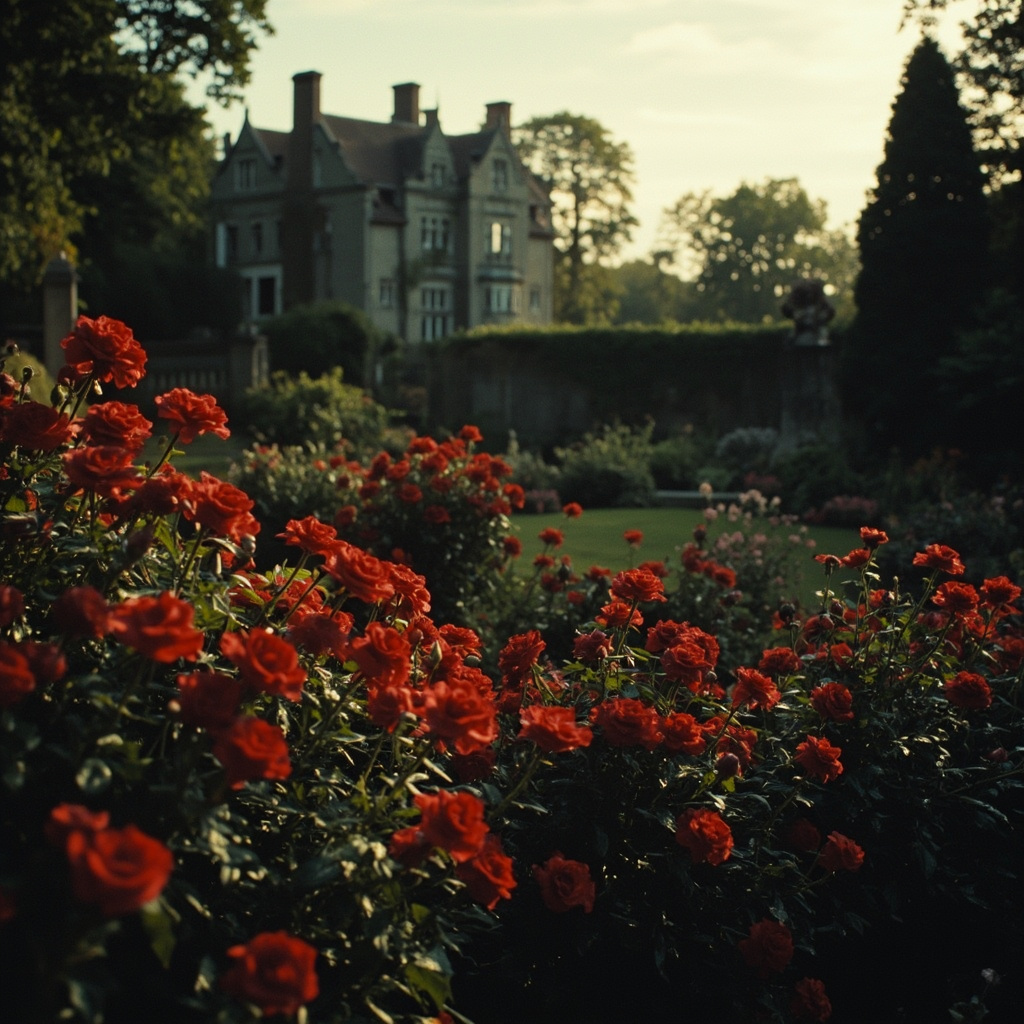
The Roses They Burned
Lady Ashworth had a garden that was famous throughout the county. Not for its beauty—for its roses. The Ashworth roses were a hybrid that had been developed by Lady Ashworth’s grandmother, a woman who had been obsessed with creating the perfect flower, the perfect combination of color and fragrance and the particular shade of red that the family called “Ashworth crimson.” The roses grew in a walled garden behind the manor house, tended by the same family of gardeners for four generations, protected from wind and weather and the eyes of anyone who might have tried to take what the Ashworths had spent a century perfecting.
Lady Ashworth’s name was Catherine. She was forty-one years old and a widow, which in the language of the county meant that she was available in a way that married women were not and unmarried women had never been. She had inherited the garden when her husband died, along with the manor and the fortune and the responsibility for the three hundred acres that surrounded them. She had not asked for any of it. She had accepted it anyway, because accepting was what the daughters of great families did when their fathers and husbands left them with the weight of legacy.
The garden was the only part of the inheritance that she actually wanted.
The visitor arrived in September, when the roses were at their peak and the garden was producing more blooms than the gardeners could sell at the weekly market. He said his name was Mr. Webb. He said he was a collector. He said he had traveled from London to see the Ashworth roses because he had heard that they were unlike any others, that they carried within their petals a fragrance that could not be replicated, that they were, in the language he used with a seriousness that made Catherine feel he was not exaggerating, irreplaceable.
Catherine gave him the tour because it was expected. She walked him through the walled garden and showed him the roses that her grandmother had developed and her mother had maintained and that she, Catherine, had preserved through years of drought and disease and the slow encroachment of the modern world. Mr. Webb walked beside her and asked questions that were specific and technical, the kind of questions that only a genuine enthusiast would think to ask. He touched the petals of the roses with a kind of reverence that Catherine recognized, because she had seen it in her own mirror, in the expression of a woman who understood what it meant to love something that could not love her back.
At the end of the tour, he made an offer. He would pay any price for a cutting—a single cutting from the original plant, the one that her grandmother had developed and that was the genetic source of every rose in the garden. Catherine said no. He offered more money. She said no again. He left, but he left his card, and he said that he would return if she ever changed her mind.
Mr. Webb returned in November, when the roses were dormant and the garden was nothing but thorns and dormant stems. He had come, he said, because he could not stop thinking about the roses. He had collectors in his family going back generations, and the Ashworth roses represented something that he had spent his life searching for: a beauty that was not merely aesthetic but absolute. He was not going to offer money again. He was going to offer something else.
He told Catherine about his wife, who had died three years earlier. He told her about the illness that had taken her, slowly, over the course of a year. He told her about the promises he had made to her and to himself about how he would live after she was gone. He had not kept those promises. He had spent three years alone, surrounded by the things that his wife had collected and that he did not know how to appreciate, unable to let go of the life that he had lost. He wanted the rose because it was beautiful, yes. But he also wanted it because he believed that if he could have something that was genuinely, demonstrably perfect, something that could not be improved upon or replaced, he might be able to start letting go of the grief that had become his entire existence.
Catherine listened. She understood grief. She had her own, accumulated over years of loving a husband who had never loved her back and who had left her with a house and a title and a garden that she maintained not because she wanted to but because maintaining it was easier than deciding what else to do with her time. She understood the appeal of perfection. She had spent her entire life surrounded by it.
Catherine made a bargain with Mr. Webb. She would give him the cutting he wanted. In exchange, he would tell her the truth about his grief—not the polished version he had presented, but the real one, the one that included the parts he was ashamed of, the moments when he had been cruel or selfish or unable to feel anything except the weight of his own loss. She wanted to know because she wanted to know if grief was something that could be survived, or only endured.
Mr. Webb told her the truth. He told her about the night he had spent in his wife’s closet, wearing her clothes, unable to explain why. He told her about the arguments he had picked with strangers because he wanted someone to be angry at and grief was not a target that fought back. He told her about the months when he had been unable to cry and had hated himself for the hardness that had replaced the tears, and the months when he had been unable to stop crying and had hated himself for the weakness that seemed to have replaced everything else. He told her about the moment, six months after his wife’s death, when he had stood at the edge of a bridge and understood exactly how easy it would be to step off, and the moment, one second later, when he had stepped back and decided to stay.
Catherine listened to all of it. When he was finished, she gave him the cutting. He took it and left. She did not see him again.
The garden continued. The roses bloomed the following spring, and the spring after that, and the springs after that, in the same walled garden that Catherine’s grandmother had developed and her mother had maintained and that Catherine herself tended with the same devotion that had sustained it for four generations. She did not sell the roses. She did not charge for tours. She maintained the garden because maintaining it was what she did, and because the roses were still the Ashworth roses, and because some things are worth preserving not because they are perfect but because they are hers.
She thought about Mr. Webb sometimes, in the early years. She hoped he had found what he was looking for. She hoped the cutting had meant what he wanted it to mean—the possibility of beauty surviving loss, the evidence that perfection was achievable, the proof that grief did not have to be permanent. She hoped, but she did not know. Some bargains are made and kept and the terms fulfilled on both sides. And some bargains are made and then carried away into other lives, where they continue to mean whatever the people who made them needed them to mean.
The roses burned in the garden that summer. Not all of them—just the ones near the east wall, close to where the original cutting had been taken. The gardeners said it was a fungus. Catherine did not argue. She let them treat the roses and remove the burned stems and work with the garden that was still there, the garden that was still hers, the garden that was still the Ashworth roses, imperfect and imperfectible and exactly what it had always been.