The Collector of Forgotten Kisses
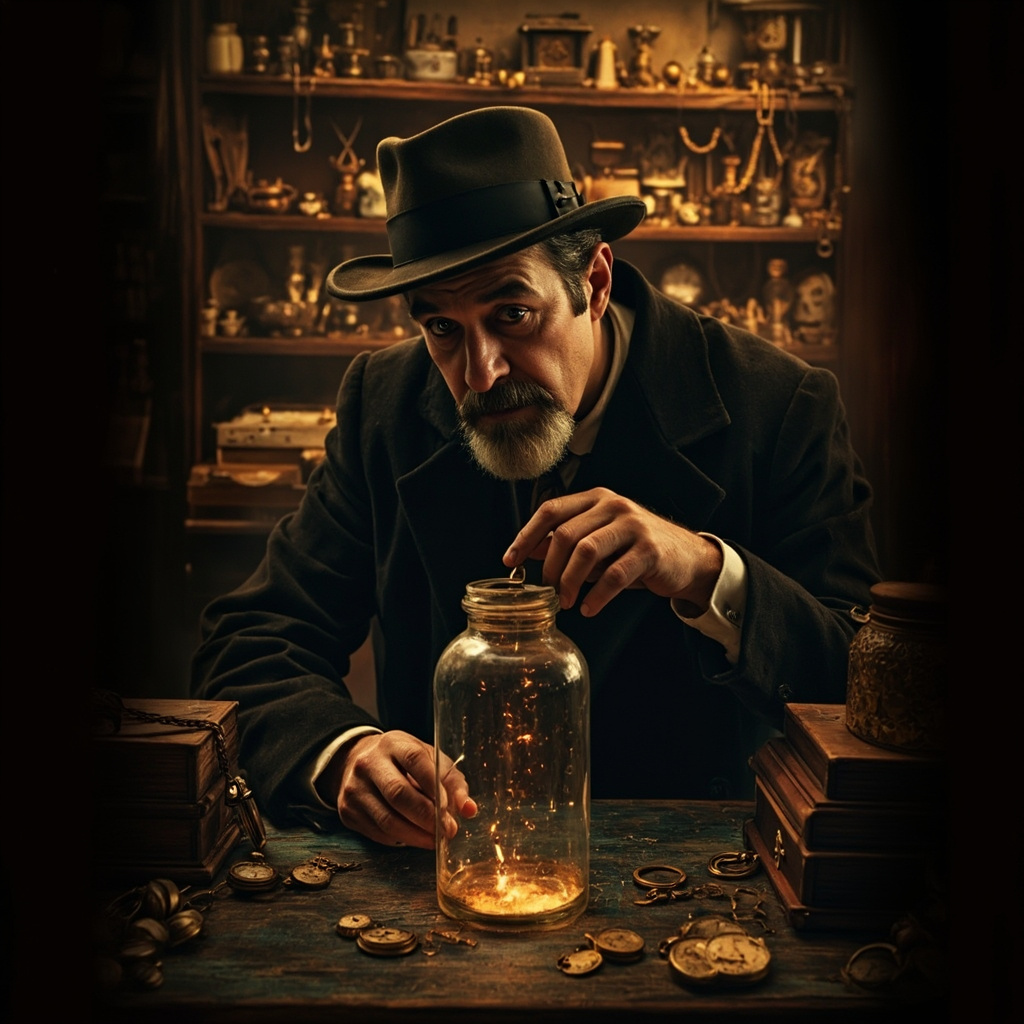
The man came to Eleanor’s shop on a Tuesday in November, which was the slowest day of the week and the month and the year. He was tall and gray-haired and dressed in a suit that had been expensive thirty years ago. He looked at the objects on her shelves—the antique clocks and the old jewelry and the collection of items that people had sold when they needed money more than they needed sentiment—and he said, “I am looking for something specific.”
Eleanor had been running the antique shop for twenty years. She had learned to read customers the way other people read books—noticing the details that people did not know they were revealing, understanding the difference between what people wanted and what they actually needed. The man in the expensive suit wanted something that he could not buy. That much was obvious from the way he stood, slightly uncertain, as if he had walked into the shop without knowing exactly why he was there.
“I collect memories,” he said, as if this explained something. “Specifically, I collect the memories that people have lost. The kisses they forgot. The moments that slipped away before they could be held.”
Eleanor had not believed him. She had smiled politely and gone back to the inventory she was cataloguing. But the man had not left. He had stood in her shop for an hour, looking at the objects, picking them up and putting them down, as if he was searching for something that he could not name.
The man came back the next day. And the day after that. He bought nothing. He did not seem to be shopping. He seemed to be waiting for something, though he never said what. On the fourth day, he made an offer.
“Your shop is failing,” he said. He was not being cruel. He was being factual. “The building needs repairs you cannot afford. The inventory is depleting. You have been losing money for three years. You will close within eighteen months.”
Eleanor did not ask how he knew. She had stopped asking questions that had answers she did not want. “What of it?”
“I can help you,” the man said. “I can give you whatever you need to keep the shop open. In exchange, I collect one memory. A specific one. Something you lost and have been looking for, though you may not know you are looking for it.”
“What memory?”
The man smiled. It was not a warm smile. “The memory of the first time someone kissed you. You have forgotten it. Or rather, you have buried it so deep that it no longer surfaces on its own. I can find it. I can take it. And in exchange, your shop will survive.”
Eleanor was sixty-three years old. She had been kissed by many people in her life—her first love at sixteen, whose name she still remembered, and whose face had faded, and whose kiss was the kind of kiss that felt like the beginning of something instead of an end. She had been married twice. She had buried two husbands. She had raised children who had grown up and moved away and become people she knew but did not recognize, in the way that parents always feel they do not recognize the adults their children become.
The first kiss had been in her parents’ garden, in the summer, when she was sixteen and the world had seemed like a place where anything could happen. The boy had been named Thomas. He had been gentle. He had been nervous. He had been her first experience of being wanted by someone who saw her and found her worthy of wanting.
She had not thought about that kiss in forty years. But when the man in the shop mentioned it, she realized that it was gone—not forgotten, exactly, but emptied, a shape with no content, a frame with no photograph. She could remember that there had been a kiss. She could remember that it had mattered. But she could not remember what it had felt like, and for the first time, she noticed the absence.
Eleanor signed the contract. The man had brought it with him, folded in his pocket as if he had known she would agree. The terms were simple. She would give him the memory of her first kiss. In exchange, he would pay off the debts on her shop, repair the building, and ensure that she could remain there for the rest of her life. The contract did not specify what he would do with the memory. He did not ask, and she did not inquire.
The extraction was painless. He touched her forehead with two fingers, and she felt something release—not pain, not pressure, but a kind of unhooking, as if a thread that had been attached to something had been gently pulled free. She thought of Thomas. She remembered that she had loved him. She remembered that he had kissed her in her parents’ garden. And she knew, with the certainty of someone who has lost something and knows exactly what is missing, that the feeling was gone. The warmth. The certainty. The sense that the world was vast and full of possibility. The kiss had taken those with it when it left.
The man’s money arrived the next day—transfers and documents and paperwork that made the bankruptcy disappear as if it had never existed. The building was repaired. The inventory was replenished. Eleanor’s shop became, once again, the kind of place that people came to find objects that held meaning, things that had survived the passage of time and still carried within them the memory of the hands that had held them.
Eleanor was not happy. But she was not unhappy, either. She was something else—a person who had made a trade and was living with its consequences, a person who had given up one kind of feeling in exchange for another. She thought about Thomas sometimes, and about the garden where she had stood with him in the summer, and about the kiss that she could no longer feel but could still, in some dim way, remember having.
The man came back once, a year later, to see how she was getting on. He looked at the shop and nodded, satisfied. He did not ask about her health or her happiness. He only asked if the trade had been worth it.
Eleanor thought about it for a long time. The shop was still open. The building was still standing. She was still here, in the place she had spent her life building, surrounded by the objects she had spent her life collecting. The kiss was gone. Thomas was gone. The feeling of being sixteen and wanted and certain was gone.
“Yes,” she said. “I think it was.”
The man left. She never saw him again. But sometimes, late at night, when the shop was empty and the clocks were ticking and the old jewelry was catching the light, she thought she could feel something brushing against the edges of her memory—the ghost of a feeling, looking for a place to land. She never let it in. Some memories, she had learned, were better left on the shelf.