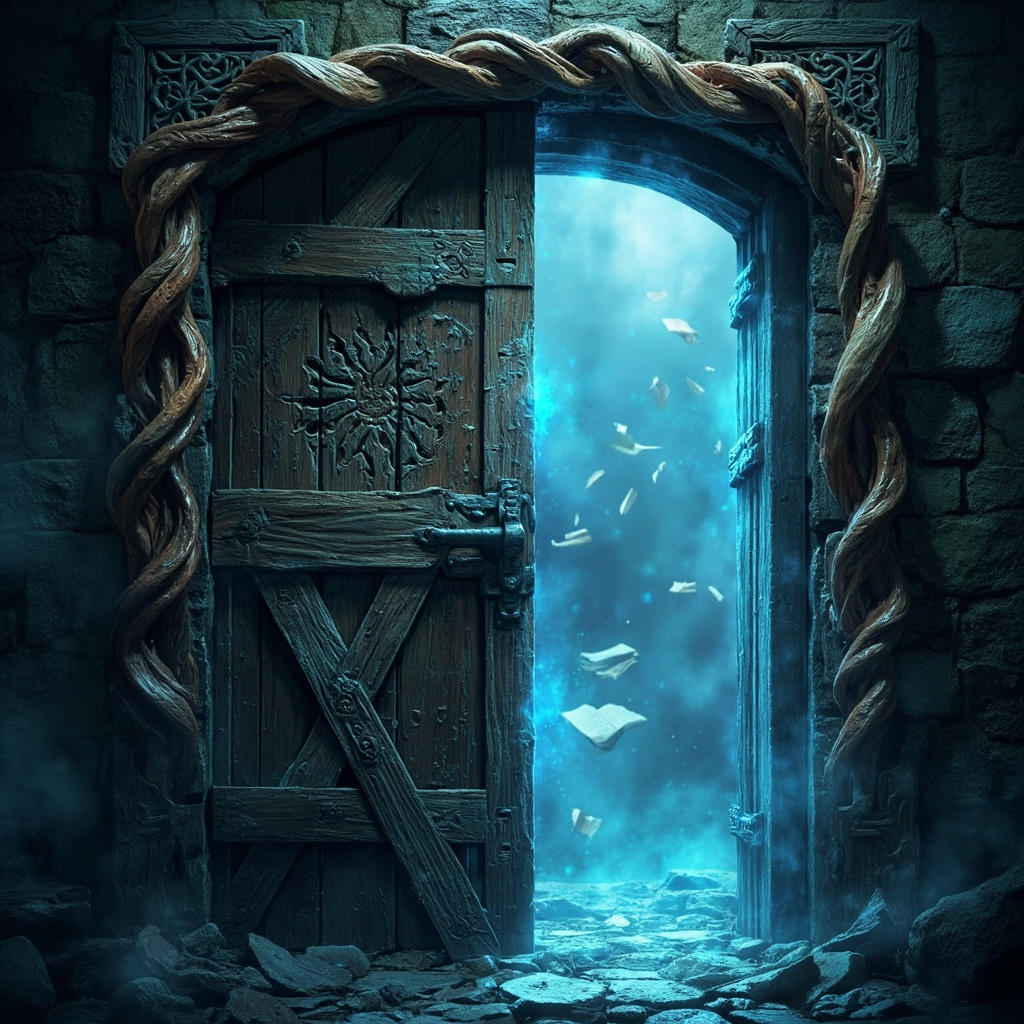
The Door They Opened
The door had been in the library for as long as anyone could remember. It was set into a wall between two sections of the stacks, a door that was always locked, that was mentioned in the library’s founding charter as “the special collections access” but that had never, in living memory, been opened. Students speculated about what was behind it. Some believed it was a rare books room that required special permission to enter. Others believed it was a climate-controlled archive for materials too fragile to be accessed. A few believed it was a remnant of the library’s original building, incorporated into the renovation but never actually used.
Mira, who was a graduate student in the library science program and who worked part-time as a page, had been curious about the door since her first week. She had asked her supervisor about it, and her supervisor had said that no one knew what was behind it, that the key had been lost generations ago, that the administration had decided it was easier to leave the door locked than to investigate what it led to.
But Mira had noticed something that her supervisor had not noticed: the dust on the door handle was disturbed. Not much—just slightly less dust than on the surrounding surfaces, as if someone had been opening it recently, or as if the door was being opened more frequently than anyone in the library knew.
The key was in the library’s archive of lost and found objects—a small brass key that had been in a box of keys that had been donated to the library decades earlier and had never been claimed. Mira found it when she was cataloguing the box as part of a digitization project. The key was labeled with a number that corresponded to the door’s location in the library’s old card catalogue system. She knew immediately what it opened.
She opened the door at midnight, when the library was empty, when she was the only person there. The door led to a staircase that went down, not up, even though the library was only two stories tall. The staircase was lit by a light that seemed to come from the walls themselves, not from any visible source. She descended. She found, at the bottom, a room that was larger than should have been possible given the building’s footprint—a room that was filled with books that she did not recognize, in languages she could not read, in bindings that suggested ages that predated the library by centuries.
The room was not empty. There was a woman sitting at a desk in the center of the room, writing in a book that was larger than any book Mira had ever seen. The woman looked up. She did not seem surprised to see Mira. She seemed, in fact, as if she had been expecting her.
The woman was the librarian. She had been there since the library was founded, and she would be there until it was destroyed, and possibly longer. She maintained a collection that was not catalogued in any system that Mira could understand—a collection of books that contained the actual experiences of the people who had read them, encoded in a format that could only be accessed by people who knew how to read what was written. The collection was vast. It contained more books than Mira could count, more books than could fit in the space she was standing in, more books than the room could physically hold.
The room was not a room. It was an aperture—a space that existed in the margin between the library and something else, a space that the library had been built to contain without acknowledging. The librarian maintained it. She kept the books. She answered questions from people who found their way down the stairs, which was rare, and which happened only when the library felt that someone needed to find what was there.
Mira spent three hours in the room, talking to the librarian, looking at books that contained experiences she could not have imagined. She did not understand most of what she saw. But she understood that the room existed because people needed it to exist—needed a place where their experiences could be recorded, where their lives could be preserved, where the act of reading could become something more than entertainment or education.
Mira returned to the room every night for a month. She learned, slowly, how to read the books—not the text, which remained opaque, but the experiences, which translated themselves into images and feelings and memories that were not hers but that she could access through the act of touching the pages. She read books that had been written by people who had died centuries ago, who had lived lives that were nothing like hers, who had experienced things she could not have imagined.
Then, one night, she came down the stairs and found the door locked. She tried the key. It did not work. She tried again, more forcefully. The door did not open. The key, she realized, was not meant to be used repeatedly. It was meant to be found, and then used, and then left alone.
She told no one about the room. She did not write about it in her thesis. She did not mention it to her colleagues or her professors or her family. She simply carried it with her, the way she carried the knowledge that some things existed beyond the categories that she had been trained to use for understanding the world.
She graduated. She became a librarian. She worked in the same library for thirty years, and every day she walked past the door and remembered what was behind it, and she never tried to open it again.
Some doors are meant to be found. And some doors, once found, are meant to be left alone.