The Painting They Completed
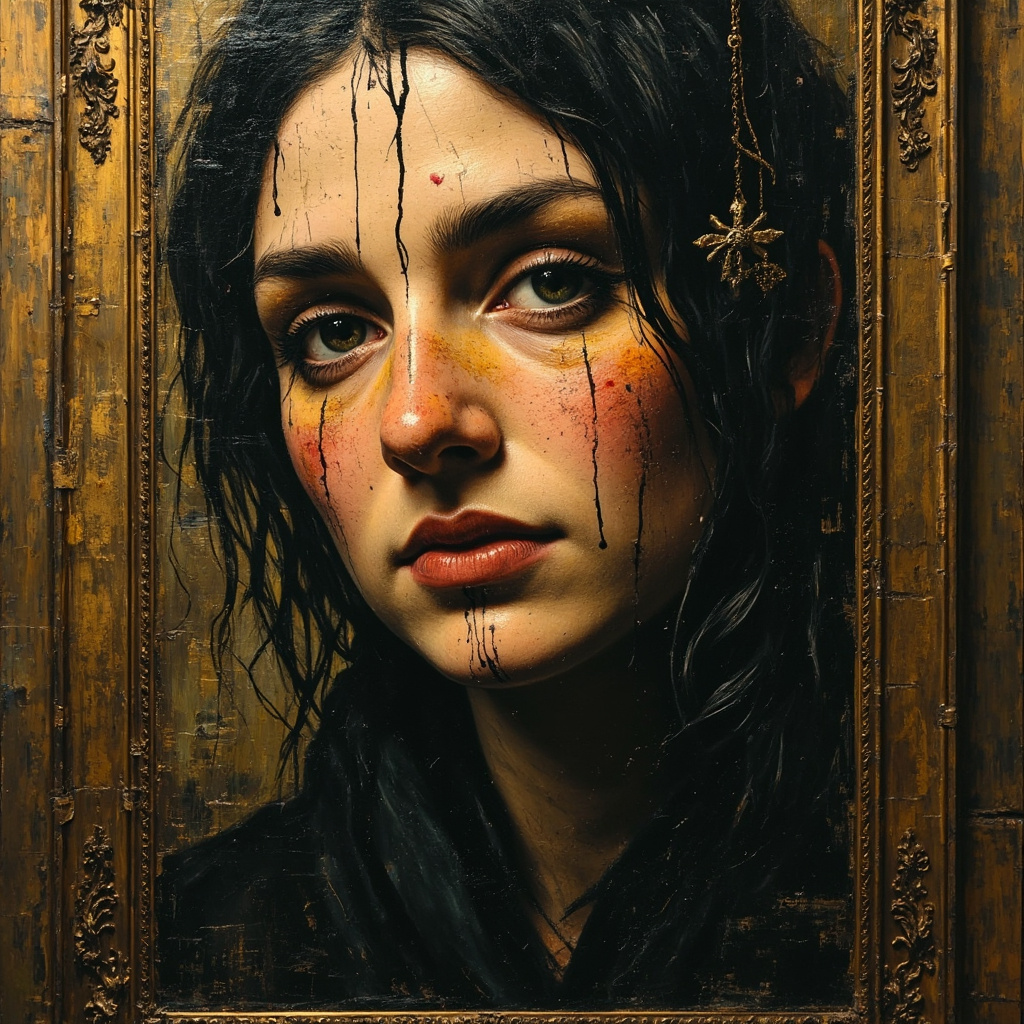
The painting had been started by a woman named Marguerite. She had been a student of a master painter in Paris in the 1920s. She had spent forty years developing a technique she called “living color.” This was a method of applying paint that was designed to capture not just the appearance of a subject but its essence. The quality of being distinguished it from every other subject that had ever been painted. The painting she was working on when she died was a self-portrait, and it was unfinished, and it had been in the possession of a family in New England for sixty years when they decided to sell it at auction.
The buyer was a museum that specialized in work by women artists—a small institution with a focused collection and a budget that was sufficient for acquisitions that other museums of its size would not have considered. The museum’s director, a woman named Elena, had seen the painting at a preview and had known immediately that she had to have it. The painting was not just unfinished. It was a study in potential, an exploration of what the technique of living color could do when applied to the most difficult subject: the self.
Elena spent three years researching Marguerite’s technique. She found notebooks, letters, fragments of a treatise that Marguerite had been writing on the theory of living color. She reconstructed the method from the evidence—how the paint was mixed, how it was applied, what the sequence of layers was supposed to achieve. She found a conservator who was willing to attempt the completion, who understood that the completion was not a restoration but an interpretation, not a finishing of Marguerite’s work but a conversation with it.
The completion took eighteen months. The conservator worked with a precision that bordered on reverence, applying paint in the sequences that Marguerite’s notebooks described, creating the layers that her technique required. When the painting was finished—when Marguerite’s self-portrait was, for the first time in a century, complete—the result was not quite what anyone had expected.
The painting was more alive than finished paintings usually were. That was the only way Elena could describe it. It seemed to move, not physically but perceptually—the eyes following the viewer, the expression shifting slightly depending on the angle of light, the whole composition seeming to respond to being observed. Visitors who saw the painting reported feeling seen in return, as if Marguerite had captured not just her own appearance but the act of looking itself.
The painting was displayed in a room by itself, the first thing visitors saw when they entered the museum’s gallery of work by women artists. The response was extraordinary—not in the sense of controversy or spectacle, but in the sense of quiet recognition. People stood in front of the painting for long periods. They came back multiple times. They brought friends and family. They wrote in the guest book about what the painting had meant to them, about the experiences it had triggered, about the memories it had surfaced.
The painting was not magic. Elena understood that. What the painting did was the same thing that all great art did: it created a space for the viewer to enter, a context for their own experience to unfold. Marguerite had developed a technique that maximized this capacity. She had understood that the goal of portraiture was not to capture the subject but to create a mirror for the observer.
The discovery came from a researcher who was studying Marguerite’s technique using modern imaging technology. She found that the painting contained, in its lower layers, a previous composition—one that Marguerite had painted over but that had not been fully covered. The previous composition was also a self-portrait, but a different one, painted perhaps thirty years earlier, showing Marguerite as a young woman. The technique she had used in the earlier portrait was different from the technique she had developed later—more conventional, more academically correct, but lacking the living quality that characterized her mature work.
The researcher showed the discovery to Elena. They spent hours looking at the x-ray images of the hidden portrait, trying to understand why Marguerite had painted over her own earlier work. The most likely explanation was also the most poignant: Marguerite had painted over the young self in order to become the older self, had used her own face as the ground for a new exploration, had made the process of aging and growing and changing into the subject of her final masterpiece.
The painting was exhibited with the discovery explained, and visitors now had a new layer of meaning to engage with—not just Marguerite’s completion of her technique, but her willingness to build on her own past, to acknowledge where she had been while continuing to explore where she was going.
Some paintings are finished. And some paintings are completed over time, by the artists who made them and by the viewers who engage with them. The painting that Marguerite started and Elena completed was one of the second kind. It was never finished, exactly. It was always in the process of becoming something else.