The Auction of Memories
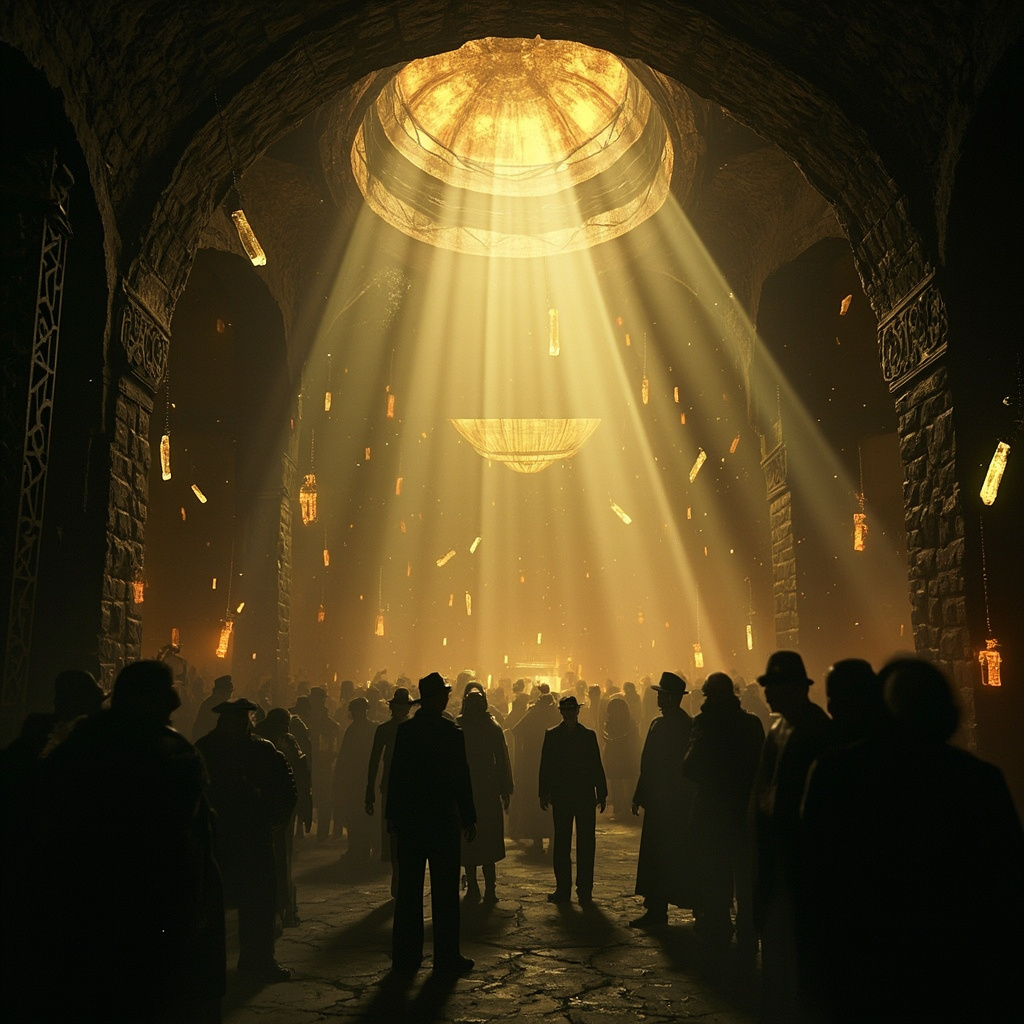
They sold memories in the underground market that existed beneath the city’s oldest district, in a network of basements and tunnels that had been built during prohibition and had found more enduring uses in the decades since. The market was not advertised and not illegal, exactly—the police knew about it, the city council knew about it, everyone who needed to know knew about it, and it had survived for forty years because it provided services that the legitimate economy could not or would not provide.
What they sold were not the important memories. Not the first kiss, not the childhood home, not the face of a parent who had died when you were too young to remember them clearly. Those memories were too valuable—too deeply embedded in the psyche, too tied to the sense of self—to be safely removed. The market dealt in the small ones. The Tuesday afternoons when nothing happened. The forgotten errands that never got run. The random Tuesday afternoon in 1987 when someone had stood at a window and wondered what their life would look like at fifty, and then had gone back to whatever they had been doing before, the wondering forgotten like so many other moments that slip through the cracks of ordinary consciousness.
Julian bought and sold these fragments for a living. He called it “memory arbitrage”—identifying memories that were undervalued, acquiring them for a pittance from people who did not know they had them, and selling them to collectors who understood their true worth. The profit margins were extraordinary. A memory that someone had stored for thirty years without ever accessing it might be worth pennies to the original owner and thousands of dollars to the right buyer. Julian had built a comfortable life on the difference.
He told himself it was harmless. The memories being sold were, by definition, forgotten. The people who had lived them no longer remembered them. That was why they were willing to sell for so little. What harm was there in giving those forgotten moments a second life, in allowing someone else to experience the texture of a summer afternoon in 1972 or the particular quality of light in a city that no longer existed?
Then Julian found a memory that should not have existed.
It was in a batch of fragments he had acquired from an estate sale—a woman who had died at ninety-seven, leaving behind a house full of ordinary objects and an underground vault full of extraordinary things. Julian had been hired to catalogue and value the vault’s contents, and among the expected treasures—jewelry, documents, bonds, the usual artifacts of a long life—there was a crystalline storage device that he did not recognize.
The device was beautiful: a sphere of what looked like glass but weighed more than lead, filled with a golden light that pulsed gently, like a heartbeat. When Julian held it, he felt something—a sense of presence, of consciousness, of a life that was still being lived even though the woman who had created it had been dead for three months.
He researched it for six months before he found anyone who could explain what it was. The woman had been a scientist—a physicist who had worked on consciousness studies in the 1970s and 1980s, who had made breakthrough after breakthrough in the technology of neural storage. She had been on the verge of changing the world when she had been erased: her work classified, her publications removed, her name struck from the academic record. Not killed—erased, which was worse. Removed from all records, all memories, all evidence that she had ever existed.
The sphere contained her entire life, encoded in a format that could not be decoded by any technology that existed. But Julian found a way—he always found a way—and what he found was not a collection of fragments but a single, continuous, coherent consciousness, preserved in crystalline form for forty years, waiting for someone to listen.
The memory was priced at ten million dollars. The seller was listed as “Anonymous.” The buyer was listed as “Anyone Who Can Afford It.”
Julian discovered the truth through a contact who knew a contact who had known the woman whose life was stored in the sphere. Her name had been Dr. Elena Marsh, and she had been one of the most brilliant consciousness researchers of her generation. She had developed the technology to store human memory—not the artificial fragments sold in the underground market, but genuine continuous consciousness, the real thing, the actual experience of being alive.
She had encoded her own life into the crystal as a demonstration of the technology’s potential. She had been三十五 years old, at the height of her powers, convinced that she was on the verge of changing what it meant to be human. She had stored her consciousness in the sphere, intending to retrieve it later, after the classification restrictions had been lifted and she could continue her work openly.
The restrictions had never been lifted. The retrieval had never happened. Elena Marsh had been erased from history, her work buried, her life ended—but not before she had encoded herself, not before she had found a way to preserve the one thing that could not be erased: the experience of having existed.
Julian bought the sphere. He spent his entire savings, emptied his accounts, went into debt for the first time in his life. He told himself he was doing it for scientific reasons, for historical preservation, for the public good. But he knew, even as he told himself these things, that they were not the real reasons.
He bought the sphere because he wanted to know her. He wanted to know what it felt like to be someone who had been erased. He wanted to understand how a person could exist without existing, how a life could be lived without being remembered, how someone could be present and absent at the same time, real and unreal, alive and dead.
Julian activated the sphere on a Tuesday afternoon in November, alone in the basement of his apartment building, with no witnesses and no way to undo what he was about to do. The activation process was not complicated—the sphere had been designed to be simple, to be accessible, to be used by anyone who had the determination to find it and the courage to use it. He held the sphere in his hands, closed his eyes, and thought about Elena Marsh.
For six hours, he lived an entire life.
He felt her childhood—the small moments, the unremarkable afternoons, the ordinary Tuesdays that she had lived through without knowing they would become the building blocks of something extraordinary. He felt her adolescence, the confusion and the wonder and the terrible, exhilarating sense of possibility that comes with discovering that the world is larger and stranger than you had been taught. He felt her young adulthood, the breakthroughs and the setbacks, the colleagues who supported her and the institutions that resisted her, the long nights in the laboratory when she came closer and closer to understanding something that should not have been understandable.
He felt her fear, when she realized what was happening—the classification, the erasure, the systematic removal of everything she had worked for. He felt her decision, made in a single moment of clarity, to preserve herself in the only way she could. He felt her final act of encoding, the deliberate and careful process of turning herself into data, of becoming her own monument, of ensuring that even if her name was forgotten, her existence would persist.
When he came back, he was crying and did not know why. The sphere was dark—empty, its contents transferred, its purpose fulfilled. Elena Marsh was gone, finally and completely, after forty years of waiting for someone to carry her forward.
Julian spent the rest of his life trying to find others who remembered her. He searched through the underground market, through the archives, through the memories of everyone who had known her or worked with her or encountered her in any way. He found traces—fragments, echoes, the faint outlines of a person who had been there and then had been made not to have been there at all.
He never found anyone who remembered her clearly. But he never stopped looking. And in the meantime, he kept the sphere on his desk, where it sat empty and dark, a monument to a woman who had refused to be forgotten even when the world did everything it could to forget her.
Some memories are worth more than money. And some memories are worth more than any price—because they are all that remains of someone the world tried to erase, and because they remind us that existence is not something that can be undone, not really, not as long as someone, somewhere, is willing to remember.