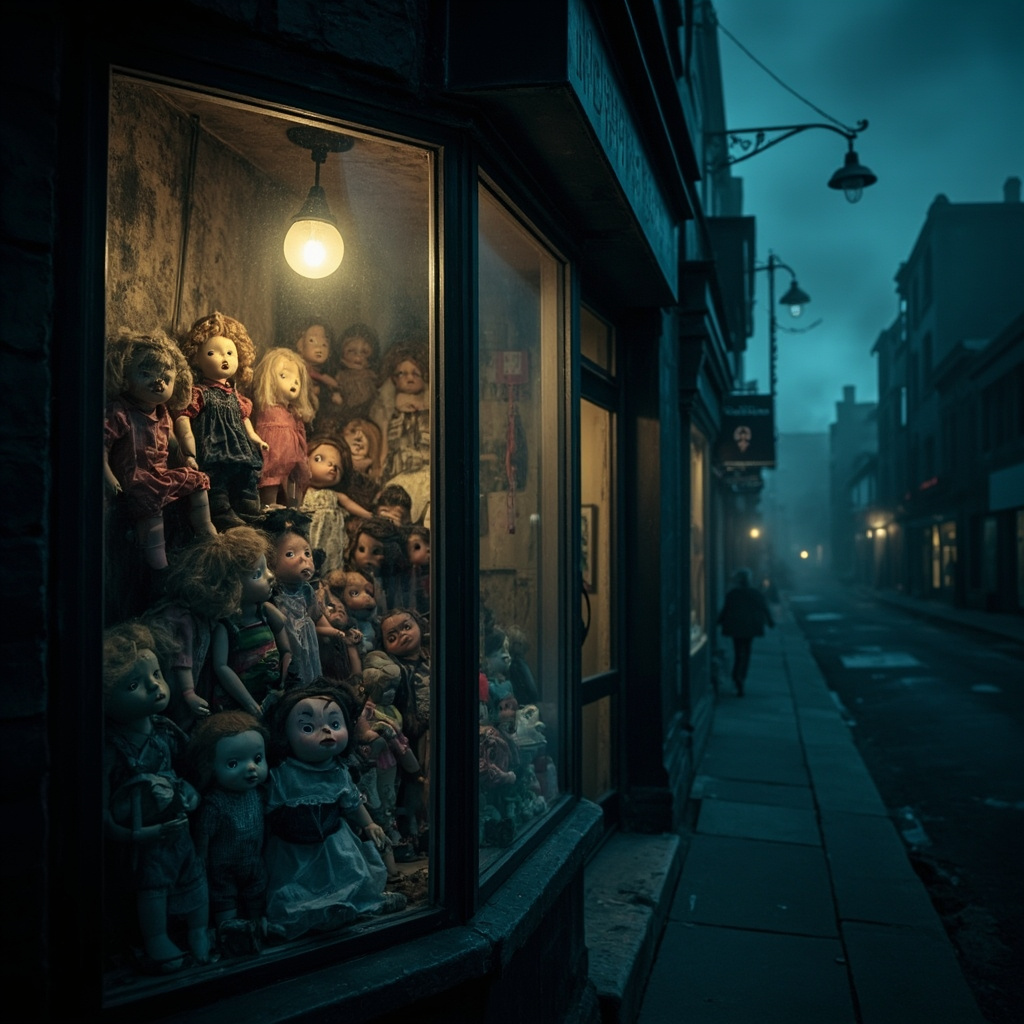
The Midnight Visitor
The doll shop had been on the same street for as long as anyone in the neighborhood could remember. It was not a cheerful place—no bright colors, no stuffed animals in the window, no shelves of toys designed to appeal to children. It was a shop for collectors, for people who understood that dolls were not merely children’s toys but artifacts with their own histories, their own personalities, their own ways of looking at the world.
Magda had inherited the shop from her grandmother, who had inherited it from her mother, who had bought it from a man whose name was no longer remembered. The dolls came from estate sales and auctions and strange connections that Magda did not ask about. They came with stories—some documented, some implied, some that she suspected were invented after the fact to increase value. And they came with something else, too, something that the paperwork never mentioned but that every owner eventually learned.
The dolls watched.
Magda had learned this when she was six years old, standing in the shop with her grandmother, looking at a cabinet of antique porcelain dolls with their painted eyes and their frozen smiles. She had felt, even then, that the eyes were not as dead as they should have been—that there was something behind them, something that was paying attention, something that was waiting.
“They remember everything,” her grandmother had said, following her gaze. “Every owner they’ve ever had. Every room they’ve ever been in. Every secret whispered nearby. Dolls are like that. They listen. They watch. And one day, when no one’s expecting it, they tell.”
The woman came on a night in December, during the worst snowstorm of the year. Magda was closing up—she lived above the shop, in an apartment that had been part of the building for as long as the shop itself—when she heard the bell above the door ring. She should have ignored it. The shop was officially closed, and no customer in their right mind would be out in weather like this. But something about the sound of the bell made her go downstairs, made her turn the key in the lock, made her open the door to the howling wind and the woman standing on the other side.
The woman was young—twenties, maybe—and beautiful in the way that magazine models are beautiful, which is to say beautiful in a way that was designed rather than natural. Her coat was too thin for the weather. Her hair was too perfect for someone who had been walking through snow. Her eyes were too clear, too focused, too aware of things that ordinary people do not notice.
“I need a doll,” the woman said. “A specific one. I was told you might have it.”
Magda should have asked which doll, and why, and what was driving a young woman to a doll shop in the middle of a snowstorm. Instead, she found herself leading the woman to the back of the shop, to a cabinet that she had always avoided opening, to a doll she had never shown anyone.
The doll was old—older than anything else in the shop, older than the building, older than the street. It was made of wood and cloth and something else, something that was not quite material in the way that ordinary matter is material. Its face was worn smooth by centuries of handling, its features almost erased, its eyes just indentations in the wood where eyes might once have been.
“This one,” the woman said. Her voice was strange—flat, mechanical, as if she was reading from a script she had memorized long ago. “I’ve been looking for this one for a very long time.”
The woman bought the doll for a price that was too high and disappeared into the snowstorm before Magda could change her mind. She never came back. The doll, however, did—not physically, but in the way that matters. Magda began to find it in places it should not have been: on her bedside table when she was certain she had left it in the shop, on the kitchen table when she had locked every door, in her coat pocket when she had checked and rechecked that it was empty.
More disturbing: other dolls began to change. The porcelain dolls’ eyes seemed to follow her more deliberately. The wooden dolls’ expressions seemed to shift, almost imperceptibly, from neutral to something else. The antique fashion dolls, with their elaborate costumes and their carefully arranged hair, seemed to be whispering when she passed—their lips not moving, but their presence somehow communicating, as if they were all part of a conversation that she was only now beginning to hear.
Magda called her grandmother, who had been dead for fifteen years. The phone rang once, twice, and then her grandmother’s voice came through—but it was not her grandmother’s voice, not really. It was a recording, or an echo, or something else entirely, something that used the memory of her grandmother’s voice the way a puppet uses strings.
“You sold it,” the voice said. “After everything I told you. After everything I warned you about. You sold it to her, and now she’s going to do what she was created to do, and you’re going to be responsible for it.”
“What is it?” Magda asked. “What does it do?”
But the line went dead, and the dolls in the shop fell silent, and Magda understood finally what her grandmother had been trying to tell her all those years ago: some dolls are not made to be owned. Some dolls are made to be released.
The woman returned at midnight, three nights before Christmas. She walked through the walls this time—not opening the door, not making a sound, just appearing in the middle of the shop as if she had been there all along and Magda had only just noticed. The doll was in her arms. It looked different now—fuller, more present, as if it had been waiting for this moment to become fully real.
“Do you know what this is?” the woman asked. She was still beautiful, but her beauty had changed—it was the beauty of something that had been alive for too long, that had seen too much, that had been forced to exist in a form that was never meant to contain it. “It’s not a doll. It was never a doll. It’s a vessel. A container for something that was too dangerous to keep in its original form.”
“What form?” Magda asked.
“The form of a woman who lived four hundred years ago. A woman who discovered something she wasn’t supposed to discover. A woman who made a deal she wasn’t supposed to make.” The woman—or whatever it was wearing the woman’s form—set the doll down on the counter. “She was sealed into this form because there was no other way to contain what she had become. And now she’s free. And because of you, she’s going to do what she was imprisoned for preventing.”
The shop was dark. The dolls were silent. And Magda stood in the presence of something that had been waiting for four centuries to reclaim what had been taken from it.
She never found out what happened next. The next morning, the shop was empty—not destroyed, not burned, just empty, as if it had never existed. The dolls were gone. The woman was gone. The doll—the vessel—was gone.
And in a city three thousand miles away, a child unwrapped a present on Christmas morning and found a wooden doll with worn features and empty eye sockets, and smiled, and said “Mommy, look what Santa brought me.”