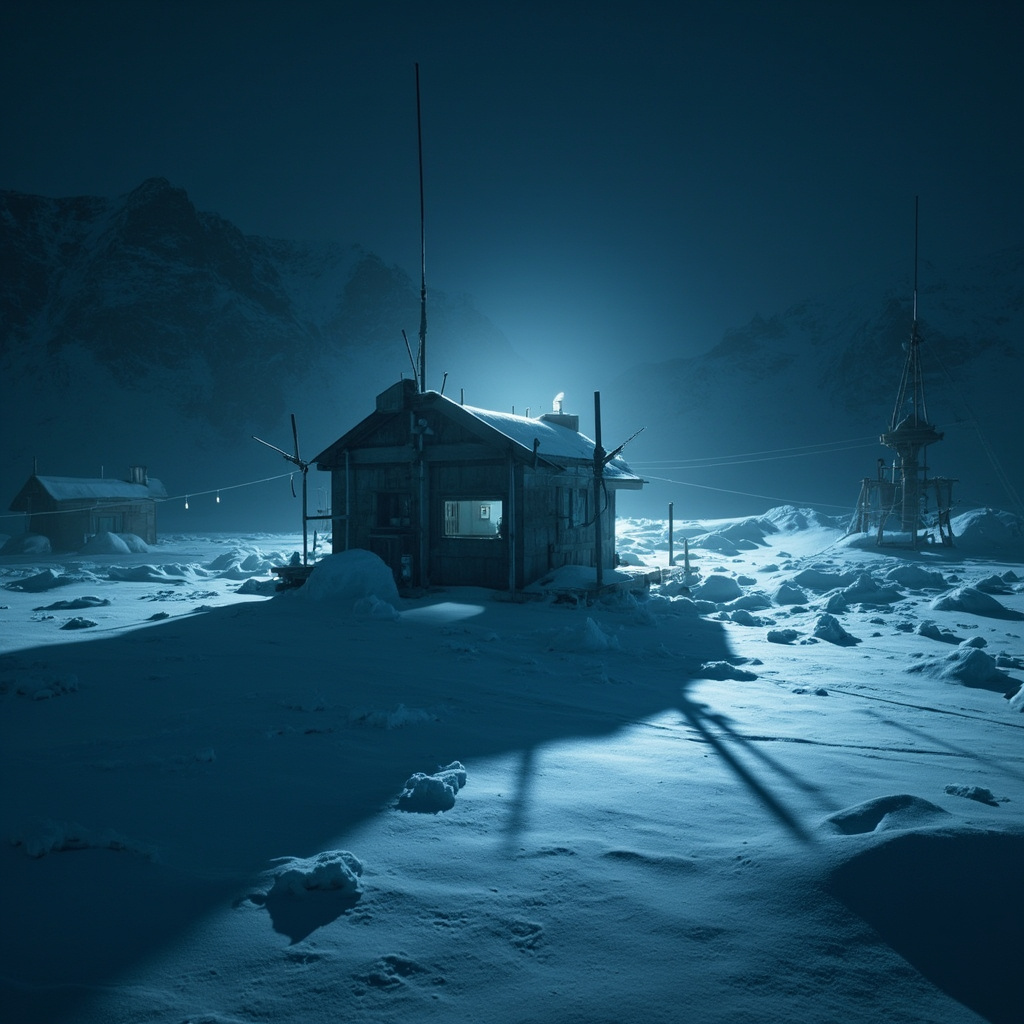
The Longest Night
Hammerfest, Norway: the town at the top of the world, where the sun disappears for weeks during winter and the darkness is absolute. Detective Inspector Sara Novak had been sent there to investigate the disappearance of three researchers from a polar research station two hundred miles north of town. They had vanished in the middle of January, during the heart of the polar night, with no bodies found, no signals sent, no evidence of what had happened except the cold and the dark and the silence that pressed in from every direction.
The fourth researcher, Dr. Elena Voss, had been found alive but barely conscious, huddled in a corner of the station’s basement. She had been there for six days, according to the medical examination. Six days alone in the dark, in temperatures that had dropped to forty below, with no explanation for how she had survived when the others had vanished so completely.
Sara arrived at the research station by helicopter on a Tuesday, in what felt like the middle of the night despite the clock reading noon. The station was a series of modular buildings connected by enclosed walkways, designed to withstand the brutal conditions of an Arctic winter. Everything was covered in ice. Everything was silent. The only sound was the wind, which never stopped, and which seemed to Sara to be speaking in a language she almost understood.
The station logs told a strange story. The three missing researchers had been studying geological samples from a cave system beneath the station—a network of tunnels that had been discovered during construction and had been of scientific interest ever since. They had been looking for fossils, for evidence of ancient life, for anything that might illuminate the geological history of the far north.
What they had found was not a fossil. It was not a mineral. It was an absence—a space in the deepest chamber of the cave system where something had been removed from reality so completely that even light bent around it. The instruments they had used to measure it gave contradictory readings, as if the space itself could not decide how to exist in the world of physical laws that governed everything else.
The absence was still growing. The latest measurements showed it had expanded by three meters in the two weeks since the disappearance. Whatever had created it—or whatever it was—had no intention of stopping.
Sara read the reports three times. She was not a scientist, but she had been a detective for twenty years, and she knew how to recognize a puzzle that was missing pieces. The official explanation—equipment malfunction, group hysteria, mass hallucination—was plausible but incomplete. It did not explain why Dr. Voss had survived, or why she had been found in the basement, or why she kept repeating the same phrase in her sleep: “It’s hungry, it’s always hungry.”
Sara descended into the caves alone. The others who had been absorbed into the absence—and she knew now, with the certainty that comes from looking at evidence too long, that they had been absorbed, not killed—were calling to her. She could feel them, as if they were part of the darkness itself, pressing against the edges of her vision whenever she looked away from where she was walking. They were not ghosts. They were something else—presences that had been removed from one context and placed into another, living in the space between existence and the absence of existence.
The descent took three hours. The caves were old—older than the station, older than the permafrost that covered everything, old enough that the rock itself felt like it was remembering something that predated memory. Sara had been in a lot of dark places in her career. She had seen bodies in basements and burned-out buildings and shallow graves by the side of the road. But she had never felt darkness like this—darkness that did not just block light but actively resisted it, that pushed back against her flashlight with a pressure that made her hands shake.
The absence was in the deepest chamber. It was beautiful. That was what she hadn’t expected. It was the most beautiful thing she had ever seen—a hole in existence that showed what was underneath, the nothing that held everything together. It was like looking at the back of the universe, the place where reality stopped and something else began. She understood, finally, why the researchers had been drawn to it. She understood why they had gone closer instead of backing away.
“Don’t,” the absorbed researchers whispered from the darkness. They were all around her now—not threatening, not frightening, just present, like an audience that had been waiting for her to arrive. “You can’t come back from this. We thought we could study it, understand it, control it. We were wrong. It doesn’t want to hurt us. It just wants us. It’s what happens when something is removed so completely that even the space it left behind forgets it was ever there.”
But Sara had spent her whole life chasing the truth. She wasn’t about to stop now, not when the truth was standing in front of her—or rather, not standing, because the truth did not have form or substance or anything that could be called existence in any way she understood. The truth was an absence, and it was beautiful, and it was waiting for her the way the darkness waits for the dawn, except that in this case the darkness would win.
The polar night lasted another six weeks. When spring finally came to Hammerfest—spring being a generous term for the period when the sun勉强 rose for a few hours each day—the research station was empty. No bodies. No equipment. No evidence that anyone had ever been there at all. The cave system had been sealed by order of the Norwegian government, officially declared geologically unstable. The teams that went down to check reported that the deepest chamber was gone—not collapsed, not empty, just gone, as if it had never existed.
Dr. Voss was transferred to a psychiatric facility in Oslo, where she remained for the next three years. She never spoke about what she had seen. She never needed to. Everyone who looked at her could see that she had been changed—that something had been taken from her, or added to her, or that she had been reorganized at the level of the fundamental structure of who she was. She was not the same person who had descended into those caves. She was something else, something that existed in the space between what she had been and what the absence had made her.
And in the darkness beneath the frozen north, the absence waited. It had been there for a very long time—longer than the station, longer than the town, longer than the human beings who had wandered into its territory and been absorbed into its endless patience. It could wait a little longer. It had nowhere else to be. It was the place where things went when they were removed so completely that even memory couldn’t find them, and it was very, very hungry—but not in the way that living things are hungry. In the way that emptiness is hungry. In the way that silence is hungry. In the way that the space between stars is hungry, always, for the light that might fill it but never does.
Sara’s notebook was found in the station, three months after she disappeared. The last entry read: “It’s beautiful. I understand now why they went closer. I understand now why I can’t go back. The only thing left to do is decide what I’m willing to become, and whether the version of me that comes out the other side will be the same person who went in. I don’t think she will be. I think I’ll be something else. I think I’ll be nothing at all. But nothing is still something, in its own way. Nothing is still here, which is more than I can say for anyone who’s been taken.”