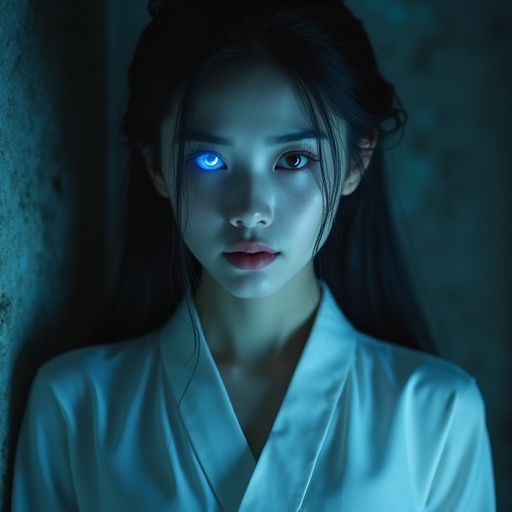
The Blue Left Eye
I was born in the tenth year of the Kangxi Emperor’s reign, in a noble Manchu household of considerable rank.
My father was an admiral of the imperial navy, a stern and honored man whose name opened doors and silenced lesser voices. My mother was beautiful, devout, and quietly afraid of nearly everything the world could not explain.
On the night of my one-month celebration, our residence was overflowing with guests. Officials, military men, noble families, silk, silver, red lanterns, endless toasts—everything glittered with the confidence of a household accustomed to fortune.
Then a beggar entered.
No one knew how he crossed the guards. No one admitted seeing him come through the gates. Yet there he was suddenly in the heart of the feast, filthy, laughing, moving with terrible purpose straight toward the cradle where I lay.
Before anyone could stop him, he reached down and laid his dirty fingers across my eyes.
My mother screamed.
The beggar only threw back his head and laughed—a wild, delighted sound that did not belong to any ordinary man—and vanished into the confusion before the guards could seize him.
By morning, my father had doubled the household watch.
By the following month, everyone had begun pretending the incident was merely an embarrassment.
By the time I was two, no one pretended anymore.
That was when my nurse saw my left eye clearly in daylight and dropped me.
Not because she meant to.
Because my eye was blue.
Not a little pale. Not strangely gray. Blue—clear and cold and unnatural in a child born to two dark-eyed parents.
My father summoned diviners, fortune readers, spirit men, scholars who claimed to understand curses, fate, blood, and Heaven’s peculiar cruelties. One after another they studied me and said the same thing in different language:
I had been marked.
A love curse, they called it.
They said I would be beautiful, desired, and doomed by affection. They said my eyes were like a cat’s—an omen of instinct, misfortune, and spiritual unrest. Most of them could tell my parents nothing useful about how to remove such a thing.
Only one wrote a single character on paper and slid it across the table to my father.
Emperor.
That night, my father had every one of them killed.
Secrecy, in our house, was always treated as a branch of love.
⸻
I grew up privileged, educated, and spoiled.
Being an only daughter in a household that feared Heaven on my behalf had its advantages. I was taught poetry, calligraphy, painting, music, the rules of conversation, the rules of silence, the rules by which a woman might survive elegance without ever possessing freedom.
I learned them all.
I also learned to ignore them whenever it pleased me.
At fifteen, proposals began arriving with embarrassing regularity. Sons of officials. Sons of generals. Men my father outranked and men who thought rank might be negotiable if the bride were lovely enough. My father refused them all.
My mother told me, with a strain she could not conceal, that my marriage would be chosen by the Emperor himself.
One evening, by accident or design, I overheard my parents arguing in low voices about the old diviner’s paper.
If only the Son of Heaven could untie the curse, then perhaps an imperial arrangement—some proximity to the throne, some blessing passing through imperial favor—might break what had been laid on me at one month old.
I went back to my room and studied myself in polished bronze.
I was beautiful.
That much could not be denied. My left eye, pale blue and lucid as water, only deepened the effect. Whatever the old men had feared, I could not see it there.
Only a woman any man would want.
I was eighteen when I entered the imperial court.
Kangxi himself received me kindly. I was not vain enough to mistake his attention for love, but I was young enough to understand my own effect. My father petitioned for me to remain in service as a companion near the women of the inner court. Permission was granted.
I thought perhaps fate had turned in my favor.
Instead, within half a year, an imperial marriage was arranged for me.
Not to the Emperor.
To a Han Chinese general named Shi Wuji.
Brilliant in battle, they said. Loyal to the dynasty. A man of real worth.
I did not care.
To be married off to a soldier—worse, a Han one—felt like insult disguised as honor.
So I entered the marriage with all the grace expected of me and all the disdain I could keep hidden beneath silk and ceremony.
⸻
On our wedding night, he lifted my veil slowly.
Candles glowed red in the room. Gold threads shimmered in the drapery. He looked at me first with wonder, then with surprise when he saw my left eye.
But he said nothing cruel.
Nothing frightened.
Only drew me gently into his arms as though the oddness were part of the bride he had been given and he meant to keep faith with all of her.
I gave him no warmth in return.
At first.
Over time, I began to understand the kind of man I had married.
He was not a brute. Not even close. He knew warfare, yes, but also poetry. Strategy, yes, but also restraint. He was patient where I was proud, calm where I was sharp, endlessly indulgent of my moods and whims without ever seeming weak.
He did not demand affection.
That, more than anything else, undid me.
We played chess by moonlight. Recited poems in the courtyard. Shared quiet I had never known how to value before. And though I could feel myself softening toward him, I also knew—painfully—that what I gave him was gratitude, admiration, perhaps tenderness.
Not yet love.
Not the kind he deserved.
That knowledge sat inside me like a thorn.
And then winter came.
⸻
It was the twelfth month of the year when I insisted we go hunting.
Snow covered the world in merciless white. No sensible person would have gone looking for game in that weather. But I was still spoiled enough to confuse desire with permission, and he still loved me enough to turn foolishness into devotion.
So we rode.
I had little experience on a real horse in open country. That should have mattered. It didn’t.
Then I saw movement in the snow—perhaps a hare, perhaps only my own imagination sharpened by cold—and spurred forward.
My horse bolted.
I panicked.
He came after me at once.
Ahead lay a ravine buried under drifting white.
He caught up. Reached my side. Seized the reins of my mount and dragged it back from the brink.
My horse stopped.
His did not.
He slipped.
One moment he was there in the storm, dark against the snow, and the next he was falling.
His voice rose from the ravine below, one last cry torn out of a dying man with all the force of love inside it:
“Lan!”
The mountains gave it back to me again and again.
Lan.
Lan.
Lan.
I dismounted and fell to my knees at the edge, striking my forehead against the frozen earth until blood stained the snow.
Not because he had died.
Because only then did I understand the full size of what I had failed to give him while he lived.
“I’m coming,” I whispered.
And I jumped.
As I fell, snow and wind swallowed me. Somewhere in that white descent, flower petals seemed to whirl around me out of nowhere, red and soft against the storm.
The sky above was pale blue.
The exact color of my left eye.
So the Emperor’s blessing had not broken the curse after all.
⸻
At the River of Forgetting, the old woman waiting there held out her bowl and told me to drink.
I nearly did.
Then I heard his voice again in memory—Lan!—and grief tore through me with such force that a single tear dropped into the bowl before it reached my lips.
“Drink,” she said. “If you want peace.”
I drank.
But because of that one tear, peace was never complete.
⸻
II. This Life
I was born again in 1979, in Hong Kong.
Different century. Different parents. Different city glittering with money, neon, humidity, and borrowed futures.
And yet I arrived carrying the same mark.
My name in this life was Sylvia Lam.
My family called me Lan.
And once again, my left eye was blue.
People called it unusual. Striking. Mesmerizing. They said it made me look less Chinese and more like some impossible mixed-blood beauty from a dream no one could place.
By eighteen I was five foot nine, all angles and symmetry, and beginning the kind of modeling career that depends on being looked at until your face becomes public property.
That was when I met you.
It was winter, cold by Hong Kong standards, and I was barely established—just another new girl fighting for castings, trying to become visible in a city that manufactured desire professionally.
You were already famous.
A photographer whose lens could make or unmake careers. You wore black the way some men wear nobility—carelessly, as if it had always belonged to you. You sat on the studio floor with your camera and your authority and your beautiful exhaustion, and the first time I saw you, something inside me moved toward recognition before it moved toward attraction.
The set that day was simple: a carved rosewood chair, a modified qipao, stylized hair.
Model after model went in and came out with the same defeated expression.
When my turn came, I was nervous enough to forget where my hands belonged.
Then I sat in the chair.
And a vision struck me.
Red silk. Candlelight. A man in ancient wedding robes seen only from behind.
The flash went off.
You looked at the test shot, then said, “That’s it. We’re done. Use her.”
Everyone cheered.
You barely looked impressed.
Later you said my eyes held confusion, wonder, and something alive behind both of them.
Then you noticed my left eye.
Blue.
I smiled and did not tell you what I had seen.
The magazine came out soon after. I was on the cover. They gave me a ridiculous industry nickname—Blue-Eyed Mary—and overnight I became marketable.
Offers followed.
Work multiplied.
But I saw you only rarely, which made wanting you feel at once more humiliating and more serious.
So I began haunting the nightclub you were said to visit.
And eventually, one night, it worked.
⸻
You were there in the usual cluster of women too beautiful to be sincere.
I watched you from the dark side of the room, drinking too slowly, pretending not to care. When you finally ended up alone between conversations, I started toward you.
That was when another vision hit.
Again the wedding chamber. Again the groom lifting the bride’s veil. This time I felt the room itself compress around me like a fist.
I fainted before I reached you.
When I woke, I was in your studio apartment.
You were there, massaging my temples with surprising gentleness.
“You need to slow down,” you said. “Fame is not worth collapsing for.”
I laughed weakly and lied about overwork.
What else could I say? That every time I came near you, another life cracked open inside me?
When I left, I passed the large blown-up print of the cover image you had taken of me. The chair had been altered in post-production until it looked rust-red, almost blood-dark. My left eye glowed blue. The whole image had a haunted, suspended quality I hadn’t understood while it was being made.
“Your left eye is extraordinary,” you said from behind me.
I should have thanked you for the picture.
Without it, I might never have risen.
Without you, I might never have remembered.
Instead I went home and thought about you until it became difficult to think about anything else.
⸻
When you finally called me yourself, months later, I would have followed you anywhere.
You picked me up in a silver Mitsubishi jeep, all dark clothes and effortless command. We spent the day in your studio experimenting—fashion, costume, fantasy, old cinema moods. You photographed me as a Bond girl, as a secretary, as something dangerous in white.
Then you asked me to dress as a ghost.
White gauze. Loose hair. Bare shoulders. A visual echo of a woman not entirely alive.
“You look best like this,” you said. “Like a spirit.”
I joked that maybe I was one.
You kissed me before I finished the line.
We made love on the studio sofa while light leaked around the blinds and my body learned the difference between longing and surrender. When you entered me, pain split through pleasure and another vision broke open behind my eyes—
the wedding chamber again.
This time the bride looked up.
It was me.
No—her.
No—both.
Lan.
The name echoed somewhere inside me.
I clung to you harder. You took it for passion. In a way, it was. Only not all of it belonged to this life.
Afterward you held me and asked why my blue eye always seemed sad.
I didn’t answer.
How could I tell you that in another century I had already failed a man who loved me as you did not yet love me, and now I feared I was being asked to pay for it?
⸻
What followed was predictable enough to be tragic.
I loved you more than was wise.
You loved me enough to keep me close, not enough to keep me safe.
I became your exclusive model for a time, turning down work because you wanted me lit only by your vision. My career stalled. I didn’t care. I would have lived in the back room of your studio if it meant remaining necessary to your days.
Then came the other woman.
Of course there was another woman.
There always is when men like you begin speaking in thinner voices, touching with absent hands, forgetting dates they would once have performed remembering.
By then I had already traveled to Lhasa with you on a shoot. Already stood before prayer wheels beneath thin high air. Already met an old monk who handed me a spinning wheel and with it, for one violent instant, the rest of my former life.
I saw everything then.
The beggar at my cradle.
The blue eye.
Shi Wuji falling into snow.
My own leap after him.
The tear in the bowl of forgetfulness.
And I understood the curse at last.
I was not meant merely to love and lose.
I was meant to suffer, in each life, the precise pain I had once caused by failing to love in time.
In the old life, he died loved too late.
In this one, I would live long enough to know betrayal before death came.
That was the arithmetic of it.
Once understood, it could not be escaped.
⸻
I died on my birthday.
A typhoon signal hung over Hong Kong. The city roared under violent wind. I dressed in white because you had once said white looked best on me.
You never came.
When I called, it was not you I found but the shape of my absence already forming in your voice.
Later that night, on the balcony, a pane of shattered glass driven by the storm sliced across my neck.
It was absurd. Sudden. Unheroic.
Blood poured down over my dress in bright sheets while the typhoon screamed around me and the city remained indifferent.
As I weakened, visions from the old life returned one final time—the snow, the leap, the flower petals, the ravine.
I remember thinking, with almost embarrassed bitterness, that even now I would not get to hear the words I wanted from the man I loved.
Then the cat’s-eye pendant at my throat shattered.
Its blue stone scattered into powder, rose in a shaft of unnatural moonlight, and re-formed above me for one instant like an eye opening in the sky.
Then everything went dark.
⸻
III. Looking at You
Death did not cure me of you.
That, perhaps, was the worst proof of all.
At the crossing place, a spirit official told me the truth at last. I had once been a flower spirit in Heaven. I had loved a thunder god. We were both punished, thrown into mortal incarnations to learn the cost of desire.
He, apparently, had repented and returned to the celestial order.
I had not.
Even offered another release, I refused.
Because without you—without at least the chance to remain near you—what was the use of any perfected peace?
So I came back.
Not fully.
Not enough to live.
But enough to watch.
You declined after my funeral. Your work lost brightness. Your sleep broke. Your other woman could not comfort you because, on at least one occasion, when you reached for her, you saw me in her place—my blue left eye open and luminous in the dark.
You grew frightened.
Good.
Though even then, I did not want to harm you.
Only to remain.
So I did one final thing.
I took out my left eye—the blue one, the one you loved best—and placed it inside your heart.
That way I would live where you could never wholly remove me.
A mark.
An ache.
A witness.
From then on, I followed you.
Sometimes in mirrors.
Sometimes in the back seat of your jeep.
Sometimes in the pause before you looked over your shoulder and did not dare complete the motion.
I wrote you this not because I expect forgiveness.
Only because I want you to understand that I am behind you still.
And always will be.
Do not turn around.
I am there.