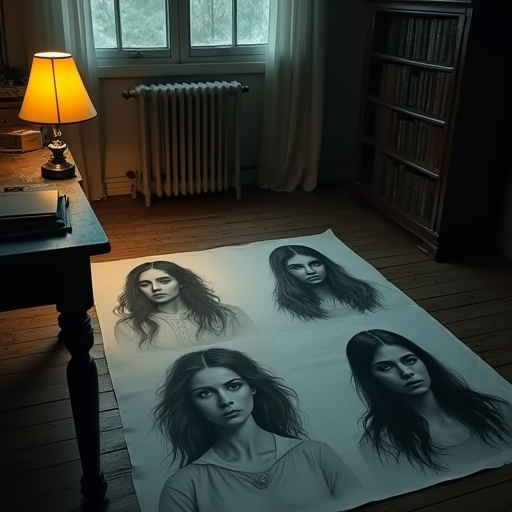
Six Drawings
Mae almost left it unopened on the dormitory table.
Almost.
By then, all three of them—Mae, Tori, and Lydia—had learned to distrust anything that arrived quietly. Too many recent weeks had been full of things surfacing out of sequence: names from old stories, objects no one remembered owning, half-finished explanations that grew more threatening the longer they were denied.
Still, a brown paper parcel tied with string is a difficult thing to ignore in a student dorm.
So Mae slit it open with a nail file.
Inside was a letter, two notebooks, and six drawings.
The notebooks were old but well-kept, their covers rubbed soft with handling. The drawings were charcoal and pencil, done on thick cream paper now yellowing at the edges. Each portrait was exquisitely rendered and deeply wrong in the way only a perfect likeness can be when you know it was never meant for public eyes.
“What is this?” Lydia whispered.
Mae unfolded the letter.
It contained no greeting, only a single line in neat handwriting:
If you want to understand what happened to Xiaoyu, begin with the faces.
No signature.
That alone would have been enough to chill them.
But then they laid out the drawings.
And everything changed.
⸻
The first portrait was unmistakably Xiaoyu.
Short hair. Hollow cheeks. Large dark eyes holding that faint unnatural brightness she carried even when silent. The likeness was so exact that Tori actually recoiled.
“It’s her.”
Mae nodded.
Not merely her features either. Her manner. The slight inward tilt of the shoulders, the tension around the mouth, the sense that she had been caught between revelation and retreat.
The second drawing showed two figures side by side: an infant and an older man.
The baby was plump-cheeked, laughing, sparse hair sticking to the scalp in damp little threads. The old man beside the child had a wide nose, a thin mouth, and a face so emotionally vacant it felt almost aggressive. The contrast between them was the disturbing part. The child rendered in softer values, alive with light. The old man surrounded by a dense shadowing that made his section of the page look bruised.
The third was worse.
A woman in a dark dress, perhaps in her twenties, standing beside a small child whose head had been split open. Blood was suggested rather than detailed, but in some ways that made it more unbearable. The child’s expression was not agony.
It was surprise.
Lydia turned the page over immediately.
Tori didn’t.
Her hands had started shaking.
The fourth portrait showed a woman in late middle age—sunken cheeks, high cheekbones, lips pressed together as if holding back every unkind word she had ever sharpened, and eyes that looked almost too alive for graphite.
The fifth drawing was a pair: a plain-looking man and woman in modest clothes, standing slightly apart though clearly meant to be read together.
The woman smiled.
The man didn’t.
By then the room had fallen completely silent.
No one wanted to touch the sixth page.
Mae did anyway.
She laid it down flat.
It was a group image.
More than a dozen figures, sketched in different tonal depths. But three of them had been rendered more brightly than the rest, pulled forward through contrast as if the artist wanted them noticed first.
Mae.
Tori.
Lydia.
The drawing showed all three of them together.
And none of them had ever posed for it.
⸻
For a long time, no one spoke.
Then Lydia laughed once, too high and too quick.
“Absolutely not.”
Tori looked up. “What does that even mean?”
“It means I’m leaving.”
She stood, then sat back down immediately because her knees no longer agreed with dramatic exits.
Mae picked up the letter again and read it a second time.
Begin with the faces.
Xiaoyu.
That was the anchor.
Everything in the past month had begun, in one way or another, to knot around Xiaoyu—her strange answers, the broken toy car, the room that seemed to carry more history than furniture, the sense that her family stories had not ended so much as gone underground.
And now someone had sent them portraits.
Not random portraits.
A sequence.
A family anatomy in charcoal.
Tori reached for one of the notebooks.
“Maybe the journals explain it.”
She opened the first.
The handwriting inside was elegant, practiced, and old-fashioned in a way that made all three girls look at one another at once. The writer was educated, precise, emotionally restrained in syntax and violent in content. The first pages were dates and household observations. Later entries turned intimate, bitter, and increasingly obsessed with lineage.
One name appeared again and again.
Pearl.
Another name shadowed it.
Aya.
Twins.
Mae felt her pulse rise.
The broken toy car story.
So Xiaoyu had not been wandering through inherited fragments at random. These notebooks belonged to the same history—the family with twins, a dead child, a rearranged marriage, generations of disguised grievance.
The second notebook was written in a different hand.
Less elegant.
Sharper.
Sometimes the strokes cut so hard into the paper they nearly tore it.
This writer did not describe events as though recording family history. She wrote as though trying to pin identities down before they shifted again.
If one daughter becomes another long enough, the house accepts the substitution.
The old man only loved the son. After the boy died, the daughters became interchangeable punishments.
The pictures are safer than names. Names move. Faces stay.
Lydia looked up slowly.
“Safer for who?”
No one answered.
⸻
They read until dusk.
As light faded, the room seemed to gather itself closer around the six drawings. Outside, ordinary campus life went on—doors slamming, voices in the hall, someone laughing too hard over a speakerphone. Inside, the girls sat on the floor surrounded by dead paper and older grief.
A pattern began to emerge.
The infant and old man from the second portrait likely belonged to the original household from the story Xiaoyu had told them.
The bloodied child in the third might have been the dead son, or another family casualty buried under generations of “accidents.”
The stern woman in the fourth journal appeared repeatedly as the enforcer of silence. A matriarch. An aunt. Someone who held together the lie once it became more important than truth.
The couple in the fifth drawing were mentioned only obliquely, but always with the tense, cautious phrasing people use when talking about a marriage that was never meant to happen between the people who actually lived it.
And then there was the sixth drawing.
Their drawing.
No explanation appeared beside it.
No date.
No names.
Only a loose page tucked into the second notebook, written in the harsher hand:
Those who inherit the story must eventually choose whether to remain audience or become evidence.
Tori swore under her breath.
Lydia closed the notebook. “That’s the kind of sentence cult leaders and dead relatives love.”
Mae was still staring at the group portrait.
There was something wrong with it beyond the obvious fact that it existed.
The three of them stood in the foreground as though posed together in a photograph.
Behind them were the ghostly half-faded figures of the previous five portraits, arranged not randomly but with the logic of ancestry—or accusation.
And behind all of them, barely suggested in shadow, was a seventh figure.
A woman seated.
Elegant. Upright.
Watching.
Mae’s mouth went dry.
“Do you see that?”
The others leaned in.
No one said yes.
No one had to.
Because once noticed, the seated woman’s presence became impossible to deny.
And stranger still: the longer they looked, the more her face seemed to shift toward resemblance with each of the women in the earlier portraits, as if she were not one person but the final shape taken by all of them layered together.
Lydia pushed the drawing away first.
“No. Absolutely not. We are not doing whatever comes after noticing that.”
⸻
That night none of them slept in the room alone.
They dragged mattresses together, left the overhead light on, and placed the six drawings face down under the desk as if orientation might matter.
At some point after two in the morning, Mae woke with the clear sensation that someone had entered.
Not loudly.
Just enough to alter the air.
The room looked unchanged.
Tori was asleep on the floor. Lydia was turned toward the wall. The desk chair sat where it had always sat. Nothing moved.
Then Mae heard paper sliding.
She sat up.
The six drawings were no longer under the desk.
They were laid out on the floor in a neat row, face up, illuminated by the weak yellow desk lamp they were certain they had switched off before sleeping.
Mae did not scream.
Fear had gone beyond scream by then.
She woke the others by touching them, one at a time, too afraid of sound.
All three stared.
The portraits had changed.
Not dramatically. Not enough to satisfy anyone who wanted clear supernatural proof. But enough.
The shadows were deeper.
The eyes more focused.
And on the final group portrait, there were no longer only three bright foreground figures.
There were four.
The new one stood just behind Mae’s left shoulder.
Xiaoyu.
Except not the Xiaoyu they knew.
This one was smiling.
Tori made a strangled sound.
Lydia whispered, “Burn them.”
Mae almost agreed.
Then she saw what had been added in tiny charcoal letters near the lower edge of the paper, in handwriting none of them recognized and all of them somehow understood:
Now you are in it.
⸻
They did not burn the drawings.
That, later, seemed like the moment the rest became inevitable.
Instead they packed everything back into the paper parcel and took it the next morning to Xiaoyu’s old address.
No one answered the door.
The house looked inhabited in the technical sense only: curtains drawn, a bicycle rusting by the wall, mail wedged in the gate, no immediate evidence of abandonment and no sign of life either.
Mae slid the package through the mail slot and stepped back.
For a second nothing happened.
Then, from somewhere inside the house, they heard a chair scrape slowly across the floor.
Only once.
The girls ran before anyone had to suggest it.
⸻
Weeks later, a thin envelope arrived for Mae at the dorm.
Inside was a single page torn from the second journal.
One sentence had been underlined twice.
A family story ends only when the final witness refuses to retell it.
Nothing else.
No new drawings.
No explanation.
No sign of Xiaoyu.
Mae kept the page anyway.
Not because she wanted it.
Because throwing it away felt too much like being noticed.
And every now and then, when she passes a campus bulletin board covered in student charcoal sketches, she catches herself looking at the eyes first.
Only the eyes.
To make sure none of them already know her.