No One Is Clean
We were on the dormitory rooftop, where she liked to smoke, lean over the railing, and look down at the campus as if she were measuring how much of it deserved to burn.
“There’s no one in this world who’s clean,” she said.
At the time, I was twenty.
Young enough to find the sentence dramatic.
Stupid enough to think I understood it.
Her voice was beautiful—still the most beautiful female voice I had heard in my life, even now. Not sweet. Not girlish. It had a slight drag at the end of each sentence, as though every word had been weighed before release and found not especially worth the effort.
That afternoon was the first time I met her.
I had been asleep on the rooftop in faded jeans and an orange T-shirt, one foot hooked lazily over the low cement edge, skipping anatomy lab because the thought of formalin and cold cadavers made me physically ill. I woke to noise and found her standing there, looking at me as though she had discovered some oddly shaped animal sunning itself in the wrong habitat.
“Which year are you?” she asked.
“Second.”
“What department?”
“Anesthesia.”
She nodded slowly. “Then you probably know who I am.”
I did.
Everyone did.
Zhang Qian.
Fourth-year clinical medicine.
The most talked-about woman in the medical school for at least three consecutive academic years.
According to rumor, she had slept with half the male students, several visiting lecturers, at least one department head, and possibly any administrative official with enough rank to make scandal inconvenient. The stories were endless. Elaborate. Detailed in the way lies become when lonely men repeat them often enough to one another. Her name showed up in dormitory conversations the way weather does: constantly, confidently, and with very little actual evidence.
No one ever admitted to being one of her lovers.
That was always the interesting part.
Only that she was a whore. A climber. A kept woman. A cautionary tale. A fantasy. A disgrace.
And when men described her, they did so with the special hatred reserved for beautiful women who seem too self-possessed to need them.
That afternoon, I made the mistake of staring too long.
She caught me at it.
“What?” she asked.
“Nothing.”
“There usually is.”
She smiled, and the smile had the hard glint of someone who’d learned early that men’s embarrassment can be more useful than their admiration.
Then she said, “Come on. Tell me. Was it the mouth or the chest?”
I went red instantly.
She laughed.
That was how it began.
⸻
After that, we kept meeting on the rooftop.
Never downstairs.
Never in the hallways.
Never in front of other people.
Maybe that was for my sake. Maybe for hers. Maybe because some relationships only survive if denied sunlight.
She would come up between classes or after dusk, carrying a cigarette or a cup of cheap tea, and find me there with some strange forensic book or medical atlas I was reading instead of the textbook I was supposed to know. I didn’t like medicine much. That was one of the first truths I ever told her.
She didn’t seem shocked.
Neither did she like it.
Not really.
That became clear quickly.
For all the gossip surrounding her, Zhang Qian spoke about life in strangely clean binaries: clean and unclean, worthy and rotten, the merely damaged and the actively filthy. She judged people first by their eyes. If she looked down at the quad and saw a pretty girl, she would say, not clean. If I pointed out a handsome guy, she’d say, look at the brows—greedy, not clean. I once asked who she did consider clean.
Without hesitation, she said:
“You.”
Then, just as quickly, she looked away.
“What about you?” I asked.
She didn’t answer.
That became her habit whenever I came too close to the interior truth of her.
On the surface she was all daring. Beneath that, silence.
A woman who could make vulgar jokes about men staring at her chest and then go mute if asked whether she had ever actually been loved.
⸻
There were only a handful of moments in my life when I felt something move between us strongly enough to name.
One of them happened on the rooftop at sunset.
She leaned closer than usual, her hand tracing the line of my eyebrow, then down the side of my face, then hovering for an instant near my mouth. I could smell alcohol on her breath—not enough to make her clumsy, just enough to make honesty feel less armored.
She almost kissed me.
Then she pulled back.
I never knew whether she changed her mind or simply wanted to see if I would follow.
I didn’t.
That too became part of the shape of us.
⸻
By then I already hated Wang Lianpu.
Everyone did.
He ran the anatomy division like a private extortion racket disguised as education. Students paid to pass. Students paid and still failed if he disliked their faces. He humiliated girls openly in class with obscene anatomical questions, then pretended it was rigor. The administration knew. No one touched him.
I made the mistake of touching him first.
In my second month of medical school, I threw an anatomy textbook at his face from five rows back after he cornered a female student into public near-tears with one of his performance humiliations. He bent down, picked up the book, read my name off the inside cover, and said in a voice calm enough to be terrifying:
“I’ll remember you.”
He did.
I failed anatomy in precisely the way I should have expected.
Then failed the retake.
Then nearly lost any chance of graduating at all.
By the time I finally scraped through, it felt less like academic survival than surviving a feud with an insect in a human suit.
Zhang Qian listened to all this with quiet amusement at first, then something closer to sympathy.
When she graduated and announced she was staying on as a teaching assistant, I thought she was joking.
Not only staying.
Working under him.
Under Wang Lianpu.
I asked her why.
She said the school had only one opening and at least this way life would be “quiet.”
Quiet.
That was not the word I would have chosen.
Still, she smiled and touched my cheek and said, “At least he let you pass in the end.”
I told her that I hoped, with all the sincerity available to a bitter young man, that Wang Lianpu would disappear forever the very first day she had to work for him.
She kissed my face lightly.
Then turned away fast enough that the single cold drop landing on my mouth took me a second to recognize as a tear.
⸻
Years passed.
I graduated before she did because anesthesia was a shorter track. We both ended up working in hospitals, though not the same one. She stayed on campus. I drifted into my life as an anesthesiologist with the vague despair of a man who has become professionally competent in a field he never loved.
And still, from time to time, we wrote.
Or rather, she wrote.
Her letters were never romantic in any ordinary sense. They were full of weather, campus trees, odd little fragments of memory from our rooftop conversations, questions she didn’t really ask, answers she didn’t really want. Almost every one ended, in one form or another, by telling me that meeting me had been the only part of university she considered worth remembering.
I rarely wrote back properly.
I called instead.
Always the old dormitory line. Always the same ritual: waiting for someone to shout her name down the hall, imagining her getting up from bed, slipping into sandals, walking to the phone while the world held still around the ringing.
Sometimes I asked why she never got a mobile.
She once answered, very softly:
“Because I like hearing someone call my name. It reminds me I’m still alive.”
I never forgot that sentence.
I should have understood it better than I did.
⸻
The call telling me she was dead came on a workday while I was half-asleep in the anesthesiology office.
Suicide, my former classmate said.
Last week.
Hanging.
I dropped the phone.
For a few moments, my hands stopped being reliable.
That same afternoon, I returned to the old medical school.
The dormitory had barely changed—same cracked walls, same laundry smell, same dead institutional air pretending not to notice what it had housed. The dorm matron remembered me vaguely. She remembered Zhang Qian more vividly.
“She was alone,” the woman said. “Hardly anyone came looking for her these last years.”
I asked to see the room.
No.
Her roommate had gone home. The room was locked. Too unlucky now.
As I turned to leave, I asked the only question that mattered.
“How?”
The matron answered without lowering her voice.
“Hanged herself.”
The campus tilted.
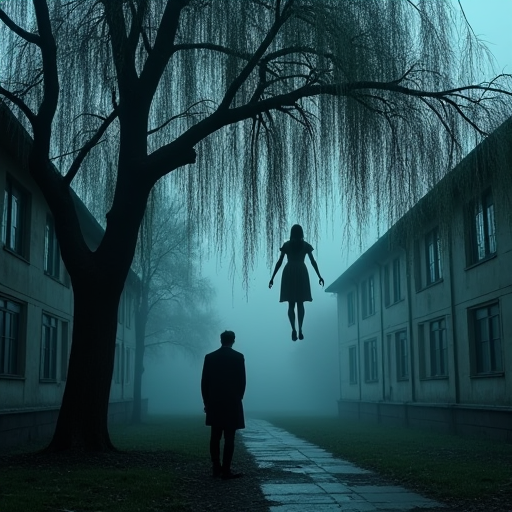
I made it as far as the willow tree outside before vomiting.
Because the image came at once—too clearly, too cruelly.
Not simply death.
Her death exactly the way I had once described it to her on the rooftop, back when we were talking about which kinds of death were “beautiful.”
A body hanging among swaying willow branches.
Hair covering the face.
Hands limp at the sides.
Like a puppet.
She had asked me once what death would suit her.
I had answered as if words had no afterlife.
⸻
After that, everything split into before and after.
I learned she had been found alone. Officially ruled a straightforward suicide. Police saw no reason to doubt it. No parents who knew anything useful. No dramatic note. No clean explanation.
My classmate, more excited than saddened in the vulgar way people become around beauty ruined, let slip one more thing before I hung up on him:
“Funny school, isn’t it? First Wang Lianpu disappears, and now Zhang Qian hangs herself.”
That stopped me.
Wang Lianpu gone?
No one had told me that part.
And suddenly the shape of the world I had been refusing to examine too closely became visible.
Zhang Qian dead.
Wang Lianpu missing.
And between them, years of her working under him in that rotting anatomy department where everyone knew filth thrived best under white coats.
I did not have proof.
I had instinct.
Sometimes that is only another name for memory refusing burial.
⸻
There was one more person in my life then.
Wang Ya.
A nurse. Younger than Zhang Qian, softer-faced, outwardly more ordinary, and for that reason perhaps more dangerous to love. She flirted with me in the casual half-serious way hospital people do when exhaustion blurs boundaries. Eventually the flirting became touching. The touching became habit. The habit became something like an affair, though not one either of us had the decency to name cleanly.
One night, after sex, she told me the truth.
Not all of it at once. That would have been too merciful.
A man named Song Yang had been blackmailing her. She had lured him out to the hill behind the campus. After that, he disappeared. Police had asked questions.
I told her not to worry.
That they would never find him.
She stared at me and asked how I could possibly know that.
I didn’t answer.
Because by then I knew far more than I should have.
I knew fear when it lived under a woman’s skin.
I knew how dirt spread from one life into another.
And I knew Zhang Qian had once told me there was no one clean in this world.
Lying there with Wang Ya’s head on my chest, I finally understood that what she meant was not merely sexual scandal, not gossip, not the casual contamination of rumor.
She meant all of us.
The medical school.
The men.
The women.
The professors who bought silence.
The students who traded bodies for protection.
The ones who looked away.
The ones who survived by pretending they did not see.
Even the ones, like me, who preferred to believe our dirt had remained internal.
⸻
I went back to the rooftop one last time after hearing about her death.
The campus looked the same from above.
That was the insult.
Students moving below like blood cells in a diseased artery. White coats on laundry lines. The anatomy building crouched in the distance like a concrete infection. A willow tree stirring in the evening wind.
I sat there until dark, thinking of her voice.
There’s no one in this world who’s clean.
At twenty, I thought she was being dramatic.
At thirty, I knew she had only been accurate.
I do not know whether she killed herself.
I do not know whether Wang Lianpu disappeared because of her or because of someone worse.
I do not know whether love would have saved her if I had ever offered it without hesitation.
What I know is smaller and more useless.
She was alive when someone still called her name down a dormitory hallway.
She was beautiful in a way that made everyone filthy around her.
And she died hanging, exactly as I once described.
There are some lines you never speak carelessly again after that.