My Online Girlfriend Was Already Dead
Most of them are disappointing.
You learn that professors are busiest when someone else is doing the work. You learn that “research opportunity” often means unpaid labor with a better font. You learn that if your advisor gives you a topic, three journal articles, and a deadline, what he really wants is for you to assemble a paper out of foreign sources, clean up the language, and hand him something that will eventually appear in print under his name.
That was my life for two years.
During the day, I worked on faculty projects for our department’s little campus tech company—cheap labor dressed up as practical experience. At night, I wrote papers I’d never get credit for, translated American theses for men who barely read them, and posted my own ideas online in the faint, increasingly humiliating hope that someone, somewhere, might take me seriously.
I studied physics.
Or rather, I studied the thin, disreputable border between physics and the things respectable physicists preferred not to discuss.
Ghosts, for example.
Not in the spiritual sense. Never that. I was not a mystic, a medium, or a crank with incense and crystals. I was interested in consciousness, signal persistence, residual neural activity, dream-state reception. If people throughout history claimed to see the dead, then either all of them were fools, or the phenomenon had a mechanism.
I wanted the mechanism.
My theory—laughed at, ignored, or politely avoided by everyone who heard it—was simple enough to summarize badly and infuriatingly complex to prove properly:
What people called ghosts were not supernatural beings in the religious sense, but residual patterns of human brain activity—electromagnetic signatures lingering after death, especially in cases of trauma, extreme will, or unfinished emotional states. Under the right conditions, those signatures could interfere with a living brain in a dream or half-dream state and project themselves into perception.
Visions. Voices. Apparitions.
Not miracles.
Just transmission.
I wrote about it obsessively.
No one cared.
On the campus forum, my posts sank beneath waves of gossip, hookups, dorm feuds, petty anonymous confessions, and endless threads about who had been seen leaving whose room at what hour.
Except for one user.
LILY.
She read everything I wrote.
She argued intelligently. Asked the right questions. Pushed me on weak points. Encouraged me when I got theatrical. She was, in the most humiliatingly sincere sense, my only real audience.
I thought about her more than I wanted to admit.
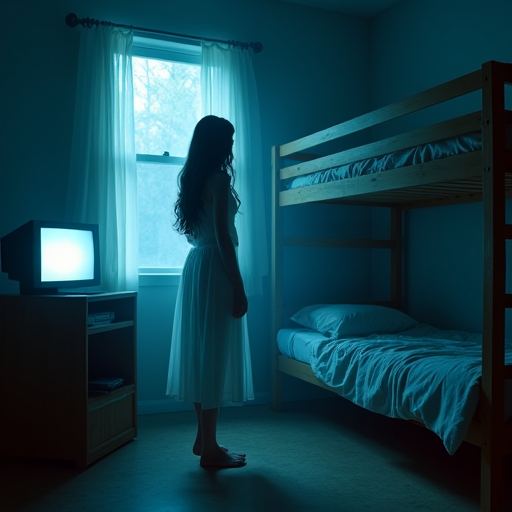
Then one night, I woke up and found her standing beside my bed.
⸻
She was dressed entirely in white.
Barefoot. Dark hair loose over her shoulders. Skin almost luminous in the moonlight. Her face had the kind of beauty that instantly makes intelligence seem optional, except her eyes ruined that impression at once—they were too sorrowful, too alert, too old for simple prettiness.
She smiled when she saw that I was awake.
“You finally opened your eyes.”
For one absurd second, I thought some female student had wandered into the wrong dorm room.
Then I realized two things in quick succession.
First: I was in the top bunk.
Second: she was not standing on anything.
She hovered beside me, feet suspended several inches above the floor.
I began to shake so hard my teeth clicked.
“Are… are you a person?”
She tilted her head with mild curiosity.
“No,” she said. “I’m dead.”
I wish I could say my first response was scientific excitement.
It wasn’t.
It was animal terror.
The woman looked at me with what seemed like genuine concern.
“Why are you frightened?” she asked gently. “You’re the one who said ghosts are only a natural phenomenon.”
Then she began quoting me.
Word for word.
Lines from forum posts I had written months earlier about neural residue, theta-wave resonance, perceptual overlays, electromagnetic retention after traumatic death. She recited them calmly, almost teasingly, and with every sentence my fear became threaded with something worse.
Recognition.
I stared at her.
She smiled.
“Yes,” she said. “I’m Lily.”
Of all the things I had imagined my mysterious online correspondent might be, dead had not made the list.
⸻
Once it became clear she was not there to kill me, curiosity began slowly strangling panic.
That is, I suspect, how most bad decisions are born.
I asked her whether she was really what I thought she was. She offered me her hand and invited me to touch it if I needed proof, which I declined for reasons that should be obvious. Then, because my instincts had always been weaker than my questions, I asked the thing that mattered most.
“How are you still here?”
That delighted her.
“Because of your species’ greatest invention,” she said.
“The internet?”
She nodded.
According to Lily, what I called residual neural activity and she called a spirit would normally fade quickly once separated from the body. But networks changed that. Computers, monitors, processors, live power sources, digital connections—all of it served as a kind of distributed nourishment. When one machine shut down, she could pass along the network to another. The web, she said with a bright, wicked little smile, was full of girls like her.
Ghosts in the circuitry.
The dead living off current and memory.
I should have been more skeptical than I was. Instead I was fascinated.
All at once, the terrifying thing beside my bed was not just evidence. She was validation.
Then she cut me off in the middle of my questions.
“I didn’t come here to help with your research,” she said. “I need a favor.”
That should have warned me too.
It didn’t.
She told me about her death.
Three years earlier, she and her boyfriend had been out together when she was struck by a speeding car while crossing the street. The driver fled. Her boyfriend saw the whole thing. He had never recovered.
“He dreams about me constantly,” she said. “And I go to him when I can. I still love him. I couldn’t let go.”
I interrupted her to ask what “moving on” actually meant in practical terms, and she answered in the same patient, slightly amused tone she had used online when correcting my assumptions.
Reincarnation, she said, was not mystical so much as opportunistic.
A newborn mind was soft, blank, unfinished. A spirit could enter, merge, anchor itself to the forming consciousness, and become someone new. Most memory would fade in the process. A reset, more or less.
I did not enjoy hearing that.
It raised philosophical questions I was not emotionally equipped to survive before breakfast.
But Lily was focused on one thing only.
She didn’t want another life.
She wanted hers back.
Or close enough.
“What I need,” she said, “is a body.”
I stared at her.
“A fresh one,” she clarified. “Young. Healthy. Preferably pretty.”
I laughed because the alternative was to scream.
She did not laugh.
Her plan was grotesquely simple.
If I wrote her name on a slip of paper and fixed it to a girl’s forehead at the precise moment the girl’s consciousness loosened—during deep emotional absorption, in a dreamlike state, in a moment of temporary dissociation—Lily could ride that opening and seize the body.
“You want me to help you possess someone?”
She blinked. “That is such an ugly way to say it.”
“It’s also the correct one.”
She leaned closer.
“Please.”
And because I was twenty-four, lonely, vain about being needed, absurdly flattered that a beautiful dead woman trusted me, and fundamentally more foolish than any theory I had ever published, I didn’t say no.
I negotiated.
I asked where I was supposed to find a girl drifting far enough from herself to be vulnerable.
“The outdoor cinema,” Lily said at once. “Find one alone. Find one lost in the film.”
I asked what name I should write.
She smiled.
“LILY.”
Then, with obvious satisfaction at my delayed realization, she added:
“Did you really think your online friend was alive?”
And vanished.
⸻
The next morning my roommate leaned over the bunk ladder and said, “You seeing someone? You were moaning ‘Lily’ in your sleep all night.”
I told him I had seen a ghost.
He grinned and said, “Sure.”
By afternoon I had borrowed a brush and black ink and copied her name neatly onto a strip of white paper, as if preparing a label for an experiment rather than an assault on another human being’s selfhood.
That weekend I took the slip to the campus outdoor cinema.
The place was built on a flattened slope at the base of a hill, all folding chairs and blankets and half-watched old movies. Most students weren’t there for the film. They were there for darkness and proximity and the excuse of shared distraction.
I crouched above the seating area on a low burial mound at the edge of the field—one of several old graves the university had inconveniently failed to relocate when they built the venue—and watched the crowd.
Couples everywhere.
Girls with boyfriends. Girls leaning on girlfriends. Girls laughing too much to drift into any usable state. The movie was terrible, but not terrible enough.
I whispered to the folded slip inside my jacket, “This is harder than you made it sound.”
It offered no reply.
Eventually, near the middle of a particularly sentimental scene, I spotted a girl sitting alone, her face tilted toward the screen, expression blank in that suspended way people have when thought has momentarily stopped and feeling has taken over.
Close enough.
I ran down the slope.
Licked the back of the paper like an idiot.
And slapped it squarely onto her forehead before she could react.
Then I turned and ran.
“Pervert!” she screamed.
Not entranced.
Not dissociated.
Furious.
The entire audience lurched into confusion. Someone grabbed at me, someone else shouted, people stood, chairs toppled, at least one argument instantly escalated into a physical fight, and I escaped only because a football player blocked my path long enough for me to point behind him and yell, with total conviction:
“Ghost!”
He turned.
I kept running.
⸻
For a while, nothing happened.
Which somehow felt worse.
Then, some nights later, I woke again to a woman in white standing beside my bed.
Naturally, I assumed it was Lily returning either triumphant or homicidal.
This new woman was beautiful too, though in a different way—quieter, softer, sadder. She regarded me with the exhausted expression of someone about to explain something to a child who has broken a machine he never understood.
I sat up and, trying for dignity, said, “All right. What do you need? A body too?”
She gave a tiny, humorless smile.
“Not exactly.”
Then she told me what had happened at the cinema.
She had been the girl I marked.
Or rather, she had been near the girl I meant to mark.
Dead already. Restless already. Watching.
When I slapped Lily’s name onto the wrong forehead, I had not opened a door for Lily.
I had signaled to something else.
And Lily, it seemed, had not been the only lonely woman haunting the network and waiting for an opportunity.
The white-clad stranger explained all this with the calm of someone discussing a scheduling error.
I sat frozen beneath my blanket and slowly understood two things.
First: I had failed.
Second: failure in this case did not mean nothing happened. It meant I no longer knew what had happened instead.
“Where is Lily now?” I asked.
The woman’s expression shifted.
“Still waiting,” she said. “And now very angry.”
That was the moment I fully understood that, whatever curiosity had brought me here, I was no longer doing physics.
I was in folklore.
And folklore, unlike physics, holds grudges.
The white-clad woman looked toward the window, where moonlight had turned the bars silver.
“You should be careful,” she said.
“Because of Lily?”
She nodded.
“And because,” she added, “now they know you’ll help.”
Then she disappeared too.
⸻
I never posted my theory online again.
Not because I stopped believing it.
Because belief was no longer the problem.
For the first time in my life, I had evidence.
Too much of it.
The forum account called LILY never logged in again. A few weeks later, a new user began replying to my old threads with unnerving precision, correcting details in my model of post-mortem signal persistence, always ending with the same line:
You still owe me a body.
I deleted the account.
Changed dorms.
Stopped going to the outdoor cinema.
Stopped sleeping well.
Every now and then, when a monitor flickers unexpectedly or a dead pixel brightens in the shape of an eye, I still think of Lily moving through the network from machine to machine, waiting with all the patience available to the dead.
And sometimes, very late, with the room dark except for the blue pulse of my screen, I wonder whether the worst part of that night was almost helping a ghost steal a life—
or realizing how close I came to doing it willingly.