The Faithful One
Up until then, life had been mildly difficult in all the usual campus ways.
Too much coursework. Too little money. A relationship that mattered enough to be frightening. His girlfriend, Emily, had recently been injured in what everyone insisted was an accident—nothing major, just a bad fall that left her with a sprained wrist and a cut above the temple. But Daniel had not liked the feel of it from the beginning. Too many small details refused to line up. Too much silence where there should have been annoyance, gossip, explanation.
And then there was Hannah.
Hannah was Emily’s dorm friend: pale, soft-spoken, intelligent, and somehow always in the room a second before anyone noticed she had entered. Daniel had met her several times before without ever warming to her. She smiled politely, spoke gently, and gave him the persistent, unsettling impression that she was watching him for reasons she had not explained.
The night it happened, Emily had already fallen asleep in the hospital wing, exhausted from painkillers and a day of questions. Daniel had gone back to the women’s dormitory only because Hannah had insisted there was “something he needed to know.”
That should have sent him running.
Instead he went.
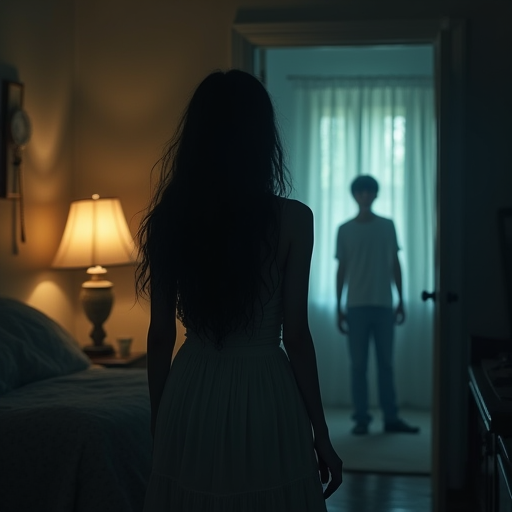
The room was dark except for a desk lamp in the far corner. Hannah sat on the lower bunk with her hands folded in her lap, looking less like a college girl than a portrait of one.
Daniel stayed near the door.
“What is this about?”
Hannah tilted her head slightly. “You wanted to know what happened to Emily.”
“Yes.”
“And why she was hurt.”
“Yes.”
She smiled—not warmly, not cruelly, but with the strained patience of someone humoring a child.
“Then sit down. The truth is easier to hear if you aren’t about to fall over.”
Daniel did not sit.
That turned out to be wise, because a moment later Hannah lifted her face fully into the light, and he saw it.
Not makeup.
Not exhaustion.
Not bad lighting.
Wrongness.
Her skin had the faint translucent stillness of something preserved too carefully. Her smile came a half-second late, as if it had to travel from somewhere deeper than the face. And when she blinked, her eyes seemed to hold the room’s shadows a little too long.
Daniel’s knees nearly failed him anyway.
“Hannah,” he said hoarsely, “what are you?”
She laughed softly.
“That depends,” she said. “Do you want the answer people can survive, or the answer that’s true?”
He swallowed and gripped the back of the desk chair hard enough to hurt.
“You’re dead.”
“Much better,” she said. “Some people take longer.”
He stared at her.
For several seconds all he could hear was the thin electric hum of the lamp and the distant plumbing groaning somewhere inside the building.
“You’re going to kill me,” he said at last.
“No,” she said. “If I wanted to, you’d already be bleeding.”
Oddly, that calmed him just enough to keep listening.
She rose from the bed, and though she crossed the floor in a way that looked normal, he could not shake the sense that she was not so much walking as deciding where to appear next.
“The ones I killed,” she said, “deserved it.”
Daniel’s mouth went dry. “The others? The missing students?”
Her smile sharpened.
“They weren’t students when I finished with them. They were simply men.”
He should have left.
Instead he heard himself ask the question anyway.
“Why spare me?”
At that, something in Hannah’s expression changed. Not softness exactly. Recognition, perhaps.
“Because Emily nearly died and you stayed.” She moved to the far bed and sat on its edge, leaving more space between them. “Because when I hurt her, I was testing you.”
Daniel blinked. “You what?”
“She’ll recover. I never meant to take her. I only needed to see whether you were what you looked like.”
Rage flared briefly through his fear.
“You hurt her to test me?”
“Yes.”
He took a step forward, fists clenched.
Then she smiled again, and the temperature in the room seemed to drop all at once.
He stopped.
“You’re angry,” she said. “Good. That means you’re real.”
Daniel forced himself to breathe.
“What do you want from me?”
“Nothing,” she said. “Only witness.”
⸻
She told him her real name was Joanna Quinn.
Not Hannah.
Not the girl Emily had introduced him to.
That had only been a shape convenient enough to wear.
Years earlier, Joanna had been a student on the same campus. Brilliant, sheltered, and disastrously certain that love, if earned honestly enough, could override every cruelty of class, ambition, and cowardice.
She met a physics student named Leo Vale.
He came from a farming village. He had arrived at the university on scholarship after publishing a paper so advanced it made older professors talk about him with envy and caution. He was poor, serious, and astonishingly gifted.
“He sat beside me in lecture,” Joanna said. “That’s how it started.”
Daniel said nothing.
Hannah—Joanna—looked not at him but at the blank wall beyond him, and when she went on, her voice was no longer the voice of the girl in the room. It had become something older. More intimate with regret.
“He was kind to me. That was all it took. Do you know how little kindness it takes when a girl has spent her whole life being admired but not understood? One person who listens as if your thoughts are not ornamental, and you begin planning your soul around him.”
They fell in love.
Or what Joanna still called love, though death had clearly revised the term.
For a while, it was everything young people promise each other in hidden corners: forever, escape, greatness shared, poverty endured together if necessary. The kind of love that survives best in borrowed time and borrowed rooms.
Then Leo changed.
Or perhaps he merely revealed the larger self that ambition had been quietly feeding all along.
He became impatient with her emotional demands, embarrassed by her intensity, irritated by what he called her “drama.” He discovered other women easier to impress, easier to use, easier to leave. He did not break with her cleanly. Men like that rarely do. Instead he let the relationship rot while continuing to enjoy the portions of it still convenient to him.
“I was not his only one,” Joanna said calmly. “That was the first humiliation. The second was that he thought I would accept it because I loved him enough.”
Daniel looked at her and, despite everything, felt the first true pulse of pity.
“What happened?”
She smiled, but there was no warmth in it.
“I died.”
The words landed with a horrible simplicity.
The official version, she told him, was suicide. The unofficial one was also suicide, but with a far richer architecture of betrayal holding it up. She had thrown herself from the old science building after discovering that Leo had already promised himself elsewhere while still using her devotion as shelter and vanity.
Afterward, campus moved on.
People always do.
There were tears. Then rumors. Then moral commentary. Then classes resumed.
Leo graduated.
He prospered.
He loved again, if what he did could still be called love.
Joanna stayed.
At first because rage anchored her.
Later because rage became habit.
Then something stranger happened: she began to recognize a certain type of man on sight. The mock-devoted. The faithless. The ones who wore tenderness like a temporary costume and grew offended when women believed it.
Those were the first to die.
“Not all at once,” she said. “I’m not crude.”
Daniel didn’t ask for details.
He did not want them.
“They all had one thing in common,” she continued. “They took love from people who meant it and treated it as tribute. I dislike tribute.”
“And Emily?”
Joanna looked at him directly.
“She chose well.”
Daniel stood in silence, still gripping the chair.
This, he realized dimly, was the real purpose of the night. Not confession. Assessment completed. Judgment delivered.
He had passed.
That was not comforting.
⸻
“What happens now?” he asked.
Joanna let out the faintest breath of laughter.
“Now? You leave this room and go back to the girl who still has a body.”
“That’s it?”
“For you, yes.”
“And for you?”
Something in her face shifted then, as if he had finally asked the only question worth asking.
“Not long ago,” she said, “I thought I was still waiting for Leo. Waiting to watch him rot properly. Waiting to see him become contemptible enough that my death would feel less wasteful.”
She crossed the room to the window.
Beyond it, the campus lawn lay dark and windless beneath a thin moon.
“Then tonight,” she said, “I saw him.”
Daniel frowned. “He’s here?”
“He came back for a conference.”
That explained nothing and everything.
“He walked past the dorm about an hour ago. Middle-aged. Thickened at the waist. The face soft with self-indulgence. Eyes always moving, even when he smiled. A man grown perfectly into the shape of his own cowardice.”
Her tone carried no romance now.
No yearning.
Only recognition.
“I looked at him,” she said quietly, “and understood all at once that I had given up eternity for someone small.”
Daniel did not move.
She turned back toward him, and for the first time since the conversation began, she seemed almost light.
“Do you know what that does to a ghost? Clarity?”
He shook his head.
“It makes departure possible.”
He stared.
“You’re leaving?”
“Soon.”
There was a pause.
Then, unexpectedly, she smiled in genuine amusement.
“You really are faithful, aren’t you?”
Daniel thought of Emily asleep under hospital blankets. Of the stupid panic he had felt when she’d fallen. Of how automatic it had been to stay.
“Yes,” he said.
“Good,” Joanna replied. “Try not to become memorable to anything like me again.”
Then she moved past him, toward the door.
He turned sharply.
“Wait.”
She paused without looking back.
“What am I supposed to tell Emily?”
“That you met a jealous roommate with poor boundaries.”
He almost laughed despite himself.
Then he said, more quietly, “Did you ever love him less?”
Joanna stood very still.
“No,” she said. “I only learned to hate him more accurately.”
And then she was gone.
Not vanished in spectacle. Not blown out like a candle.
The door had never opened.
She was simply no longer in the room.
⸻
Emily recovered within two weeks.
Daniel never told her the full story.
He said Hannah had transferred. That the strange things around campus would probably stop now. That some people carry too much hurt and eventually start spilling it into other people’s lives.
All of that was true, in its way.
A month later, at the edge of campus near the old science building, Daniel saw an elderly groundskeeper standing beside a pile of swept leaves.
The man leaned on a long-handled broom and smiled at him with the serene patience of someone who had watched generations misunderstand the same lessons.
Daniel had never seen him before.
Yet something about him felt familiar enough to stop the breath in his chest.
The old man nodded once.
As Daniel watched, the broomshaft shifted in the angle of the dying light and, just for a heartbeat, became the long clean silhouette of a scythe.
Then it was only a broom again.
Daniel said nothing.
Neither did the old man.
By the time Daniel looked back after one terrified blink, the path was empty.
Only wind moving through the leaves.
⸻
Years later, Daniel would still remember Joanna Quinn not as she first appeared, frightening and elegant in the dormitory lamplight, but standing by the window with a strange peace settling over her at last.
Some ghosts linger because they want revenge.
Some because they are afraid.
And some because they cannot admit that the person they died for was never worth the inconvenience.