What the Mirror Knew
That was the most reasonable explanation.
She was seventeen, in her final year of high school, trapped in the kind of middle-class household where stress didn’t arrive as drama so much as weather. Her father had recently been passed over for a promotion at work, her mother had started measuring every conversation by its cost, and the apartment itself seemed to absorb disappointment through the walls and hold it there.
Nothing in the home was openly broken.
Which was almost worse.
The curtains still hung straight. The dishes were still washed. Dinner still appeared on time. But every room felt charged with the kind of silence that only exists when people are trying not to hate their own lives in front of one another.
Lily had gone to her room before dinner to change.
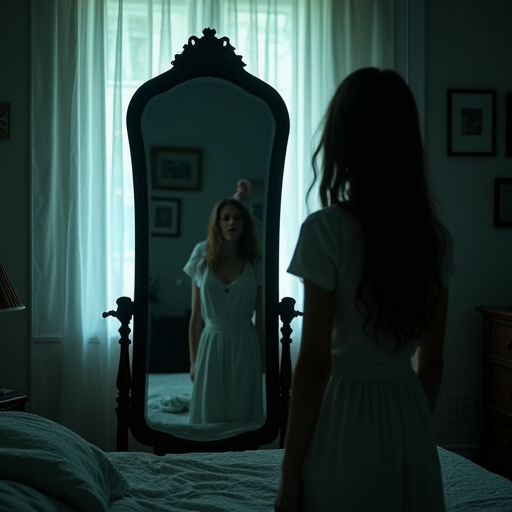
Her bedroom mirror was old—too old for the apartment, really. A tall standing mirror in a carved wooden frame that had belonged to her grandmother before anyone could remember it belonging to anyone else. The glass had that slight waviness antique mirrors sometimes carry, enough to make your reflection seem subtly delayed, as though the person inside it was thinking about whether or not to imitate you.
Lily had never liked it much.
That evening, as she stood in front of it brushing her hair, she noticed movement behind her in the reflection.
Not behind her in the room.
Behind her in the mirror.
At first she thought it was simply the dining room reflected strangely through the half-open door. But the angle was wrong, impossibly wrong. The mirror showed the apartment’s dining table clearly—her father slamming a hand against it, her mother arguing back, plates rattling, tempers flaring.
The image was sharp. Too sharp.
Her father’s mouth was twisted in anger.
Her mother’s shoulders were stiff with contempt.
Lily stared, frozen.
From outside the room came her father’s voice, impatient and loud:
“Lily! Dinner!”
She jerked away from the glass and turned.
Nothing behind her except her room.
No dining table. No parents. No argument.
Only the ordinary bedroom shadows and her own heartbeat.
For a few seconds she stood very still, one hand gripping the hairbrush hard enough to hurt.
Then she laughed under her breath.
Stress, she told herself.
Fatigue. Low blood sugar. Some stupid visual trick.
She went to dinner.
And walked directly into the scene she had just seen.
Her father was already angry. Her mother was already answering in the exact tone Lily had heard in the mirror. Then came the same words, the same gesture, the same crack of palm against table, the same shudder of plates and bowls.
It unfolded so precisely that Lily lost all appetite.
She barely heard the argument.
All she could think was:
I already watched this happen.
⸻
For the next several days she avoided the mirror whenever possible.
This proved difficult.
The thing stood in the corner like a quiet witness.
An object of furniture. A family heirloom. A polished slab of ordinary glass.
But now Lily felt it waiting.
Eventually curiosity got the better of her.
That is usually how these stories move forward—not with courage, but with the slow humiliation of curiosity proving stronger than fear.
One evening she stood before it again.
At first it reflected only what it should: her desk, her bed, her own thin, anxious face.
Then the surface seemed to deepen.
That was the only way she would ever know how to describe it.
Not cloud, not shimmer—deepen.
As though the glass had become a dark pool and something below it had risen just close enough to be seen.
This time the image was not the dining room.
It was the front hallway.
Her father was standing there in his coat, phone in hand, pale with fury. Her mother was behind him, shouting something she could not hear. A framed picture near the door crashed to the ground and splintered.
Then her father turned toward the mirror—toward Lily, or toward the place where Lily would be—and for one strange instant his eyes locked directly on hers.
She stumbled backward with a cry.
The image vanished.
An hour later, her father came home from work, received a phone call in the hallway, and nearly tore the apartment apart after learning that the promotion had gone permanently to someone else.
The photograph shattered exactly where she had seen it break.
That was the second time.
After that, Lily could no longer tell herself it meant nothing.
⸻
She tried small experiments.
Not with other people. Never with other people.
Only with the mirror.
She would sit in front of it after school and wait.
Sometimes nothing happened.
Sometimes the future came only a few minutes ahead—a spilled cup, a dropped book, a phone ringing just before it rang. But sometimes it reached further. Hours, even.
Never days.
Never enough to change anything properly.
That was the most maddening part.
The mirror did not warn so much as rehearse.
It showed her what would happen, but never early enough to prevent it, only early enough to make her live through it twice.
The apartment deteriorated around her.
Her father grew meaner in direct proportion to his professional failure. Her mother grew colder, sharper, more openly contemptuous. Money became a constant invisible participant in every meal. Their arguments lengthened. Doors slammed harder. Silence sharpened into threat.
And always, before the worst of it, the mirror showed her.
A shout.
A broken plate.
A hand raised.
A suitcase by the door.
Her mother crying in the kitchen with the lights off.
Lily stopped sleeping well.
She began to dread not only what might happen, but what the mirror might choose to show her next.
Because the mirror had started choosing.
⸻
The turning point came on a Thursday.
Rain all afternoon. Wind against the windows. Her father came home smelling of tobacco and humiliation. Her mother had clearly been drinking.
Lily had gone to her room immediately after dinner, intending to stay there until both of them either calmed down or exhausted themselves.
She did not mean to look in the mirror.
She looked anyway.
And this time it showed something different.
Not the dining room.
Not the hallway.
Her own bedroom.
In the reflection, she was standing beside the mirror in her school uniform, still as a photograph.
Behind her was her father.
His face looked wrong—drained, fixed, almost peaceful in its anger. In his right hand was one of her mother’s kitchen knives.
Lily could not breathe.
In the mirror, her reflected self turned slowly, as if hearing him too late.
He stepped closer.
The knife flashed once in the yellow room light.
The image went black.
Lily screamed and staggered backward so violently that she knocked over her chair.
At once she heard pounding footsteps in the hall.
Her father’s voice:
“What now?”
The bedroom door flew open.
He stood there, annoyed, flushed, breathing too hard.
Alive. Empty-handed.
For one terrible second she thought maybe this was how it happened.
Maybe this was the beginning of the scene.
But he only stared at her.
“What is wrong with you?”
Lily couldn’t answer.
He muttered something bitter about dramatics and slammed the door behind him.
She sat on the floor for nearly an hour, shaking so hard her teeth hurt.
After that she began watching her father the way prey watches a narrowing field of escape.
Had he ever looked at her that way before? Had he always? Had stress finally opened something ugly and dormant inside him, or had the mirror simply made visible what had been growing for years?
The worst part was that she could not tell anyone.
What would she say?
My mirror has started showing me my murder.
⸻
She tried covering it with a sheet.
The next morning the sheet was on the floor.
She blamed poor draping.
She nailed the sheet in place.
That night she woke to the sound of fabric tearing. The sheet had fallen again.
She moved the mirror to face the wall.
When she came home from school, it had been turned back.
Her mother insisted she hadn’t touched it.
Her father laughed when Lily demanded to know whether he had.
“Why would I care what direction your stupid mirror faces?”
That night the mirror showed her something else.
Her mother.
Alone in the kitchen after midnight, one hand over her mouth, the other gripping the edge of the sink as if she were trying not to collapse. Then she reached into a drawer, took out a packet of sleeping pills, and poured a small white hill into her palm.
The image vanished before Lily could move.
She ran to the kitchen.
Too late.
Her mother was there, exactly as seen, pills in hand, eyes red from crying.
Lily shouted.
The pills scattered.
Her mother slapped her hard enough to split her lip, then burst into tears and sank to the floor.
That was the first time Lily interfered successfully.
Or thought she did.
Because later that same night, after her mother had gone to bed sedated and ashamed, Lily passed the mirror again and saw the kitchen floor covered in broken glass.
Not one glass.
Dozens.
And blood.
⸻
The next day was Friday.
All day at school she felt as though she had left a lit fuse burning in the apartment.
When she got home, the place was silent.
Too silent.
The front door was unlocked.
She went in slowly.
Her father was in the kitchen, drinking.
Her mother was not there.
The kitchen floor was clean.
No broken glass.
No blood.
For a single hopeful second, Lily thought maybe the mirror had finally lied.
Then her father turned toward her with a strange little smile.
“She left,” he said.
Lily stared.
“Packed a bag. Took off. Guess she finally got tired of this dump.”
He said it lightly, but his eyes were shining in a way that made her stomach twist.
Lily backed toward the hallway.
Then she saw the bedroom door.
Her parents’ bedroom door stood half open.
Inside, reflected in the full-length mirror attached to the wardrobe, she saw the broken glass.
Not in the kitchen.
In the bedroom.
A lamp shattered against the wall. Blood on the floorboards. Her mother’s hand visible near the bed.
Lily turned and ran.
Her father caught her halfway down the hallway.
He smelled like whiskey and old resentment.
“She was going to take you,” he said, almost conversationally. “After everything.”
He pulled her back toward the bedroom.
She fought him with the strength panic gives and nothing else.
They crashed into the room together.
And then Lily saw what the mirror had actually been trying to show her.
Her mother was there.
Alive, barely.
On the floor beside the bed, bleeding from the scalp, struggling to rise.
The broken lamp lay nearby.
The mirror on the wardrobe reflected all three of them in a jagged fractured image—father, daughter, mother—cut into separate pieces by cracks in the glass.
Her father lunged for the knife on the bedside table.
Lily got there first.
Later, when people asked exactly what happened, she would say only that the knife ended up in his chest and that she did not remember deciding.
Her father died on the bedroom floor.
Her mother lived.
And in the cracked wardrobe mirror, while sirens wailed somewhere beyond the building, Lily saw one final image that did not belong to the room:
A younger version of her father, smiling at no one, walking willingly into darkness with his own reflection lagging half a step behind.
Then the glass went dull.
Only glass again.
⸻
Her mother sold the mirror within the month.
Or tried to.
The dealer who came for it refused to take it after one look, saying only that some antiques carry stories and some carry appetites.
Eventually the mirror was hauled away with old furniture and renovation trash when they moved apartments.
Lily never saw it again.
Years later, she sometimes wonders whether the mirror had wanted to save her or simply wanted an audience.
It had shown the truth.
But never gently.
Never helpfully.
Only with enough time to be afraid.
She still avoids mirrors in rooms she does not know.
And whenever a reflection seems even slightly out of sync, she leaves without looking back.
Because once, in the worst house of her life, a mirror taught her something no one ever tells children:
The future does not always come to warn you.
Sometimes it comes only to make sure you understand exactly what is about to be lost.