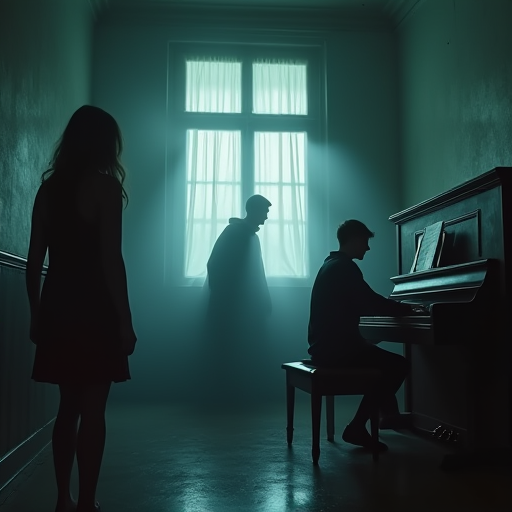
Nocturne for the Dead
That was the only word for it.
Hollow.
During the day it was full of ambition—pianos hammering through scales, violinists butchering études, sopranos bruising the upper register, professors walking the halls with the dead-eyed patience of people who had sacrificed too much to beauty to tolerate mediocrity. But after midnight, when the classrooms emptied and the fluorescent lights began to hum louder than footsteps, the whole building changed.
At that hour, sound no longer felt like performance.
It felt like memory.
Lena preferred it that way.
She was in her second year in the conservatory, and while she had talent, she did not have the kind of talent that arrives fully formed and humiliates everyone in the room. Hers was the slower, more exhausting kind: hard-earned, anxious, never secure. She hated practicing in the afternoon, when better students might hear her make mistakes. So she came late, long after everyone sensible had gone back to the dorms.
The first time she heard him, she stopped playing mid-phrase.
Another piano had answered hers from down the corridor.
Not loudly. Not showily. Just a few bars, soft and fluid, picking up the same melody she had been struggling through and returning it to her transformed—more graceful, more sorrowful, more alive than anything she had managed with her own hands.
She stood from the bench and stepped into the hallway.
At the far end, in one of the rooms by the window, a man was sitting at the piano.
He looked older than the students, perhaps twenty-six or twenty-seven. Slim, pale, with a fine narrow face and the sort of sadness some people seem to wear so long it becomes part of their beauty. He was dressed oddly—an ash-gray cotton shirt, worn blue trousers, clothes that made him look not fashionable, but misplaced, as though he belonged to a different decade and had wandered into the wrong year.
He stopped when he saw her.
“You’re rushing the left hand,” he said.
Lena should have been embarrassed.
Instead she laughed.
“That obvious?”
He stood from the piano bench and came closer, not enough to be improper, only enough to seem interested.
“What year are you?”
“Second,” she said. “Piano performance.”
He nodded once. “I’m Gabriel. Class of ’92. Music department.”
She blinked. “Ninety-two?”
“Long time ago,” he said mildly. “I still come back sometimes.”
“To teach?”
“To listen.”
Something about that answer should have unsettled her.
Instead it charmed her.
He offered to help.
And because lonely girls with difficult art forms are especially vulnerable to talented men who appear at exactly the right hour, she let him.
When he sat down and played the piece she had been mangling, Lena felt the whole room rearrange itself around the sound. He didn’t play like a student. He didn’t even play like a professor. He played like someone speaking privately to the instrument and allowing her to overhear.
By the time he finished, she was openly staring.
He smiled faintly, almost apologetically.
“I’m out of practice.”
She laughed again. “If that’s out of practice, I should probably switch majors.”
That night he corrected her pedaling, showed her how to shape the middle phrase, and left without giving her any way to find him again.
The next night, he was there waiting.
After that, he came every time.
Always after midnight.
Always in the same room or the one beside it.
Always dressed the same way.
Always gone before dawn.
⸻
For a month, Lena told no one.
It wasn’t that she thought she had a secret lover. Nothing like that. At least not at first.
Gabriel was too restrained to invite fantasy easily. He never flirted. Never touched her except once to gently lower her wrist when she was holding too much tension in the phrase. Never asked where she lived, never walked her back, never spoke much about himself.
And yet he seemed to know how to enter the exact silence she carried inside her—the one made of self-doubt, effort, loneliness, and the humiliating suspicion that everyone else around you has been born into the language you are still trying to learn.
With Gabriel, she didn’t feel judged.
Only seen.
That is how most dangerous attachments begin.
Sometimes, while he played, she watched his profile in the dim light and thought he looked less like a living man than a memory the building was trying very hard not to forget.
It was his clothes, perhaps.
Or the way he never seemed to cast the right kind of shadow.
Or perhaps it was just that his sadness had no edge to it, no self-pity. It felt finished. Settled. The sadness of something already lost beyond recovery.
Eventually she asked about it.
“What happened to you?” she said one night when he had gone unusually quiet.
He was sitting at the piano, one finger resting lightly on a key he had not yet pressed.
He looked at her, then away.
“I loved someone badly,” he said.
Lena waited.
“She loved someone else worse.”
He smiled, though it was not a happy expression. “That’s one version.”
He would say no more.
And because she was young enough to mistake damaged men for meaningful mysteries, she found herself thinking about him constantly after that.
About his hands.
About his voice.
About who had broken him.
About whether anyone had ever loved him properly.
The answer, she thought, was probably no.
That made her ache for him.
Which should have warned her too.
⸻
Then he vanished.
Three nights.
Then five.
Then eight.
Lena kept returning to the building after midnight, first out of habit, then out of irritation, then with the full humiliating force of longing. She practiced badly, listened for footsteps that never came, and felt the building’s emptiness closing around her in a way it never had before.
When he reappeared, she nearly cried from relief and was furious with herself for the fact.
“Where were you?”
He did not answer immediately.
Then he said, “Away.”
“That’s not an answer.”
“It’s the only one I can give.”
He looked thinner somehow. Fainter, if such a thing makes sense. She wanted to ask whether he had been ill.
Instead she said, “I thought maybe you were avoiding me.”
For the first time, he laughed.
“Lena,” he said quietly, “if I meant to avoid you, I wouldn’t come here at all.”
That should have felt reassuring.
Instead it sounded like a confession of limitation rather than affection.
That night, after helping her through Chopin until her fingers ached, he stayed at the piano and played something slow and deeply mournful, a melody that seemed almost afraid of reaching its own cadence.
When he finished, he said:
“You should know the truth before this goes any further.”
Her heart stumbled.
She thought, absurdly, that he was about to tell her he was married.
Instead he said, “I’ve been dead for seven years.”
The silence after that sentence felt larger than the room.
Lena stared.
He met her eyes calmly, as if waiting for the blow of disbelief to land where it always did.
She laughed because it was automatic and thin and terrified.
“That’s not funny.”
“I know.”
She stood.
The bench scraped loudly against the floor.
“This is some kind of joke?”
“No.”
“You said you were class of ’92.”
“That part is true.”
“You said you work here.”
“I said I come back.”
Her mouth had gone dry.
He looked at her with that same bruised gentleness he always carried.
“My body is gone,” he said. “But not everything goes when the body does.”
Lena wanted to run.
Instead she asked the only question that rose cleanly out of panic:
“Then why are you still here?”
His answer came almost at once.
“Because she is.”
⸻
She met the woman two nights later.
Lena had left the music building just after one in the morning and was cutting across the lower campus lawn when she saw an old man near the path.
He was bent-backed and weathered, carrying what looked like a caretaker’s broom over one shoulder. There was nothing remarkable about him until she got close enough to see that he was not alone.
A woman in white stood beside him beneath the trees.
She was beautiful in the old, dangerous way that belongs more to memory than flesh—long dark hair, pale face, eyes full of sorrow and some private knowledge Lena had no wish to share. She looked at Lena with immediate understanding.
“So,” the woman said softly, “you’re the girl from the piano rooms.”
Lena’s breath caught. “You know Gabriel?”
The woman smiled in a way that made pity feel like an insult.
“Yes.”
There, under the night trees, she told Lena the rest.
Years ago, she had fallen hopelessly in love with a man not worth the damage. He had lied, promised, taken what he wanted, and left her with humiliation so complete that she chose death over surviving it. Gabriel had loved her then—quietly, faithfully, and to no avail. He had tried to save her and failed. In one version of the story, he died soon after. In another, he had already been dying and simply never found his way back once grief took hold.
“Some people don’t remain because they hate,” the woman said. “Some remain because they loved too long.”
Lena looked from the woman to the old man and back.
“And you?” she asked.
The woman’s expression changed.
“I stayed for the wrong reason,” she said. “I thought dying made my love noble. It didn’t. It only made me foolish for longer.”
Then she glanced toward the road.
A man was walking there in the distance, shoulders hunched against the wind, face puffy with age and bad habits, moving with the furtive dullness of someone who had spent years becoming smaller and meaner than his younger self.
The woman watched him without tenderness.
“I wanted to see him once more before I left,” she said. “Now I have.”
Lena understood then.
This was the man.
The one for whom she had died.
He was not tragic. Not magnificent. Not worth even one ruined year.
The woman looked back at the old caretaker and smiled with actual peace.
“I’m ready.”
The old man nodded.
For one heartbeat, the broom in his hands lengthened and changed shape, its silhouette sharpening in the moonlight until it no longer resembled a broom at all but a long-handled scythe.
Lena shut her eyes.
When she opened them, the old man had not moved. The broom was only a broom.
But the woman’s face had become bright and almost girlish.
“I wasted enough time,” she said. “He shouldn’t.”
“Gabriel?” Lena whispered.
The woman nodded.
Then she gave Lena a look full of strange kindness.
“Live loudly,” she said. “For people like us, that is the only revenge worth envying.”
And she was gone.
Not vanished in spectacle.
Simply no longer there.
The old man smiled at Lena, patient as weather.
Then he too was gone.
⸻
The next night Lena returned to the practice room.
Gabriel was there.
Before he even spoke, she knew he understood.
“She came to you,” he said.
Lena nodded.
“She’s leaving.”
“Yes.”
He lowered his head.
For a long time he said nothing.
Then he played.
Lena would spend the rest of her life trying to describe that music and fail each time. It was not a farewell exactly. More the sound of something being loosened with great care after being caught too long on one sharp thing.
When the last note faded, the whole room seemed to exhale.
Lena was crying.
She didn’t remember when it had started.
Gabriel turned toward her.
“You should go back to your dorm,” he said.
“Will I see you again?”
He almost smiled.
“No.”
It hurt more than it should have.
He stood and looked at her not as teacher or ghost or impossible man, but with the grave tenderness of someone trying not to take too much from the living.
“You’ll get better,” he said. “You only rush when you’re afraid.”
Lena laughed through tears. “That sounds exactly like you.”
“It sounds like someone who listened.”
She wanted to say something enormous and final.
What came out instead was:
“I’m glad I met you.”
That, at least, seemed to matter.
His face softened.
“And I,” he said, “am glad you came at night.”
Then he stepped back from the piano.
The fluorescent light flickered once.
When it steadied, he was gone.
No wind.
No shadow.
No dramatic collapse into dust.
Just absence.
And the still-warm keys beneath her fingertips.
⸻
Lena graduated three years later.
She became, slowly and painfully, the pianist she had once hoped to be. Never famous. Never effortless. But good. Honest. Precise. The kind of player whose feeling had cost her something.
Every now and then, deep into a nocturne, she still hears him at her shoulder.
You’re rushing the left hand.
And when she does, she slows.
Not because she is afraid.
Because somewhere between grief and music and the midnight hush of an empty conservatory, a dead man once taught her how not to abandon a difficult passage just because it hurt to stay inside it.