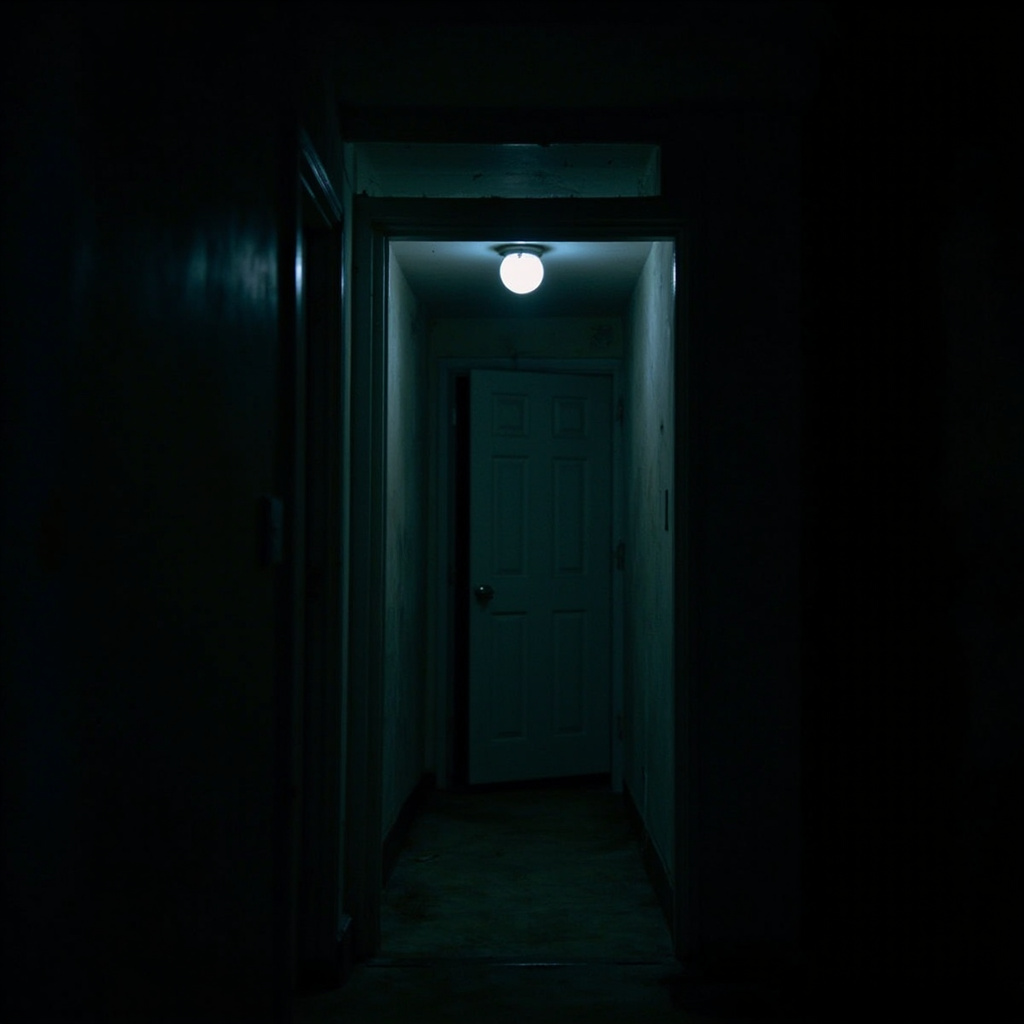
The Sound They Heard at 3AM
Marcus had lived in the apartment building for three years. He knew his neighbors by sight. He knew the woman in 4B who always had grocery bags. He knew the couple in 4C who fought loudly every Saturday night. He knew the elderly man in 4A who never seemed to leave his apartment. Marcus had sometimes wondered about the people who lived around him, in the way that city dwellers do, without ever actually knowing them. Marcus was not nosy. He was curious in the way that everyone who lives in close proximity to strangers is curious: passively, observationally, without ever doing anything about the questions that occurred to him.
The sound started in October. It was three in the morning when Marcus heard it for the first time—a low, rhythmic thumping that seemed to come from the apartment above him. Not footsteps. Not the building’s pipes. Something else, something that had a regularity to it that suggested either a mechanical source or a deliberate action. Marcus lay in bed and listened for ten minutes. Then he went back to sleep, because three in the morning was not a time for investigation, and because he had learned, in his three years of city living, that most strange sounds had mundane explanations.
The sound returned the next night. And the night after that. Same time, same rhythm, same source—the apartment above him, which was 5A, which was the apartment that belonged to the elderly man in 4A, directly below it. Marcus had never heard anything from 5A before October. He had, in fact, assumed that 5A was empty, because he had never seen anyone enter or leave it in the entire time he had lived in the building.
Marcus began paying attention. He started noting the times when the sound occurred and the duration of each occurrence. The sound always started at 3 AM. It always lasted between twenty and thirty-five minutes. It always had the same rhythm—not mechanical, not random, but somehow purposeful, as if the person making it was engaged in an activity that required repetition and timing.
He asked the woman in 4B about 5A. She said she had never met the tenant in 5A. She said that the building manager had mentioned, at some point, that the apartment was occupied by an elderly man who rarely left his unit. She said she had lived in the building for five years and had never had a conversation with the man in 5A.
Marcus asked the couple in 4C. They said they had heard the sound too—the wife had complained about it twice, and the husband had been ready to pound on the door until his wife pointed out that it was three in the morning and that there were probably better ways to handle a noise complaint. They had not, apparently, pursued those better ways.
Marcus went to the building manager. The building manager confirmed that 5A was occupied. The tenant was a man named Howard, who was seventy-eight years old, who had lived in the building for twelve years, and who paid his rent on time and caused no problems. The building manager could not explain the sound. He suggested that Marcus talk to Howard directly.
Marcus knocked on the door of 5A on a Tuesday afternoon. He waited. He knocked again. He was about to leave when the door opened, just a crack, just enough for a pair of eyes to appear in the gap. The eyes were old, watery, surrounded by the kind of wrinkles that come from a lifetime of squinting into distance or light. The eyes looked at Marcus without recognition or curiosity.
“I’m your neighbor,” Marcus said. “From 4A.”
The door opened a little wider. Howard was smaller than Marcus had expected—shorter, thinner, wrapped in a cardigan that seemed to have been knitted for a different body and a different era. He did not invite Marcus in. He stood in the doorway and waited.
“I’ve been hearing something,” Marcus said. “At night. Around three in the morning. I wanted to make sure everything was all right.”
Howard was quiet for a long time. Then he said, “He’s awake then. I wondered if anyone else could hear it.”
“Who?” Marcus asked.
Howard looked at him with an expression that Marcus could not read. “My brother,” Howard said. “He died in this apartment. Forty years ago. He comes back at three in the morning. He always has.”
Howard told the story in fragments, over the course of several conversations that took place in the hallway outside his apartment, because he never fully opened the door and never invited Marcus inside. Howard’s brother had been named Thomas. Thomas had lived in 5A with his wife and their two children. Thomas had died of a heart attack at forty-seven, in the apartment, in the bedroom where Howard was now sleeping. His wife had moved out six months after his death. The children had grown up and moved away. The apartment had passed through several tenants before Howard moved in, twelve years ago, when he was sixty-six and recently widowed and looking for a place that was cheap and quiet and that did not remind him too much of his own life.
Howard had known, when he moved in, that his brother had died there. He had known, because their mother had told him, on her deathbed, where Thomas was buried and where he had died, as if these two pieces of information were equally important, as if knowing the location of a body’s final resting place and knowing the location of its final moments were both things that a brother was entitled to. Howard had accepted this information without questioning it. He had moved into the apartment anyway. And he had begun, on the first night, to hear what Marcus was now hearing: the sound of his brother, awake at three in the morning, doing whatever it was that dead people did when they came back to the places they had lived.
Marcus asked Howard what Thomas was doing when he came back. Howard said he did not know. He said he had never opened his eyes when the sound started. He said he lay in bed and listened and tried not to think about what it meant that his brother was still here, in this apartment, forty years after his heart had stopped. He said the sound had been going on for twelve years. He said he had gotten used to it.
Marcus moved out six months later. He gave his landlord thirty days’ notice and paid the penalty for breaking his lease early. He told his friends that the apartment was too small and the neighborhood had gotten loud. He did not tell them about the sound at three in the morning, or about Howard’s brother, or about the conversation they had had in the hallway outside 5A.
He thought about moving sometimes, in the years after. He found himself avoiding buildings with old residents, buildings where the walls were thick and the floors creaked and the history of the people who had lived there before was pressed into every surface. He could not explain this avoidance, could not articulate exactly what he was afraid of. He was not afraid of ghosts, exactly. He was afraid of the possibility that the dead stayed where they had lived, that they continued to occupy the spaces they had occupied in life, that the world was more crowded with presence than he had previously believed.
Howard died in 5A four years after Marcus moved out. He was found by the building manager, in his bed, in the bedroom where his brother had died forty-four years earlier. The cause of death was listed as natural causes. The sound at three in the morning stopped. The new tenant of 5A, a young woman who had moved in the month before Howard’s death, said she never heard anything unusual.
Some sounds are made by the living. And some sounds are made by the dead, in the places where they used to live, for reasons that the living are not entitled to understand.