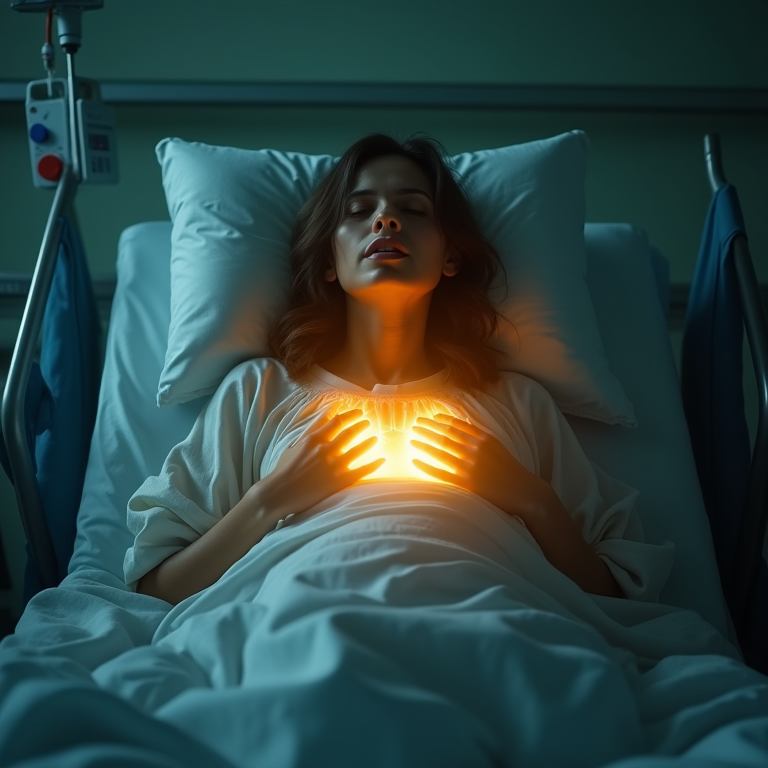
The Silence Between Heartbeats
The doctors gave her six months. Sophie was thirty-four, otherwise healthy, with a tumor in her brain that had appeared as casually as some people develop allergies. She spent her last weeks the way most people spend their lives—trying to figure out what mattered and what didn’t.
What mattered, she discovered, was sound. Not music or conversation or the ambient noise of daily life. The sound of her own heartbeat. The proof that she was still alive, still present, still here.
But in the final days, even that began to fade.
The doctors called it cardiac brake. The tumor was pressing on the nerves that controlled her heart rate, causing it to pause—sometimes for seconds, sometimes for the length of a held breath. Each pause felt like the world going quiet. Like being erased, one moment at a time.
Sophie started recording herself. Audio files on her phone, capturing the quiet between heartbeats—the gaps where she wasn’t sure if she would come back. She listened to them obsessively, trying to hear what happened in the space between beats. Was there something there? A door she was meant to walk through? Or just nothing?
The recordings were hours long. She listened to every one.
The hospice nurse was a woman named Ruth, who was either sixty or ninety, depending on how you counted. Ruth had a way of appearing in Sophie’ room without knocking, without sound, without any of the usual announcements that people make when they enter a space. She simply was there, the way dawn simply is.
“You hear it,” Ruth said one night, listening to one of Sophie’s recordings. “The silence. Most people can’t hear it. They fill every moment with noise, with distraction, with the endless business of being alive. But you—you’re listening to the gaps.”
“I don’t want to die,” Sophie said.
“No one does. But everyone does. The question isn’t whether. The question is what you hear in the silence before it takes you.”
The silence wasn’t nothing. Sophie learned this on her third week in hospice, when the pauses grew longer and her consciousness began to wander. In the silence, there was something. Not a presence exactly. More like a frequency—a vibration that existed below the threshold of normal perception, the sound the universe made when it thought no one was listening.
And in that frequency, Sophie heard her own name. Not spoken. Not thought. Just there, the way a color is there when you open your eyes.
Ruth was waiting for her, in the silence. But Ruth wasn’t a hospice nurse. Ruth was a door. A transition. A passage from one kind of hearing to another.
“You’ve been listening to the right thing,” Ruth said. “Most people hear nothing. You heard the frequency. That’s why you’re here. Not everyone who dies gets to hear it. But everyone, eventually, becomes it.”
Sophie died on a Tuesday, with her phone still recording, with the silence between her heartbeats stretching longer than they ever had before. The recording captured the last beat—the final thump of her heart—and then the frequency that had been underneath it all along.
It sounded like a name. It sounded like a question being answered. It sounded like the universe remembering something it had been trying to forget for a very long time.
Ruth was there at the end, though the other nurses never saw her. She held Sophie’s hand through the final silence, and when it was over, she smiled—the first genuine smile anyone had ever seen on her face.
“You heard it,” she said. “That means you get to become part of it. Not everyone does. But you did.”
Sophie’s phone kept recording for another eleven minutes. When her family listened back, they heard only silence—the comfortable, complete silence of a room where someone has finally stopped fighting the inevitable. But if they listened closely, in the gaps between the nothing, they could hear something. A frequency. A name. A door, still open, still waiting for whoever was ready to walk through.