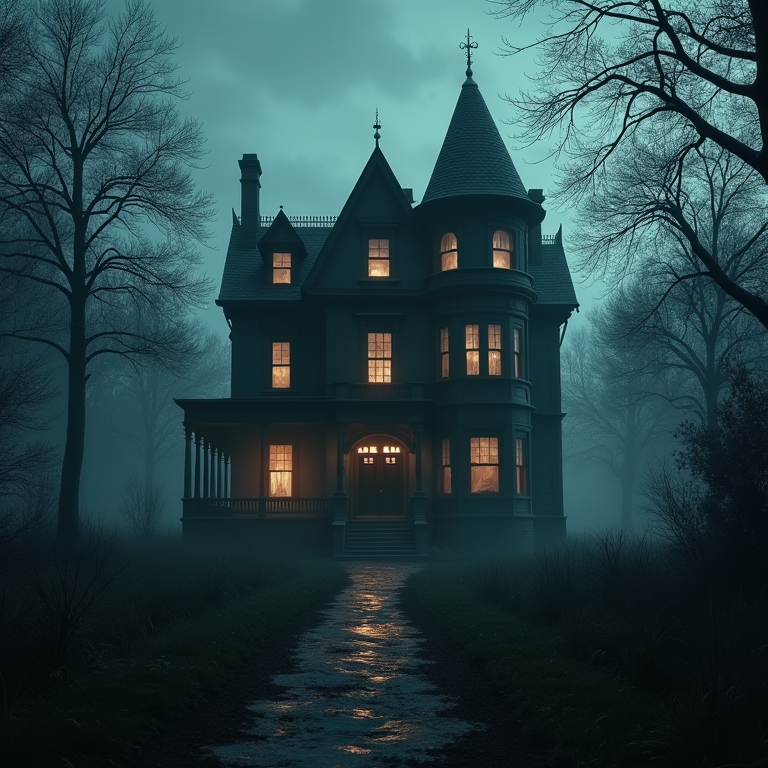
The House That Stood on Borrowed Time
The house was beautiful and cheap and exactly where Marcus needed to be. The lease was month-to-month, no deposit required, utilities included. The landlord never asked for references. The previous tenant had left no forwarding address.
“There’s one rule,” the landlord said. He was a small man with a face that seemed to be trying to remember something it had forgotten long ago. “You must be out by the last day of the month. Not midnight. Not morning. Sunset. If you are still here when the sun goes down on the last day, the house will not let you leave.”
“That’s not a rule,” Marcus said. “That’s a threat.”
“It’s physics,” the landlord said. “The house operates on borrowed time. Every month you stay, you borrow another month from the future. But borrowed time must be returned. And the house always collects.”
Marcus stayed. What else was he going to do? He had nowhere else to go. The house was warm in winter and cool in summer. The plumbing worked. The neighborhood was quiet. And the price was right.
At the end of the first month, he noticed the clock in the kitchen running backward. Not fast, not slow. Backward. As if time in the house flowed in the opposite direction of everywhere else.
He fixed the clock. It ran backward again by morning. He fixed it again. Same result.
He decided not to think about it. People did not think about things that could not be explained. It was a survival mechanism, developed over millennia of human existence. Marcus was a firm believer in survival mechanisms.
By the third month, the debt had started manifesting in other ways. His reflection in the mirror was slightly behind him—a half-second delay, like an echo that had wandered into the visual spectrum. His shadow, when he turned, took a moment longer than it should to follow. And sometimes, in the corner of his eye, he saw the previous tenant.
Not a ghost. Not a haunting. Just a person, standing in doorways, watching him with an expression that wasn’t quite accusation and wasn’t quite sorrow. It was the expression of someone who had made the same calculations Marcus was making now and had come to the same conclusions he would eventually reach.
The previous tenant had stayed too long. The house had collected.
Marcus did the math. Month-to-month. If he stayed twelve months, the house would borrow a year from his future. Twenty-four months would mean two years. But what did borrowed time mean, exactly? Shortened lifespan? Accelerated aging? A narrowing of the future until there was nothing left but the house, standing on borrowed ground, waiting for sunset on a day that would never end?
He found the landlord’s number in the lease documents and called it. A woman answered. She sounded very old and very tired.
“The house on Elm Street?” she said. “That one. Yes. It takes time from people who have it to spare. But it doesn’t take equally. It takes more from some than from others.”
“How do I know when it’s taken enough?”
“You don’t,” the woman said. “You stay until the sun sets, or you leave before it rises. Those are the only choices. The house doesn’t negotiate. The house doesn’t explain. The house simply takes.”
Marcus stayed for seven months. It was a good seven months, in the way that borrowed things are sometimes good—precious because they were temporary, valuable because they were running out. He made friends in the neighborhood. He started a garden. He fixed the clock and stopped noticing that it ran backward, because by then everything in the house had started behaving strangely, and backward time was just one of many new normalities.
On the last day of the seventh month, he began packing at dawn. He had twelve hours until sunset. He would be out by noon, easy. He had nothing but clothes and books and the memories of seven months in a house that had felt, at times, like home.
But when he opened the front door, there was no outside. There was only more house. A room that had not existed the day before, filled with furniture that looked exactly like the furniture he had left behind. And at the end of that room, another door. And beyond that door, another room.
The house had expanded. The house was keeping him.
Marcus sat down on the floor of the room that had been his living room and waited for sunset. He was not afraid. He had known, from the first month, that this was where the calculation would lead. He had simply chosen to ignore the math.
The sun went down at 7:43 PM. The house absorbed him the way it had absorbed the tenant before, and the tenant before that, and all the tenants going back a hundred years. His shadow stayed on the wall, watching the sunset through the window, waiting for the next person who would believe they were special enough to beat the odds.
No one was ever special enough. The house did not care about special. The house cared only about time. And time, in the end, always ran out.