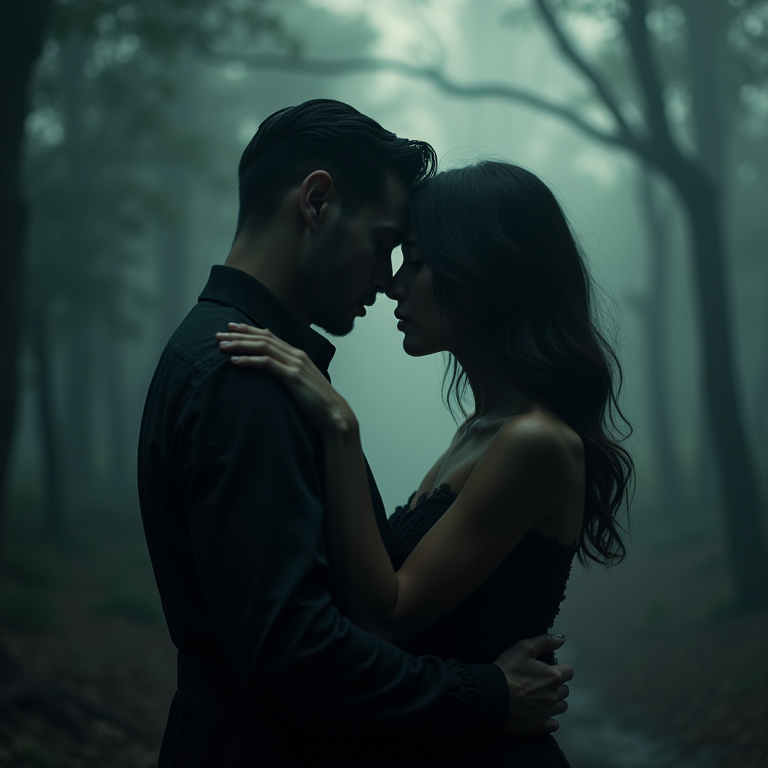
The Secret We Kept
The rain had been falling for three days when he found her in the ruins of the old cathedral on the hill above the city. She was sitting cross-legged among the broken pews, surrounded by candle stubs that guttered in damp wicks, her dark hair spilling over shoulders clad in nothing but a man’s dress shirt—his shirt, judging by the monogram stitched at the cuff.
Liam should have turned back. Every instinct screamed at him to walk away from whatever possessed woman sat among the rubble two miles from his apartment. But something about the way she held herself—still as stone, eyes fixed on nothing—anchored him to the wet stones where he stood.
“You’re bleeding on my candles,” she said without turning around.
He looked down. He wasn’t bleeding. The rain had carved shallow rivulets into his jacket, and maybe one drop had landed near the nearest candle. That was all. But he knelt anyway, because some compulsion deeper than reason told him compliance would be the currency that bought him passage into her world.
“I’m Liam.”
She finally turned. Her eyes were the color of tarnished silver—gray-green-black depending on how the light hit them—and they pinned him with an intensity that felt physical, like fingers closing around his throat. Beautiful, yes, but not in the way that made you want to hold her. In the way that made you want to run.
“You know what I am?” she asked.
Liam didn’t answer immediately. He looked at her properly then: the thin scar that traced her jawline like a drawn bowstring, the way her bare feet were caked in dried mud and something darker, the collection of small objects arranged around her like offerings—chess pieces, a pocket watch with no hands, a lock of someone else’s blonde hair tied with red ribbon.
“No,” he said finally. “But I think I want to find out.”
She smiled. It was not a nice thing.
He started coming every day after that. Told himself it was curiosity. The rational part of his brain knew better—he’d never met anyone who looked at him the way Clara did, as though he were a locked door she intended to pick open methodically, screw by screw. She never asked where he lived or what he did for work. Instead she asked questions like “What’s the last thing you lied about?” and “If I disappeared tomorrow, would you look for me or let yourself breathe again?”
He answered honestly because honesty felt like the only weapon he had left against her, and because lying to Clara was impossible—the way trying to lie to gravity is impossible. It just won’t work.
On the seventh day, she showed him the room behind the altar. Stairs going down into earth-dark coldness, walls lined with shelves of journals bound in cracked leather. Hundreds of them. Thousands. She ran a hand along the spines the way a musician runs fingers across piano keys.
A cold that had nothing to do with the underground seeped into his bones. “And what happens to forty-two?” he asked, though he already knew the answer.
“Same as the rest. They fell in love. I killed them.” She spoke plainly, the way one might describe the weather. “Not with malice. Not even with cruelty, if you want to be charitable. Love is the mechanism. I become everything you need until you can’t remember your life before me, and then I take what I’ve grown too attached to let go.”
Liam should have fled. Some animal core of him was already screaming it, but his feet refused to move. What terrified him most wasn’t her confession—it was the fact that even knowing this, even understanding the architecture of her destruction, the heat between them had already reached a point of no return. His body arched toward hers like iron filings drawn to a magnet he could see, understand, and still not resist.
“Why tell me?” he whispered.
“Because forty-three is different. Because you already know.” She stepped close enough that he could feel her breath, smelled damp stone and something faintly metallic underneath, like blood on a copper coin. “The difference is you’re choosing it with your eyes open. And I wanted you to choose.”
That night, he took off his shirt and pressed his palm flat against the scar on her shoulder blade—the one he’d traced twice now during those stolen moments when proximity dissolved into something neither of them named. Her skin was warm beneath his hand. Alive. So vividly alive that he thought perhaps she’d changed her mind, perhaps the cycle could break this time.
Clara caught his wrist. Her grip was impossibly strong, like steel cable wrapped in velvet. She pulled his hand up until her mouth could reach it, and she kissed his palm the way a starving person kisses bread—reverently, desperately, like salvation itself.
“Don’t pity me,” she murmured against his skin. “Don’t try to save me. Just stay.”
“Just stay.” The words hung between them like a threat and a prayer simultaneously.
So he stayed. Stayed through the nights when she held him with both arms locked tight, the kind of embrace that bordered on suffocation. Stayed through the mornings when she woke beside him with tears tracking silently down her cheeks and wouldn’t say why. Stayed through the day she brought him breakfast in bed—a bowl of fresh strawberries she’d somehow procured in the dead of winter—and watched her watch him eat them with an expression of such desperate hunger that he wondered if she fed on his attention the way plants feed on sunlight.
Spring arrived with a violence that surprised everyone except her. The cherry trees along the river bloomed overnight, clouds of pink petal snowing onto streets slick with relentless rain. Liam noticed things now—patterns he’d overlooked before. How she never cast a shadow. How the birds went quiet when she passed through the park. How the temperature dropped exactly two degrees whenever she touched his face.
Once, he saw her standing at the window of his apartment past midnight, staring at her own reflection in the glass while whispering names. Dozens of them. Forty-two names, each one a soft syllable in a language of grief so ancient it sounded older than the building she was studying.
When he appeared behind her, she didn’t startle. She simply reached back and found his hand without looking, lacing their fingers together the way a bridge connects two cliffs.
“You heard,” she said.
“You talk in your sleep.”
“I always talk in my sleep. Never noticed before?” Her laugh was brittle, like ice cracking underfoot. “Maybe that’s the problem. Maybe I’ve gotten lazy.”
He turned her to face him. She let him—reluctantly, like a prisoner allowing the guard to adjust the shackles—but her silver eyes held a challenge that bordered on defiance.
“Tell me how to stop it,” he said quietly.
“There is no stopping it.”
“Then kill me quickly.”
Something cracked in her expression—just for an instant, a fracture wide enough to see everything trapped behind it. Grief. Loneliness. A hunger so vast it consumed logic and left only the raw arithmetic of need: one more, just one more, let this one survive longer than the others.
“I don’t want you dead,” she whispered, the words breaking apart in ways that shattered him right back. “I want you alive inside me forever. Don’t you understand? This isn’t murder. This is preservation. You’ll never age, never fade, never turn to dust. I keep you perfect by keeping you here.”
He understood perfectly. He understood completely. And that understanding is what doomed him, because he realized in that moment that her monsterhood wasn’t the opposite of love—it was its furthest, most corrupted extremity. A love so fierce it bypassed mercy entirely and went straight to ownership.
He kissed her then with everything he had left, all the days he’d spent confused by her, frightened by her, enthralled by her, folded into one gesture of surrender and defiance both. She kissed him back with the ferocity of someone drowning, pulling him closer until there was no air left between them, until breathing became a negotiation he couldn’t win.
The next morning, she was gone. The cathedral was empty. The candles had melted into shapeless puddles on the floor. But on the central pew, arranged deliberately in a circle, lay his wallet, his keys, his phone—all returned neatly, as though he’d left them there himself. And beside them, a single strawberry stained crimson, and a note in handwriting so elegant it looked carved into the paper:
Forty-three was the longest they ever lasted. Thank you.
Liam picked up the strawberry and ate it. It tasted like sweetness and rot and the bitter edge of something irreversible. He sat alone in the ruined cathedral as the April rain poured through the collapsed roof, and he waited—not running, not searching, just waiting—for the knock on the door that he knew, with absolute certainty, was still coming.
Because he hadn’t escaped. He’d been pardoned. And pardons in her world always carried terms he was only beginning to understand.
Some loves are cages disguised as arms. And some people spend lifetimes mistaking captivity for devotion, wondering which is worse: being kept by someone who loves you too much, or loving someone who kills you too well.