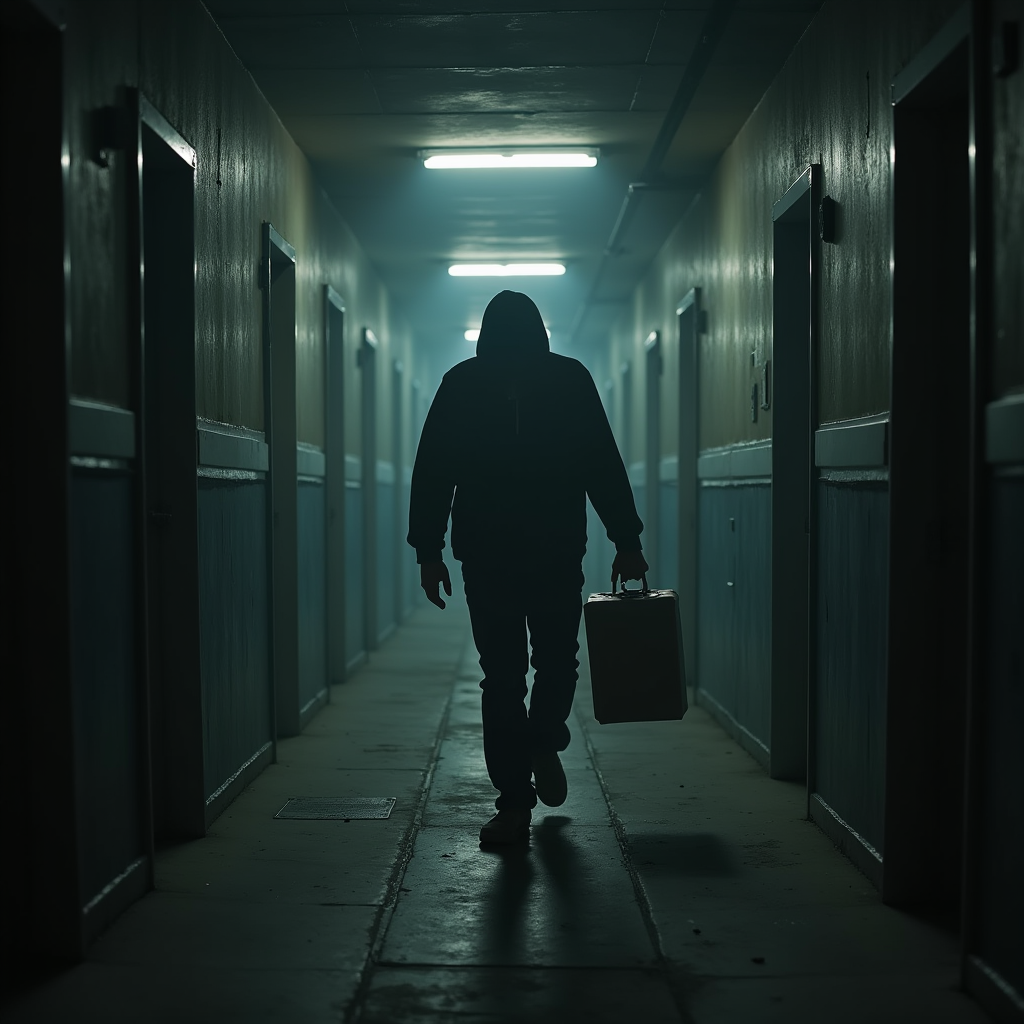
The Courier’s Dilemma
The package weighed exactly four hundred and twelve grams. Leo knew this because he’d weighed it on the kitchen scales before sliding it into his messenger bag. He knew its dimensions too — twelve by eight by three centimetres, wrapped in brown paper, sealed with black tape. He knew all of this because knowing things was the only currency that mattered in his line of work.
“Don’t open it,” the woman had said when she handed it to him at King’s Cross. She wore sunglasses indoors and a coat that cost more than Leo’s car. “Don’t stop moving. Don’t talk to anyone who asks about it. Deliver it to the address on the label by midnight, and your account receives fifty thousand pounds.”
Fifty thousand. For a two-hour delivery through central London. Leo had been a courier for eleven years and had never seen a payout that high. He should have walked away. But his daughter’s medical bills were stacking up like unread mail, and desperation has a way of narrowing your moral horizons.
He was on the Bakerloo line when he noticed the man watching him. Not the casual, bored watching of a fellow commuter — the focused, predatory attention of someone who’d been briefed on his face, his clothes, his bag. The man was on the platform at Baker Street. He was on the same carriage at Oxford Circus. And when Leo got off at Piccadilly Circus, the man followed.
Don’t stop moving.
Leo moved. He cut through the station tunnels, up the escalators, out into the rain-slicked chaos of the Circus, and into the crowd. He didn’t look back. He didn’t need to. He could feel the man’s attention like a physical pressure between his shoulder blades.
The address on the label was in Canary Wharf — a glass tower that rose from the Thames like a blade. Forty-three floors up, Suite 4301. Simple enough. Except the Docklands Light Railway was suspended due to a security incident, and every taxi driver Leo flagged either didn’t hear him or suddenly remembered an urgent appointment elsewhere.
His phone buzzed. Unknown number.
“You’re being followed, Mr. Chen,” a pleasant British voice informed him. “I’d recommend taking the Thames Clipper from Embankment. Less complications.”
“Who is this?”
“Someone who wants you to succeed. The boat leaves in twelve minutes. I suggest you run.”
Leo ran. He ran past the man who’d been following him — who was now on the ground, nursing what looked like a broken nose — and down the steps to the river. The Clipper was boarding. He showed his Oyster card, boarded, and stood at the rear deck watching London slide past in the grey afternoon light.
That’s when the package started vibrating.
Not his phone. The package. A low, rhythmic pulsing that he felt through the canvas of his bag. He pulled it out carefully, setting it on the bench beside him. The brown paper was warm to the touch. And then, impossibly, he heard it — a faint sound coming from inside, like a heartbeat.
Don’t open it.
But he was a man who’d survived eleven years by trusting his instincts, and every instinct he had was screaming that this wasn’t a document or a drive or whatever he’d been told to expect. This was alive. Or it contained something that was.
He opened it.
Inside was a phone — a burner, basic Nokia — and it was ringing. He answered before the second ring.
“Leo Chen,” the voice on the other end said. It was a child’s voice. A girl, seven or eight years old. “Please don’t deliver the package. If you do, I die.”
“Who is this?”
“My name is Sophie. I’m in the building you’re going to. They’re going to use me to —” The line went dead.
Leo stared at the phone. The Thames stretched out on either side, grey and indifferent. Canary Wharf was approaching, its glass towers multiplying in the murky water like reflections in a broken mirror.
He had two choices. Deliver the package and collect fifty thousand pounds — enough to pay for his daughter’s treatment, enough to breathe again, enough to stop running from debt collectors and his own failures. Or he could throw the phone into the river, walk away, and pretend he’d never heard a child’s voice begging for her life.
He thought about his daughter. About the bills. About the life he’d promised her and hadn’t been able to provide.
Then he thought about Sophie’s voice. Small. Terrified. Trusting a stranger with her life because she had no one else.
The boat docked. Leo stepped onto the pier, the package heavy in his hands, and made his decision.
He didn’t go to Suite 4301. He went to the police — not the local station, but Scotland Yard, where he demanded to speak to whoever handled human trafficking. He handed them the package, the phone, and everything he knew. And then he sat in a windowless room for six hours while they verified his story, checked his background, and decided whether he was a witness or a suspect.
They raided the building at two in the morning. They found Sophie — alive, frightened, alive — along with eleven other children and enough evidence to indict three government ministers and a FTSE 100 CEO.
Leo didn’t get his fifty thousand pounds. He lost his courier licence. His landlord evicted him after the tabloids ran his photo with the headline COURIER IN TRAFFICKING SCANDAL. His daughter’s treatment was delayed by three months while they relocated to a new hospital under new names. It cost him his home, his career, his reputation, and very nearly his sanity.
But Sophie called him on Christmas Day. Just to say thank you. Just to tell him she was safe. Just to let him know that the voice he’d heard on that boat wasn’t gone.
It was enough. It had to be. Because the alternative — living with what he would have done if he’d kept walking — was a price no amount of money could cover.