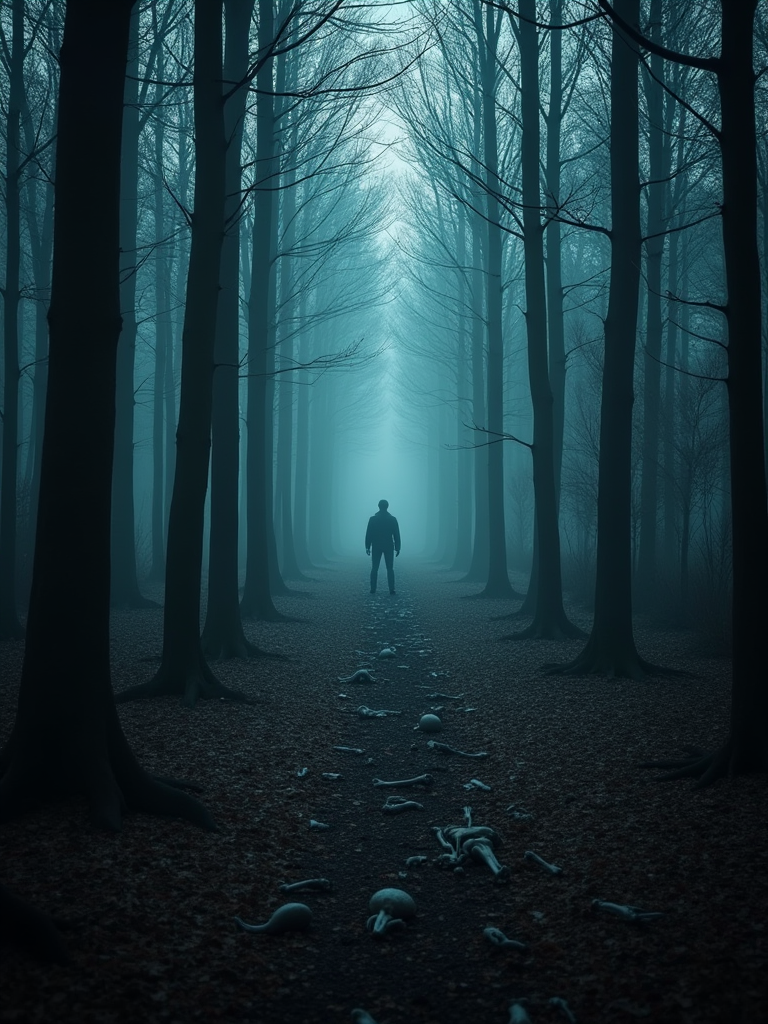
The Bone Collector
Inspector Maya Okonkwo stood at the edge of the excavation site and watched the archaeologists brush dirt from the remains of a skeleton that was not supposed to be there. The site was a Roman villa, or at least it had been until the ground-penetrating radar revealed something beneath the foundation—a second structure, smaller, older, and aligned in a direction that made no archaeological sense.
“It is not Roman,” the lead archaeologist said. She was a small woman with fierce eyes and the impatient energy of someone who had spent her entire career telling people to stop touching things. “The bones are medieval. Fourteenth century at the earliest. And they have been placed deliberately.”
“Placed?” Maya asked.
“Buried, yes. But not buried in the usual way. The skeleton is positioned face-up, arms crossed over the chest, with a stone on the sternum. That is not a burial. That is a containment.”
The Pattern
Maya had been called to the site because of a missing person. A local farmer named Thomas Greeley had vanished three weeks earlier, leaving behind a wife, two children, and a farm that was still operating as though he had simply stepped out for a cigarette and forgotten to come back. The search had found nothing—no footprints, no vehicle tracks, no sign of struggle. Just an empty house and a half-eaten breakfast on the kitchen table.
Then the archaeologists found the skeleton. And the skeleton had something in its mouth—a small metal tag, the kind used for livestock identification, stamped with the number that matched the tag on Thomas Greeley’s prize bull.
“That is impossible,” Maya said when she heard this. “The skeleton is medieval. The tag is modern.”
“I know,” the archaeologist said. “That is what makes it interesting.”
Maya did not find it interesting. She found it deeply troubling. A medieval skeleton with a modern livestock tag in its mouth was not an archaeological curiosity. It was evidence of something she could not yet name but could feel approaching like weather.
The Discovery
She returned to the excavation site the next morning with a team of officers and a warrant to search the surrounding land. The archaeologists had uncovered three more skeletons overnight, each one positioned identically—face-up, arms crossed, stone on the sternum. Each one had a modern object in its mouth. A key. A wedding ring. A child’s tooth.
Maya knelt beside the fourth skeleton and examined the object between its teeth. It was a photograph, folded and refolded until it was the size of a postage stamp. She unfolded it carefully with gloved hands and found a picture of a house—Thomas Greeley’s house, taken from the front garden, with Thomas himself standing on the porch looking directly at the camera.
“These are not medieval remains,” she said quietly. “Someone is placing modern objects in old bones. Someone wants us to find them.”
The archaeologist knelt beside her. “Why would anyone do that?”
“Because they are sending a message. They are telling us that the past and the present are connected in ways we do not understand. And they are telling us that Thomas Greeley is part of that connection.”
They found Thomas three days later, alive but changed. He was sitting in a field two miles from his farm, staring at the sky with an expression that suggested he had seen something he could not explain and would spend the rest of his life trying to forget. When Maya asked him what had happened, he said only one thing.
“I went down into the ground. I saw them. The ones who were buried. They were waiting for me.”
“Waiting for what?”
“For someone to remember them. They have been waiting a very long time.”