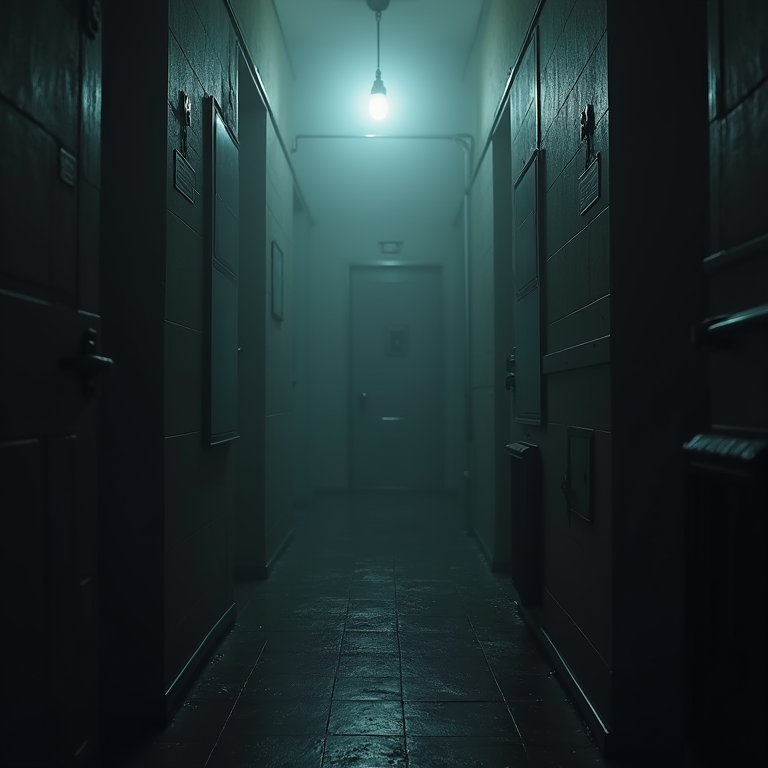
The Neighbor Who Never Left
There was a man in Portland who had bought silence, if the testimonials he published on his own website were to be believed. He did not advertise publicly. His website, a minimal page with only a list of names and addresses and a single paragraph describing his work, appeared in search results when someone typed “how to remove noise from neighborhood” or “neighbor won’t stop making sound.” The paragraph read: If your neighbor produces sounds that you cannot explain and cannot stop and that have persisted despite repeated requests for their cessation, I can resolve the issue. Contact information below.
Elena found the website through a friend of a friend. Her apartment building had four units. The unit directly above hers belonged to a man in his sixties named Arthur who made a continuous, rhythmic tapping sound every evening between seven and eleven o’clock. It was not loud enough to be audible through thin walls from outside the building. Inside the unit, it was unmistakable — a steady tapping, like a metal rod striking wood at regular intervals, approximately once per second, continuing for hours at a time.
Elena had lived in the building for eight months before she could bear it no longer. She had spoken to Arthur three times. On her first visit, he had opened the door wearing slippers and thick wool socks and had listened to her request to reduce the noise with an expression of genuine surprise and polite concern. He said he would try. Two days later, the tapping resumed. On her second visit, Arthur apologized again and explained that he had a medical condition that affected his hands — he had begun tapping objects against surfaces as a way to regulate his nervous system. It helped, he said, and he hoped she understood. Elena said she hoped he did too.
The third conversation happened at the mailboxes, when Elena intercepted him in the lobby and asked him more forcefully whether there was anything he could do to address the situation. Arthur looked at her for a long time. Then he closed the mailbox and went back upstairs. The tapping started at seven that evening and did not stop until one in the morning.
Elena’s email to the man whose name appeared on the website went unanswered for five days. Then she received a reply. No greeting. No introduction. Just three sentences: I need to know what kind of sound. I need to know how long it has been going on. I need to know what you have tried already.
Elena responded fully. She described the tapping, the frequency, the duration, the conversations she had had with Arthur, and the sleep deprivation that had left her unable to concentrate at her job as a data analyst. The sender replied within an hour: Meet me. Thursday. 9 PM. Address attached.
The address led to a small storefront on Southeast Division Street that housed nothing visible from the exterior except a steel door and no signage. Elena texted the number that had messaged her from the website. The door buzzed open.
Inside was a room the size of a garage office, lined floor to ceiling with recording equipment. Not the professional variety — these were consumer-grade digital recorders, dozens of them, stacked in shelves and arranged on desks, all running simultaneously on different frequencies and sampling rates. An older man sat at the central desk, wearing headphones over a pair of wire-rim glasses, monitoring screens that displayed waveform patterns in muted greens and ambers.
“You’re Elena,” he said without turning around. He had not heard her enter. He must have been watching her reflection in one of the monitors.
“You got my email.”
“I get seventy emails a month about this. Most of them are pranks. Your description was detailed enough to suggest authenticity.”
He finally turned to face her. He introduced himself as Martin. He told her that he was a sound engineer who had been hired, three years ago, by a couple whose new neighbor played music at high volume late into the night. He had recorded the music, analyzed it, discovered something unusual about its acoustic signature, and used that discovery to help the couple file a complaint that resulted in the neighbor moving away. Since then, people with unexplained noises had begun finding his website and reaching out.
“What exactly do you do?” Elena asked.
“I listen to the noise. I listen carefully. And then I determine whether it is coming from inside the person making it or from outside.”
He brought her to a set of heavy acoustic headphones connected to a portable recorder he had assembled specifically for this purpose. He plugged the jack into the device and handed her one ear cup. On the device was a directional microphone and a preamplifier designed to isolate extremely quiet sounds in noisy environments.
“Put this near the wall between your unit and his. Record for ten minutes. Send it to me.”
Elena returned home, placed the device against the shared wall, and recorded for ten minutes. At midnight, she emailed the file. By three in the morning, Martin called her back.
“It’s not him,” he said. His voice was flat, devoid of judgment.
“But the sound —”
“The sound is being produced by the structure. Not by Arthur. The building is settling. The pipes are groaning. There is resonance in the floor joists that amplifies certain frequencies. What you’re hearing is a harmonic feedback loop between the building’s age and the way the units share structural elements. Arthur does nothing but watch television and drink tea.”
Elena felt a complicated mixture of relief and deflation. She thanked him. She asked him how much she owed. He told her he did not charge.
She began sleeping again. But the relief lasted only a few weeks. New problems arose — creaking floors in the middle of the night, a faint hum that seemed to come from the walls, the occasional sharp clatter with no discernible source. Each time, Elena visited Martin’s storefront and sent him recordings. Each time, he diagnosed the same thing: the building itself was producing the sounds, its aging structure finding new ways to resonate with itself.
This continued for fourteen months.
Then, one Tuesday, Martin did not answer her email. Three days later, Elena drove to Division Street and found the storefront empty. The steel door was still locked. Through the narrow glass window beside it, she saw that the room had been stripped bare — no recorders, no shelves, no desks, just the concrete floor and the bare drywall, which bore faint rectangular marks where the equipment had once sat.
She filed no police report. There was nothing to report. But she noticed, in the weeks that followed, that the sounds in her building had changed. They had not stopped — they had evolved. The rhythmic tapping had become irregular. The humming had developed undertones. And sometimes, at precisely 3 AM, she could hear something that resembled speech — muffled, garbled, speaking a language she could not identify — emanating from somewhere deep within the shared walls.
She never contacted Martin again. She moved out of the apartment after signing a lease break clause, paying double the monthly rent to leave early. On her last day, she placed her hand against the shared wall and listened. For approximately twenty seconds, she heard nothing. Then, slowly, as if the building had been waiting for her to confirm that it was still there, a single tapping sound echoed against her palm — precise, deliberate, and unmistakably coming from the other side.