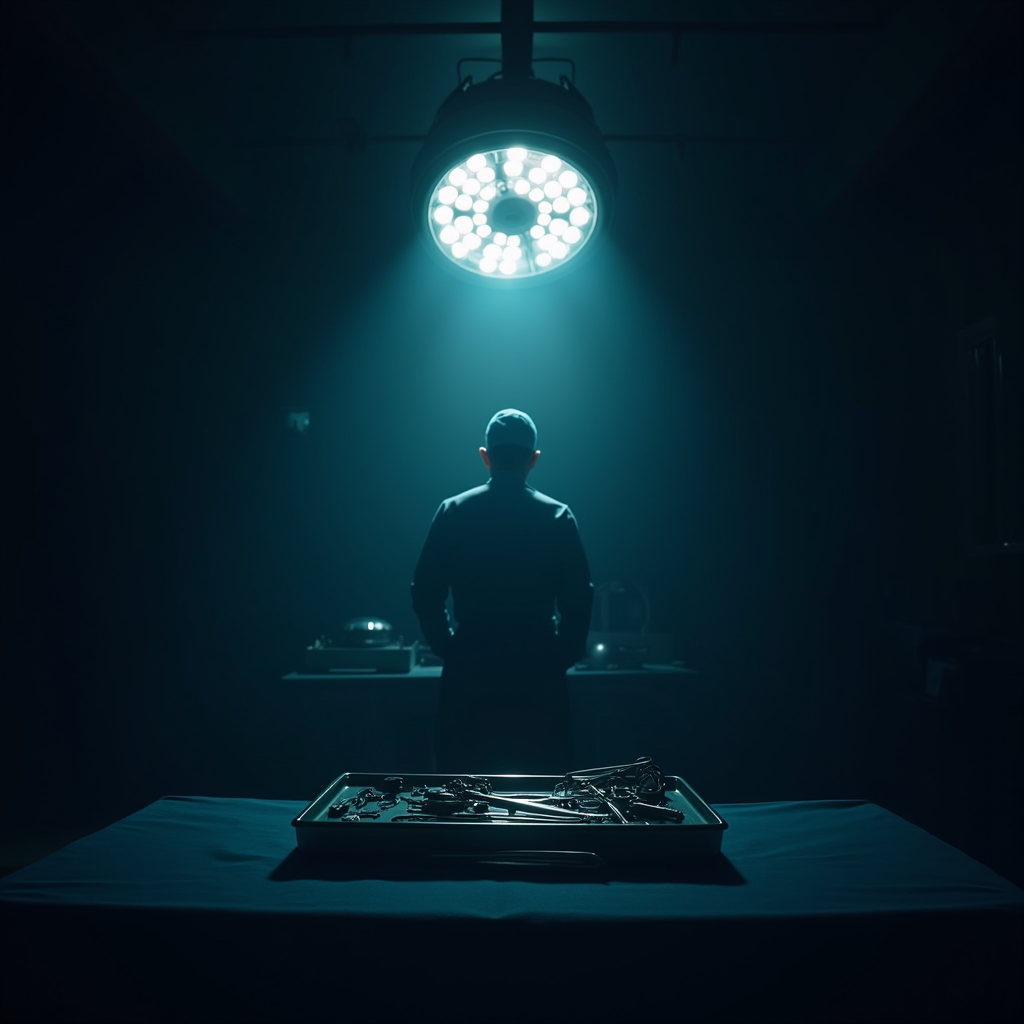
The Doctor Who Stopped Counting
Dr. Rachel Okonkwo had been a surgeon for nineteen years, and in that time she had performed approximately four thousand procedures, and she had never once lost count of her instruments until the night she performed an emergency appendectomy on a patient named Harold Meacham and opened him up and found something that was not supposed to be there and closed him back up and sent him to radiology and the radiology came back and said there was nothing there, and she was left standing in the operating room with a patient who was unconscious and an instrument count that was wrong by one, and the missing instrument was not a scalpel or a retractor or any of the things that could reasonably go missing in a surgical field, it was a suture, and she could not account for where it had gone, and she did not tell anyone, because she did not know what to tell them, and because the patient was fine, and because she had learned, in nineteen years of surgery, that sometimes the most important professional skill was knowing which mistakes to keep to yourself.
Harold Meacham died three weeks later. The cause of death was listed as complications from peritonitis, which was accurate, because his appendix had been inflamed and had ruptured during the appendectomy and the rupture had allowed bacteria to enter his abdominal cavity, which was a known risk of the procedure and which was not, the hospital’s review concluded, attributable to any deviation from the standard of care. Rachel read the review. She noted that the instrument count discrepancy was not mentioned in it. She did not ask why. She went back to work.
The suture appeared, two months later, in an X-ray that was taken of a different patient — a woman named Diana Vance who had come to the ER with abdominal pain and who had, during the examination, swallowed a coin that she had been holding in her mouth as a nervous habit. The coin was visible on the X-ray, which was expected. The suture was also visible on the X-ray, which was not. It was lodged in her small intestine, at a location that corresponded precisely to the location where Dr. Okonkwo had been working during Harold Meacham’s appendectomy. The radiologist who read the X-ray called Rachel directly, which was unusual, and said: I need you to look at something.
Rachel looked. She recognized the suture. She recognized it because she had been looking at it every day for two months, in the sense that she had been unable to stop thinking about it, in the sense that it had become a kind of obsession that she had been managing through the simple expedient of not looking at X-rays or thinking about Harold Meacham or asking herself where the suture had gone. She recognized it because it was her suture — her technique, her knot, the specific way she had been taught to tie sutures twenty years ago and had never changed because it worked and because changing it would have required acknowledging that she had learned it from someone who had since retired and who had not, as far as Rachel knew, taught anyone else the same technique.
She went to Diana Vance’s room. She introduced herself. She explained that there had been an incident during a previous surgery, that a suture had been inadvertently left inside a previous patient, and that it appeared, based on the X-ray, that the suture had migrated through Diana Vance’s body from that previous patient. Diana Vance looked at her with the expression of a person who has just heard something impossible and who is deciding whether to believe it or to call a lawyer. Rachel explained that this was a known phenomenon, that sutures did occasionally migrate, that it was not anyone’s fault, that the appropriate treatment was removal, which was a minor procedure that Rachel would be happy to perform.
Diana Vance agreed to the removal. Rachel performed the procedure on a Thursday afternoon. She removed the suture. She sent it to pathology, which confirmed that it was the same type of suture used in Harold Meacham’s surgery. She filed her report. She did not amend Harold Meacham’s death certificate, because there was no evidence that the suture had contributed to his death, and because amending a death certificate was the kind of action that triggered reviews and investigations and hearings, and because she had learned, in nineteen years of surgery, that the kind of honesty that destroyed careers was not the same as the kind of honesty that helped patients.
She retired the following year. She did not retire because of the suture. She retired because she had turned sixty-two and because her hands were beginning to shake in ways that were too small to notice in ordinary life and too large to ignore in surgery, and because she had decided, after nineteen years, that the moment to stop was before the moment when stopping was no longer her choice. She moved to a small town in New Mexico. She did not practice medicine there. She spent her time gardening, and she did not think about Harold Meacham, or about Diana Vance, or about the suture that had traveled from one to the other through a mechanism that no one had been able to explain, and she did not think about the fact that the human body, when you left things in it long enough, sometimes moved them to places where they were not supposed to be, and that this was not a malfunction of the body but a decision, and that the suture had made a decision, and that she had decided not to investigate why.