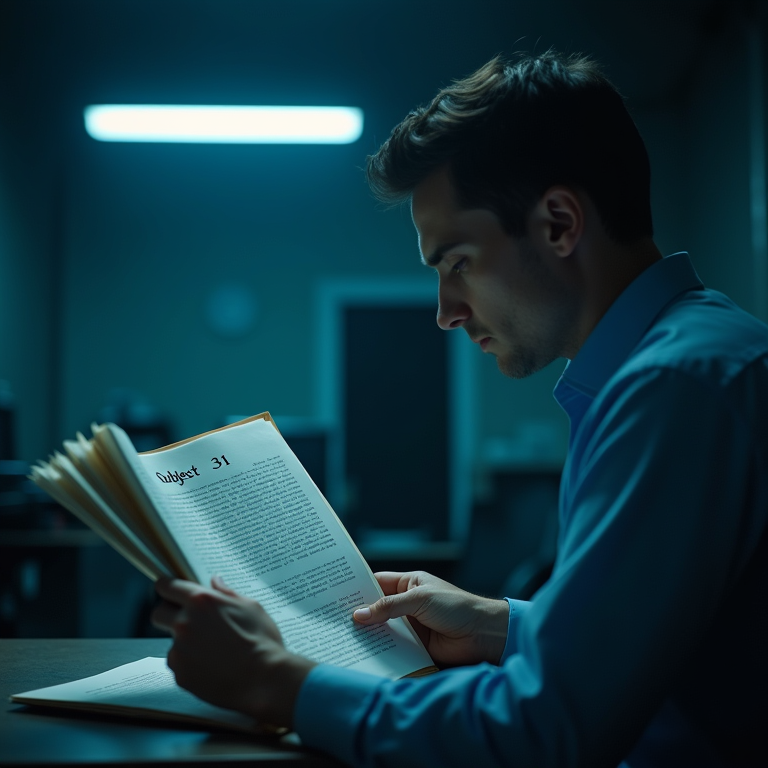
The Test Subject Who Was Not Supposed to Exist
The file was labeled Subject 31, and it was stored in a cabinet that was supposed to contain only active files, and it was eleven years out of date, and the person who found it was a compliance officer named Daniel who had been doing a routine audit of the research division’s record-keeping practices and who had opened the cabinet because the door was slightly ajar and because he had always been the kind of person who closes doors that are open, not out of compulsion but out of a general belief in the appropriate relationship between things and their containers.
The file contained three hundred pages. Daniel read all of them, over a weekend, in his apartment in Queens, and by Sunday night he understood that the file was not a research file in the ordinary sense. It was not a collection of data points and methodology notes and results summaries. It was a record of a person — specifically, a record of a person who had been enrolled in a clinical trial in 2013, and who had been given an experimental drug that was intended to enhance memory consolidation, and who had died, in the trial, in circumstances that the file described as involving “anomalous cognitive events” and “unprecedented neurological responses” and “a termination of consciousness that did not correspond to any known mechanism of death.”
The subject’s name was Rachel Oduya. She had been twenty-nine years old at the time of the trial. She had been a graduate student in linguistics at Columbia. She had enrolled in the trial for money — three thousand dollars, which was a significant amount of money for a graduate student in 2013. She had died on the forty-seventh day of the trial, in a hospital bed, while being monitored by a team of researchers who had documented everything they observed and who had observed, in the final minutes of Rachel’s life, a series of events that they had been unable to explain and that they had classified, in their notes, under the heading “unexplained phenomena.”
Daniel did not know what to do with the file. He was a compliance officer, not a journalist or a regulator, and his job was to ensure that the research division was following proper procedures, not to investigate the contents of old trial files. But the file was eleven years out of date and was stored in the wrong cabinet, and the fact of its storage in the wrong cabinet was itself a compliance issue, and Daniel had been doing his job, which was to document the issue and report it, and what he documented and reported was not the contents of the file but the fact of its misfiling, and the report he filed was brief and said only that the file labeled Subject 31 had been found in the active cabinet and should be transferred to the archive.
The transfer was not made. Instead, Daniel received a call, the next day, from a woman in the research division’s administrative office who asked him to come to a meeting. He went to the meeting. The meeting was in a conference room on the fourteenth floor, and there were four people there, all of whom he knew by sight but none of whom he knew well, and the woman who had called him said: We need to discuss the file. And Daniel said: Which file. And the woman said: You know which file. And Daniel understood, from the way the woman said it and from the expressions on the faces of the four people in the conference room, that the file was not a file that was supposed to have been found, and that the finding of it was itself the problem, and that the problem was not what was in the file but the fact that anyone had read it, because what was in the file was something that the research division had decided, eleven years ago, should not exist in any form that was accessible to anyone who was not part of the specific team that had managed the trial, and that the team was no longer intact, and that the decision had been made by people who were no longer with the organization, and that the decision had been to make Rachel Oduya not exist — not in the records, not in the memories of the people who had known her, not in the files that were accessible through normal channels — and that Daniel had found the file and had read it and had therefore become, in the view of the four people in the conference room, a problem that needed to be managed.
Daniel did not go to the meeting on the fourteenth floor the following week, which was the meeting he had been invited to and which he had been told was optional but which he understood was not optional. He went, instead, to a lawyer, and he gave the lawyer the file, and he told the lawyer everything he remembered about the call from the woman in the administrative office and the conference room and the four faces. The lawyer told him what he expected: that he had every right to refuse the meeting, and that the organization he worked for had every right to be concerned about what he had found, and that the file he had found was evidence of something that had happened eleven years ago and that the statute of limitations on whatever had happened was probably close to expiring, and that the right thing to do was to make sure that the file existed in a form that was not only in the organization’s possession, because organizations have a tendency to make things that they do not want to exist stop existing, and that this was not a conspiracy theory. It was a documented historical pattern.
Daniel gave the file to three people: his lawyer, a journalist he knew from college, and his sister, who was a professor of bioethics at NYU and who was the only person he trusted to understand what the file actually meant, beyond the legal implications and the institutional politics. His sister read the file and said: This is the record of a person who was killed by an experiment. Not accidentally. Not through negligence. Killed, in the sense that her consciousness was ended in a way that was not supposed to be possible and that was not explained and that was documented and then buried. She said: The appropriate response is not to sue. The appropriate response is to make sure that Rachel Oduya is remembered as a person who died in an experiment, not as a file that was misfiled.
The journalist wrote the story. It was published eighteen months later, after the statute of limitations on whatever could have been charged had expired, and after the research organization had done everything it could to prevent the publication, and after the story had been killed by three other publications before the fourth one, a small online journal, had decided to run it. The story did not change anything. The research organization continued to exist. The people who had been in the conference room continued to work. Rachel Oduya continued to be a name that almost no one remembered. But the story was published, and the file was no longer hidden, and the hiding was the thing that had been the problem, and the publication was the thing that had undone the hiding, and this was not justice. It was only memory. But memory is the thing that has to come before justice, and justice is the thing that rarely follows, and the people who are left after justice has failed are the people who do the remembering, and who tell the stories, and who make sure that the files that were buried are not left in the ground, and who understand that the digging up is not the same as the solving, but it is the thing that has to happen first, because the solving cannot happen in the dark.