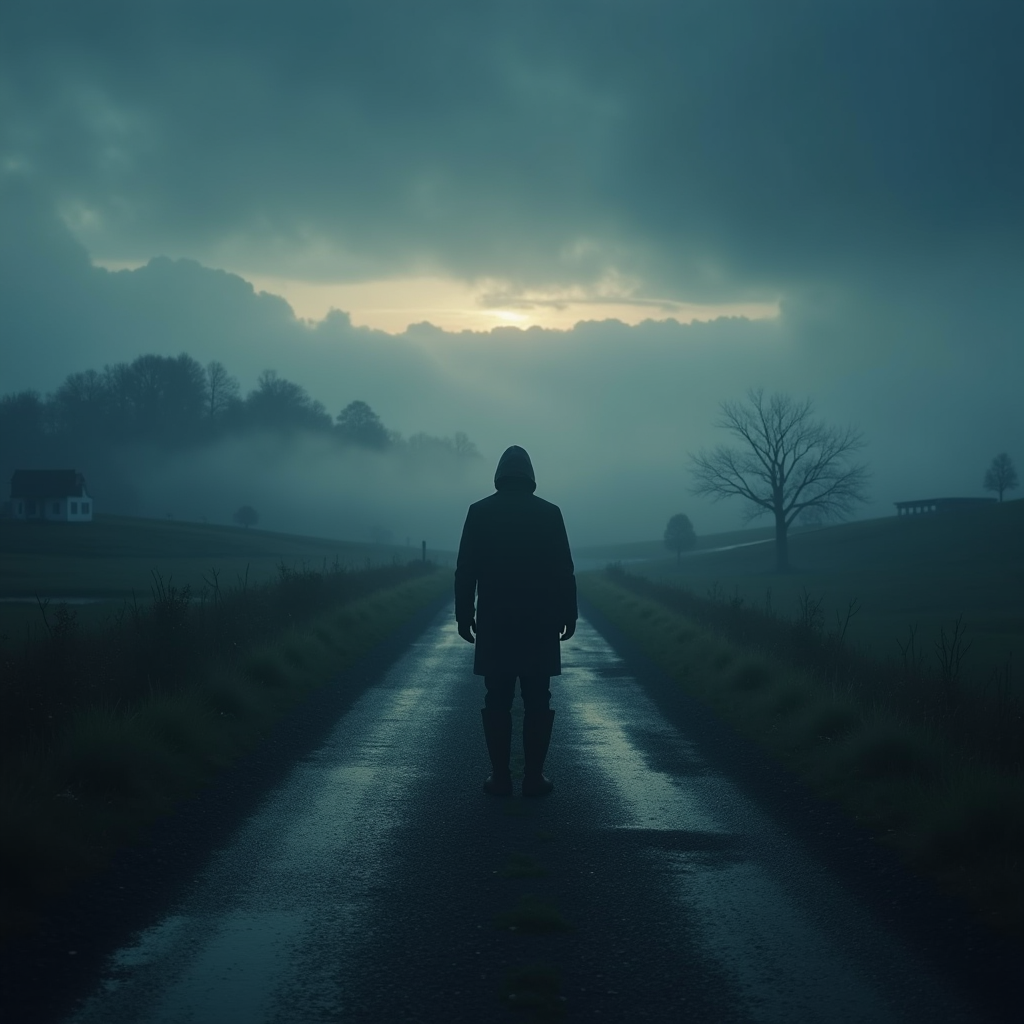
The Town That Existed in the Gap
She found it by accident, the way important things are always found — she had taken a wrong turn on a rural road in Oregon, driving from Portland to Bend for a conference she had been dreading, and the GPS had lost signal and she had followed the road without knowing where it went and the town had appeared, suddenly, at a bend in the road, like something that had been waiting for her to arrive.
The town was called Marrow. The sign at the entrance said so — a wooden sign, weathered, with the word Marrow painted in white letters on dark brown wood. The town had a main street, which was lined with buildings that looked like they had been there for a long time — a general store, a post office, a diner, a pharmacy — and it had people on the street, which surprised her, because she had not expected to find a town this size on a road that did not appear on any map she had consulted before leaving Portland.
She stopped the car. She got out. She walked down the main street and the people she passed nodded at her in the way that people nod at strangers in small towns, which is to say they acknowledged her without speaking, and they continued with whatever they had been doing. She went into the diner. She ordered coffee. The waitress was friendly in the way that waitresses in small-town diners are friendly, which is to say that she was efficient and warm and did not ask questions that were not relevant to the delivery of coffee.
The coffee was good. She sat for twenty minutes and drank it and watched the town through the window. The town looked normal. The town looked like a town — people walking, a dog crossing the street, a pickup truck parked in front of the general store. There was nothing in the town that seemed unusual or unexpected or out of place. And yet she did not leave. She ordered a second cup of coffee. She sat for another twenty minutes. She watched. The town continued to look normal. The light changed, slowly, from afternoon to early evening, and the shadows of the buildings lengthened across the main street in the way that shadows do in towns where the buildings are positioned to catch the morning light and are therefore in shadow by evening.
When she finally left, driving back the way she had come, she found the road she had turned onto by accident and she followed it back to the highway and she continued to Bend and she arrived at her conference and she gave her talk and she drove back to Portland and she did not think about Marrow for three weeks, and then she thought about it constantly, in the way one thinks about something that has pressed itself into a memory and refuses to be dislodged.
She went back. She drove four hours to find the road, and when she found it, she turned onto it, and she drove for twenty minutes, and thirty minutes, and forty-five minutes, and the town did not appear. She drove for an hour. She drove for an hour and a half. She turned around and drove back to Portland and she told herself she had imagined it, or that she had been tired, or that the GPS had been wrong about the route she had taken and she had actually come from a different direction and the town was somewhere else entirely.
She found it again by accident, the second time. She had been driving to Seattle for a different conference, and she had taken a different wrong turn, on a different rural road, in a different part of Oregon, and the town had appeared at a bend in the road, like something that had been waiting for her to arrive. The sign said Marrow. The main street looked the same. The diner was there. The waitress — who was, she realized as she walked in, the same waitress — looked at her and said, You came back.
She sat. She ordered coffee. She asked the waitress where she was. The waitress said she was in Marrow. She asked what state. The waitress said that was the wrong question. She asked what the right question was. The waitress said there was no right question, there was only the answer, which was that Marrow was where it was, and that it had been there for as long as anyone who lived in it could remember, and that people came to Marrow when they needed to come to Marrow, and that they did not always know why they needed to, and that this was fine, because Marrow did not require understanding. It only required presence.
She went back to Marrow four more times over the following year. Each time she found it by accident, on a different road, in a different part of the state. Each time the town was the same and slightly different — the buildings were in different positions, the light fell differently, the people she passed on the street were different people. She began to suspect that Marrow was not a town in the conventional sense of the word. It was more like a condition — a place that existed between locations, that was accessible by wrong turns, that appeared to people who were not entirely sure where they were going and who were, for that reason, exactly the kind of people Marrow was looking for.
The last time she went, she drove for three hours on roads she had never taken before, and she found the town, and she sat in the diner, and she ordered the coffee, and the waitress set it down in front of her and said: You know this is the last time, don’t you. She said she knew. The waitress said she was welcome to stay, if she wanted to. Marrow always needed people who understood it, even incompletely. She said she knew. She drank the coffee. She left. She drove back to Portland and she did not try to find Marrow again, because she understood — in the way that people understand things that have been shown to them clearly, without ambiguity, in a tone of voice that is not unkind — that some places are meant to be found and not kept, and that the gift of a wrong turn is that you can always pretend it was an accident.