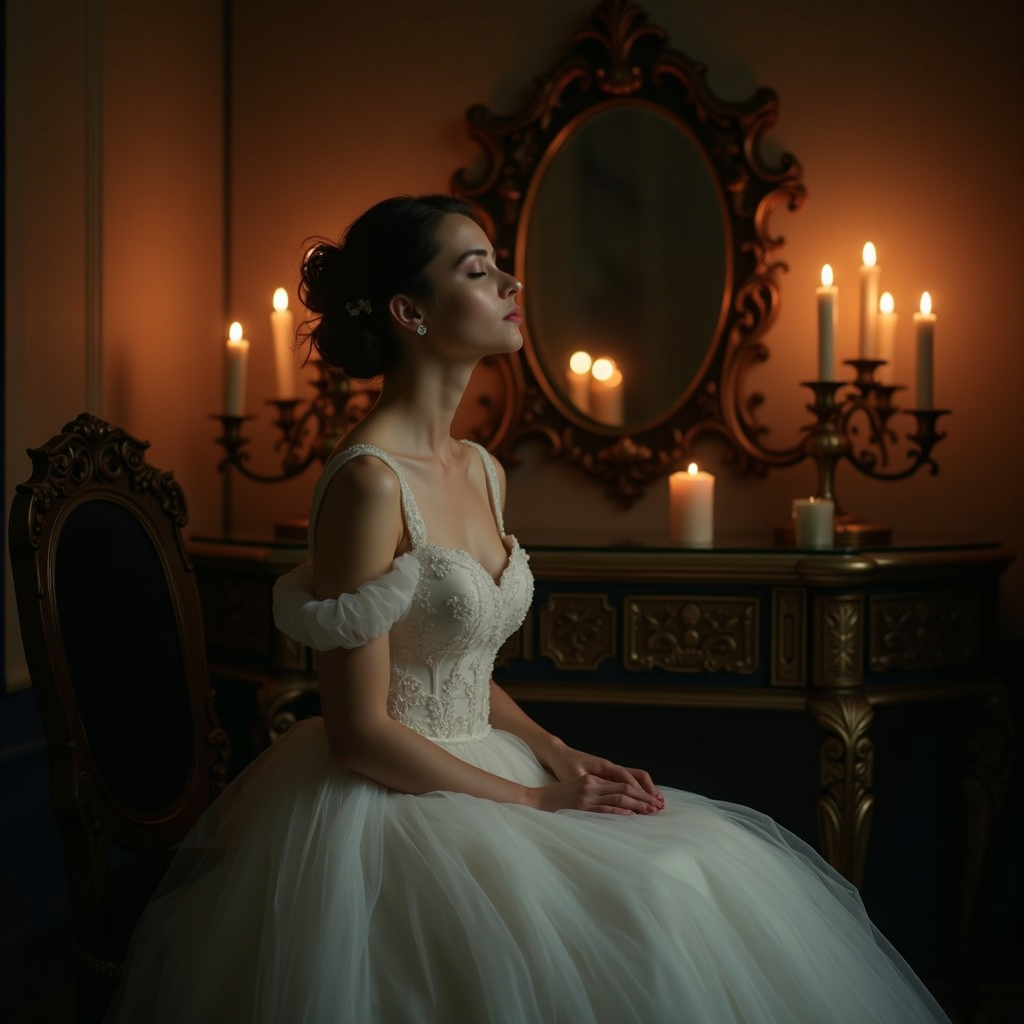
The Bride Who Kept Her Eyes Closed
The photographer had never seen a bride keep her eyes closed through the entire ceremony. Not sleeping — her eyes had been open, half-lidded, focused inward, and she had walked the aisle with the certainty of someone who had done this before and who knew exactly what was coming and who was not afraid of it. The groom had not seemed to notice. The groom had seemed, in fact, to be the kind of groom who would not notice if something unusual was happening, because he was too focused on the performance of his own role in the ceremony — the steady voice, the appropriate pauses, the composed expression of a man entering the most important contract of his life.
The photographer noticed. The photographer noticed everything, because that was her job, and what she noticed was that the bride’s eyes, in every photograph where they were visible, were open but not looking at the groom. They were looking at something beyond the camera, beyond the officiant, beyond the assembled guests — at something that existed in a direction that the photographer could not identify from inside the frame. In the photograph of the vows, the bride’s eyes were half-closed and focused on a point approximately three feet to the left of the groom’s head. In the photograph of the kiss, her eyes were fully closed and her expression was one of absolute concentration, as if she were listening to something very carefully.
The wedding was held at a private estate in Marin County, which the photographer had photographed at before and which had always felt, to her, like the kind of place that had opinions about the events it hosted. The estate had been built in 1923 by a shipping magnate who had filled it with art that he had acquired in ways that were not entirely legal and had decorated it with furniture that was beautiful and uncomfortable and that communicated, to anyone who sat in it for too long, the specific message that it was not meant for sitting. The photographer had always found it difficult to work there. The light was strange. The walls were thick. The rooms held sounds in a way that was different from other rooms, as if sounds entered them and did not leave.
The bride’s family had booked the estate for the entire weekend. The photographer had been hired for the ceremony and the reception, and she had arrived on the Saturday morning to set up and had spent three hours adjusting her equipment and finding her angles and testing her lighting. The bride had been there, in the bridal suite, with her mother and her maid of honor, and the photographer had gone in to take the getting-ready photographs and had found the bride sitting at a vanity table, alone, her mother and maid of honor having stepped out for some errand that the photographer did not catch, and the bride had been staring at herself in the mirror with an expression that the photographer would later, when she was reviewing the photographs on her computer, describe as anticipatory. Not nervous. Not joyful. Anticipatory, the way a person looks when they are waiting for something they have been waiting for for a very long time and who can see, in the mirror or in the future, the moment when the waiting ends.
The photographer asked the bride if she was ready. The bride said she was ready. The photographer asked the bride if she was nervous. The bride said she was not nervous. The bride said she had done this before, and that she was looking forward to doing it again, and that she understood that this was the second time and that the groom did not know that it was the second time, and that this was fine, because the groom did not need to know everything. The photographer did not ask follow-up questions. She had learned, in fifteen years of wedding photography, that the best thing to do when a bride said something strange was to nod and take the photograph and move on to the next shot.
The reception went normally. The photographer took the photographs she was supposed to take — the first dance, the cake cutting, the bouquet toss — and in none of these photographs was the groom behaving strangely, and in none of them was the bride behaving strangely, and yet in all of them the bride’s eyes were not quite focused on what was in front of her. She was looking past the camera. She was looking past the groom. She was looking at something that the photographer could not see and could not identify and that seemed, in the photographs, to be pulling the bride toward it with a gentle and inexorable gravity.
The photographer delivered the photographs six weeks later. She did not think about the wedding again until she was reviewing her archive three years later, when she came across the files and looked at them again and found — in the photograph of the first dance, which she had always remembered as a straightforward photograph of a couple dancing — that the bride’s eyes were open, and that they were looking not past the camera but directly into it, and that what they were looking at was not the photographer and was not the camera and was not anything that existed in the visible spectrum, and that the expression on the bride’s face was not an expression of joy or anticipation or any of the emotions a bride was supposed to have on her wedding day. It was an expression of recognition. The expression of a person seeing something they had been waiting for, finally arriving, exactly on time.
The photographer deleted the photographs. She told herself she was protecting the client’s privacy. She did not show them to anyone. She did not keep them in her archive. She did not post them on her website, which was something she had originally planned to do, because there was something about them that she did not want other people to see — not because it was scandalous or disturbing, but because it was private, in the way that the moments before and after a wedding are private, in the way that the moment when a person crosses a threshold they have crossed before and will cross again is private, in the way that the space between what a person was and what they are becoming is private and should not be photographed, even by accident, even with permission, even with the best light and the most careful composition.