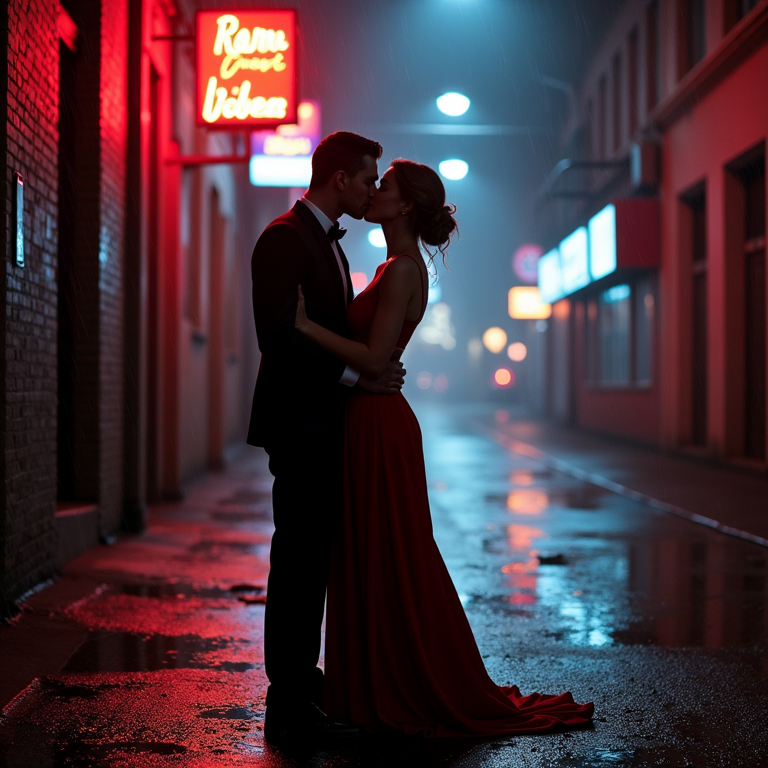
A Kiss in the Darkest Hour
The blackout came without warning. One moment Elena was standing in the crowd at the charity gala, champagne in hand, watching her father’s rival across the room; the next, the chandeliers died and the city went dark in a way it hadn’t in twenty years.
She found Marco in the chaos—her father’s enemy, the Castellano heir, the man she had been raised to hate since the day she understood what her family’s name meant in this city. He was standing by the emergency stairs with his phone light on, and his face when he saw her was something she had never seen before in all the years of boardrooms and ceasefire negotiations and cold nods across crowded rooms.
“Your father?” he said.
“Probably orchestrating this. He’s been planning something for weeks. The timing isn’t coincidental.”
“Mine too.” Marco clicked off his phone light. “We’re in the same boat, then. Or the same storm, at least.”
They walked down eighteen flights of stairs together because the elevators were useless without power, and somewhere around floor twelve, when the emergency lights flickered too and the stairwell became a place of shadows and echoes, Elena realized she was holding his hand. She didn’t remember deciding to do it.
“This is strange,” she said.
“Everything about our families is strange. This is just honest.”
The street outside was a disaster—cars stopped in the middle of intersections, people walking with flashlights, the whole city in that strange suspended state that only happens when infrastructure fails and everyone becomes equally lost. Marco pulled her into an alley where the buildings blocked the wind, and they stood there in the dark, and he said the thing that had been building between them for two years:
“I’ve been pretending to hate you because it was easier than admitting why I couldn’t stop looking at you.”
Elena wanted to argue. She had a lifetime of conditioning that told her this was wrong, that the feud between their families was a fact as immutable as gravity, that what he was saying was impossible. But the blackout had taken away all the structures that told her how to be, and in the dark she was just a woman standing in an alley with a man whose voice made her feel something she had never allowed herself to feel before.
“If my father finds out—” she started.
“Your father probably already knows. He’s been watching us dance around this for eighteen months. That’s probably why he’s doing all of this—to see what we’ll do when there’s no light to hide in.”
Marco kissed her in the alley. It was not a gentle kiss. It was the kind of kiss that has two years of tension behind it, two years of watching each other across rooms and pretending not to look, two years of choosing family over something neither of them had ever been brave enough to name. When he pulled back, Elena’s breath was shaking, and the city was still dark, and the world had fundamentally changed in a way neither of them could undo.
“This is going to be a problem,” she said.
“Everything important is.”
They stood in the alley until the emergency services got the traffic lights working and the city started to remember its patterns. Then they walked out onto the main street like nothing had happened, like they were still the enemies their families needed them to be, and somewhere above them Elena’s father was probably watching through a window, and somewhere above them Marco’s father was too, and the game had changed but the rules hadn’t—and both of them understood that what had started in the dark was going to have consequences neither family was prepared for.