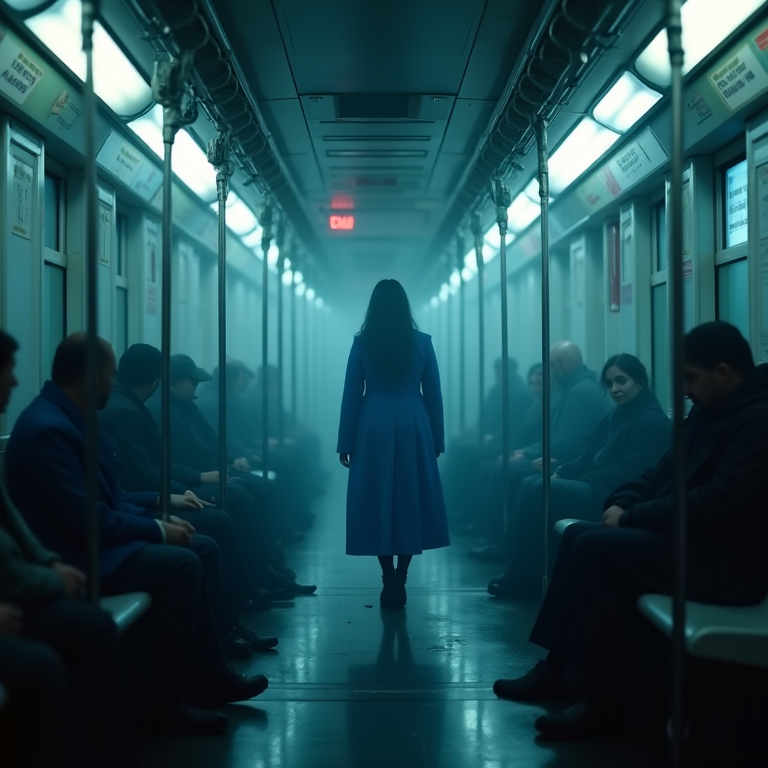
The Train That Never Arrived
Sophie had taken the 11:47 commuter rail every night for four years, and she knew every face on it by heart—the retired professor who always read newspapers from the bottom up, the young nurse who always fell asleep with her earbuds in, the中年男人 who never looked up from his phone. She knew the conductor’s name was Rick and that he had a daughter Sophie had never met but had learned to recognize from the photographs he kept in his pocket.
The night the strangers appeared, the train was nearly empty. It was a Tuesday, raining, and Sophie was one of maybe twelve passengers in the back three cars. Rick announced the next station—the final stop—as he always did, and the doors opened, and no one got on.
That was unusual but not unprecedented. Sophie went back to her book.
Then the woman in the seat across the aisle looked up from her phone, and Sophie saw her face, and felt something cold move through her chest.
She knew that face. She had seen it on a missing persons poster at the grocery store three weeks ago. Young woman, twenty-five, disappeared from the Westside station, last seen wearing a blue coat. The poster was still up. Sophie remembered because she had thought about how someone’s family was probably still checking that station every day, hoping for a miracle.
The woman with the blue coat looked at Sophie, and smiled, and Sophie understood that the woman knew she had been recognized.
The train didn’t stop at the next station. It didn’t slow down. It just kept moving, faster than it should have been going, and Sophie’s phone had no signal—her texts weren’t going through, her calls weren’t connecting—and when she looked around the car, she saw that every passenger was staring at her with expressions she couldn’t interpret, and none of them were the faces she knew from her four years of commuting.
The faces she knew—the professor, the nurse, the中年男人—were gone. In their seats sat people who looked like them but weren’t, people who had been watching her for as long as she had been watching them, people who were waiting for her to understand what was happening.
And the woman in the blue coat was standing now, walking toward Sophie’s seat, and the conductor’s voice came over the speaker, and it wasn’t Rick anymore, it was someone or something that sounded like a recording played too many times.
“The last stop is the next station,” the voice said. “Please gather your belongings and prepare to disembark. The last stop is the next station. The last stop is the next station.”
Sophie didn’t know what would happen when the train stopped. She didn’t know where the train was going, or why, or what she had done to become one of the people on this train instead of one of the people waiting at the stations she passed. But she understood, with a certainty that felt like ice water in her veins, that she was not getting off at the next stop the way she had gotten on at every stop for four years.
The train kept accelerating. The lights flickered. And the woman in the blue coat sat down next to her and took her hand and said, with a voice that sounded like Sophie had imagined it: “You’re going to be fine. They’re always fine at first.”