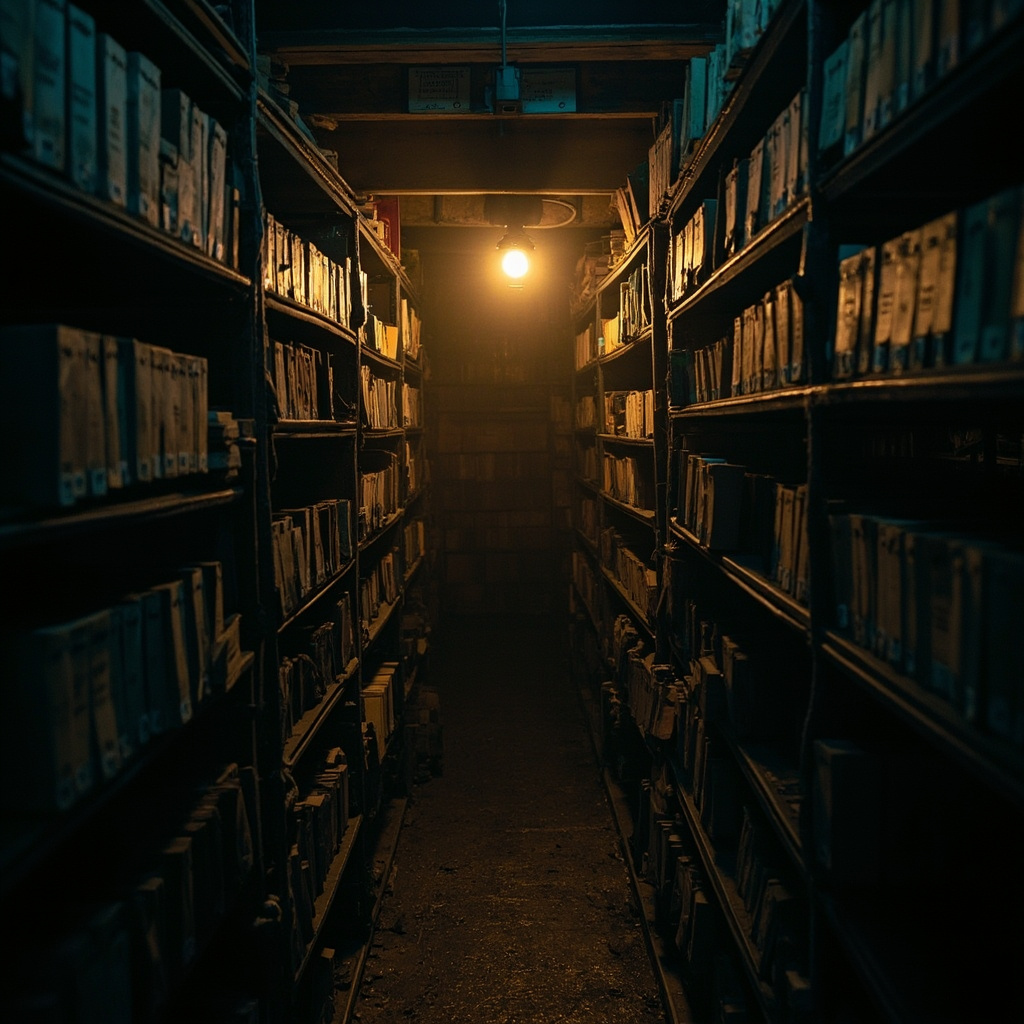
The Archive They Built at Night
Eleanor had been an archivist at the university for twenty-three years. She had started in the paper archive, the one with the climate control and the acid-free boxes and the policy that required users to wear white cotton gloves when handling anything older than 1950. She had survived the digitization project, the budget cuts, the reorganization that had merged the paper archive with the digital archive and created a new hybrid department that no one was quite sure how to manage. She had survived all of it by doing what archivists do, which is to say that she had preserved things. She had taken the record of what people had done and thought and created, and she had kept it safe from the entropy that consumes all human effort eventually.
The university archive was in the basement of the main library, a space that had been designed in the 1960s and had not been updated since. The shelves were metal and institutional. The lighting was fluorescent. The temperature was kept at sixty-five degrees year-round, because that was what the standards required, and because the standards had been written by people who had never actually worked in an archive and who believed that preservation was primarily a matter of controlling numbers rather than understanding the material they were designed to protect.
Eleanor knew better. She had learned, over twenty-three years, that archives were not just storage spaces. They were arguments. They were the physical manifestation of decisions about what mattered and what did not, about who deserved to be remembered and who could be safely forgotten. Every box in the archive represented a choice that someone had made, and every choice had consequences that rippled outward in ways that the choosers could not have predicted.
The discovery happened on a Tuesday in March, when Eleanor was processing a collection of materials that had been donated by the family of a professor who had died in 1987. The collection was mostly routine: lecture notes, correspondence, the ordinary detritus of an academic career. But at the bottom of the third box, Eleanor found a set of papers that did not belong.
They were handwritten, in a script she did not recognize. They were not in English. They appeared to be some kind of catalog or index, listing items by name and location and what could only be described as “condition”—though the conditions described were not conditions that any archival standard would recognize. There were entries for things like “the memory of a first love, preserved at the moment of recognition” and “the sound of a mother’s voice as it was the last time the child heard it before the illness took it away.”
Eleanor did not believe in what she was reading. She was a rationalist, a scientist of sorts, a woman who had organized her professional life around the principle that the world was exactly what it appeared to be and that anything that suggested otherwise could be explained by insufficient evidence or active fraud. But the entries continued, page after page, and they were too specific and too detailed to be random. Someone had created this catalog. Someone had maintained it. Someone had hidden it in a box of donated materials and left it there to be found.
Eleanor did not tell anyone about the papers. She put them back in the box, processed the rest of the collection, and went home. She could not sleep. She lay in bed and thought about the catalog, about the things it listed, about the impossible specificity of its entries. She thought about the professor who had owned the collection—a man named Dr. Ashworth, who had been a psychologist and who had died alone, according to his obituary, with no surviving family. She thought about the fact that Dr. Ashworth’s obituary had mentioned, almost in passing, that he had been working on something that his colleagues had not fully understood.
She went back to the archive the next night. She went back the night after that. She began to search the stacks for other materials that might have been part of what Dr. Ashworth had been doing—other documents that might have been misfiled or hidden or simply left in places where no one would think to look. She found fragments: a letter discussing “the extraction protocol,” a diagram that appeared to show the structure of memory itself, a photograph of an room that she did not recognize, filled with shelves that were filled with objects that she could not identify.
The room in the photograph looked like an archive. But it was not the university’s archive. It was something else—a place that had been built specifically to contain what Dr. Ashworth had been collecting.
Eleanor spent the next six months building the room that Dr. Ashworth had started. She did not know exactly what she was doing, not at first. She was working from fragments, from hints, from the evidence of a life’s work that had been hidden deliberately and that revealed itself only when she was willing to follow where it led.
She converted a storage closet in the archive’s basement into something that was not quite an archive and not quite a laboratory. She acquired the materials that Dr. Ashworth’s notes described: specific kinds of paper, specific kinds of ink, specific organizational structures that seemed to follow principles that were not documented in any standard archival text. She learned, through trial and error, how to do what Dr. Ashworth had done—which was to take a memory and remove it from the person who had it and preserve it in a form that could be accessed by someone else.
The first memory she preserved was her own. She did it on a Saturday afternoon, when the archive was empty, when she had no witnesses and no one to explain what she was doing if it went wrong. She sat in the closet that was becoming a room and she thought about her mother, who had died five years earlier, and who had been the most important person in Eleanor’s life for thirty-seven years before that. She thought about the last conversation she had had with her mother, the ordinary things they had said to each other, the way her mother had looked at her when she was leaving and had said “drive safe” in the tone that mothers use when they mean “I love you” but do not know how to say it directly.
She preserved that memory. She took it out of herself and placed it in a box and labeled the box with the date and her mother’s name. And then she reached for the memory, expecting it to be gone—and found that it was still there, unchanged, undimmed, still hers to access whenever she wanted. But the box was also there, containing the same memory in a form that she could share with someone else, that she could leave behind when she was gone, that would outlast her own ability to remember.
Eleanor worked in the archive for another fifteen years. She built the collection that Dr. Ashworth had begun. She preserved memories for people who came to her in secret, who heard about what she could do through the kind of word-of-mouth that secret knowledge travels, who brought her the things they most wanted to keep and most feared they would lose. She did not charge for this service. She did not advertise it. She did it because it was what archivists do: they preserve things. They take the record of what people have done and thought and created, and they keep it safe from the entropy that consumes all human effort.
When Eleanor retired, she donated her collection to the university archive. The donation was catalogued as “personal papers, E. Marsh, access restricted.” The boxes were placed in the basement, in the same climate-controlled environment as everything else. They remained there, waiting, for someone else to find them and to understand what they contained and to continue the work that Dr. Ashworth had started and Eleanor had completed.
Some archives hold records of what happened. And some archives hold the things that people wanted to happen, preserved in forms that outlast the people who preserved them and the people they were preserved for. Eleanor’s archive was the second kind. It was not a record of the past. It was a gift to the future.