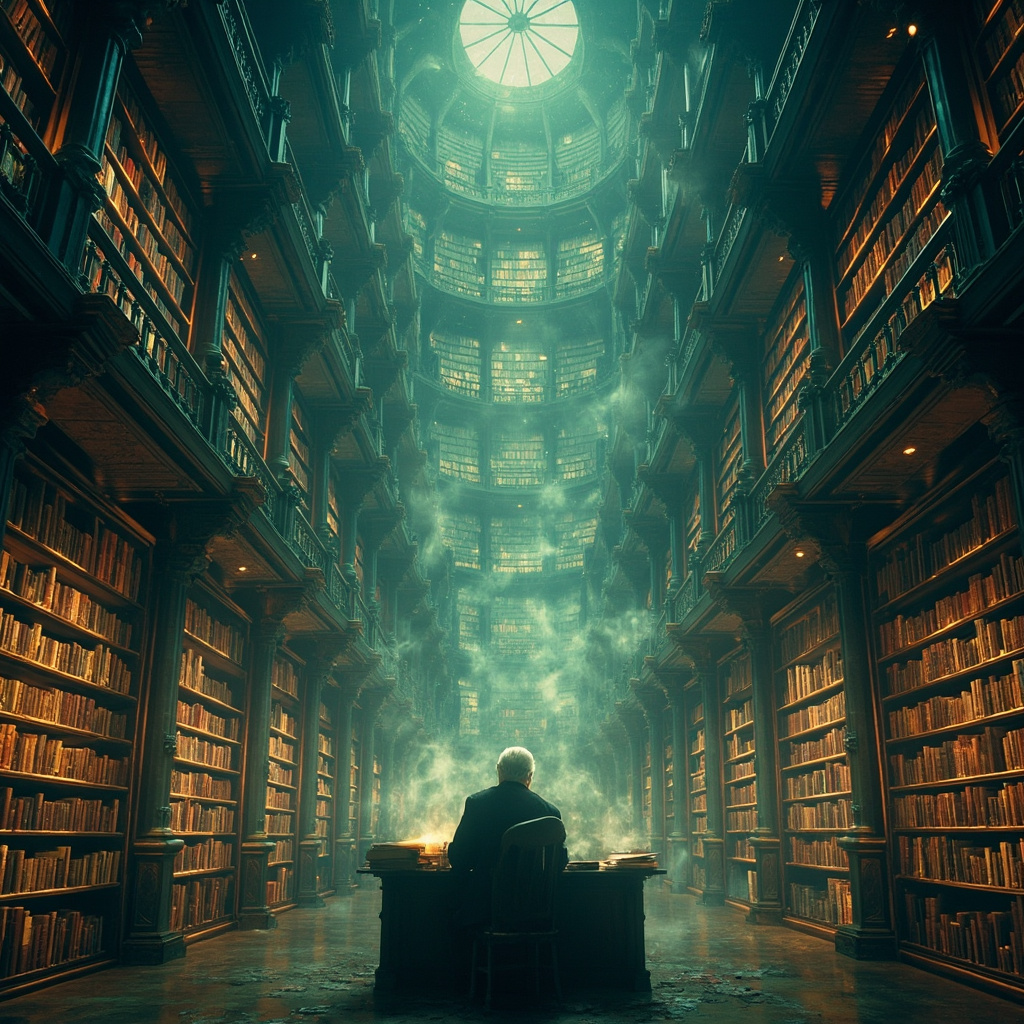
The Library Where Stories Come to Die
Nadia had been a librarian for eleven years. She had worked in three different libraries over the course of her career, and she had learned, in that time, that libraries were not just buildings full of books. They were ecosystems. They had their own rhythms and their own moods. Some libraries were warm and welcoming, full of the sound of pages turning and keyboards clicking and the quiet conversations of people who came to think and research and be alone together. Other libraries were colder, more transactional, places where people came to get what they needed and leave.
The Whitmore Library was neither. It was old—older than any building had a right to be, given the neighborhood it stood in, a neighborhood that had been built in the 1970s and had never quite recovered from whatever had caused its initial construction to stall for nearly a decade before finally being completed. The Whitmore had been there before the neighborhood. The neighborhood had been built around it. This was the kind of historical fact that most people did not know, and that Nadia had discovered only after she had been hired and had begun, out of professional curiosity, to research the building’s history.
What she found was not in any official record. What she found was in the basement.
The basement of the Whitmore Library was not accessible to the public. It was accessible to staff, which meant that Nadia had been down there in her first week, learning where the electrical panel was and where the water shutoff valve was located and what the protocol was in case of a flood. She had walked through the basement on her first day and had noted, with the kind of attention that experience brings, that the basement was larger than the building above it.
This was not possible. The basement’s footprint matched the building’s footprint, exactly, as measured by the property records. But when she walked the basement’s perimeter, her steps told a different story. The basement was deeper and wider than it should have been, by a margin that she could feel but not explain.
She mentioned it to the building manager, who said that old buildings often had basement extensions that were not fully documented. She mentioned it to her supervisor, who said that the previous librarian had also mentioned the basement’s unusual dimensions and that it was probably just the way the building was constructed. She stopped mentioning it. She started, instead, to go down to the basement during her lunch breaks and walk the perimeter, measuring with her footsteps, trying to understand what she was feeling.
On the seventeenth day of her investigation, she found the door.
The door was set into a wall that should not have existed. It was made of a wood that Nadia did not recognize—dark and dense and smooth, as if it had been polished by centuries of hands. There was no handle. There was no keyhole. There was only a panel of wood that looked, in the basement’s fluorescent light, like it was waiting for something.
Nadia pressed her hand against the wood. It was warm. This surprised her. She had expected cold, the way that old wood in a basement is usually cold. But the wood was warm, and it seemed to pulse slightly under her palm, the way a heartbeat pulses, the way a living thing breathes.
The door opened.
Beyond the door was a room that was not a room. It was a library—larger than the Whitmore’s main reading room, larger than any library Nadia had ever seen—but it was filled with books that she did not recognize, in languages that she could not read, in bindings that looked like they were made from materials that should not have been used for bookbinding. The room was lit by a light that came from the books themselves. The books glowed. They glowed with different colors—some warm, some cold, some flickering, some steady—and the light they produced filled the room with a color that Nadia had no name for.
A woman was sitting at a desk in the center of the room. She was old, in the way that ancient things are old—not frail, not weak, but old in a way that suggests depth, layers, the accumulation of time that cannot be measured in years.
“You found us,” the woman said. “Good. We have been waiting.”
The woman was named Vesper. She had been the keeper of the room for longer than Nadia could comprehend—centuries, perhaps, or longer. The room was not a room. It was an archive. It was the place where stories came when they were finished—not published, not read, but finished in the sense that the people who had lived them had moved on and the stories themselves had been left behind, waiting to be catalogued and preserved and, if necessary, remembered.
“Every story that has ever been lived is here,” Vesper said. “Not the stories that have been written. The stories that have been lived. Every experience that a person has ever had, encoded in a form that can be read by someone who knows how.”
Nadia walked among the shelves. She pulled out a book at random—a slim volume with a cover that showed a garden in moonlight. She opened it and read a page. The page described, in precise and devastating detail, a summer evening in 1923, when a woman named Clara had sat in her garden and thought about the life she was living and the life she had imagined she would live, and the gap between those two things. It was not a famous life. Clara was not a historical figure. She was simply a woman who had lived and died and been forgotten by everyone except the archive that had been waiting for her story.
“Can I read any of them?” Nadia asked.
“You can read the ones that call to you,” Vesper said. “The archive reveals itself to those who can understand it. Some people find one book that speaks to them. Some find hundreds. It depends on what they are looking for, and on their capacity to hold the weight of what they find.”
Nadia visited the archive every day for a month. She read stories that she found by following instincts she did not know she had—the way a book would glow slightly brighter when she walked past it, the way a title would seem to rearrange itself as she approached. She read lives that had been lived in every era and every place. She read stories of love and loss and triumph and failure, stories that were unique and stories that were universal, stories that felt like they had been written specifically for her.
Then, one day, she found her own book.
It was on a shelf near the bottom of the room, in a section that she had not explored before. The cover showed a library, and her heart stopped when she recognized it. She opened the book and read her own life—her childhood, her career, the choices she had made and the consequences she had lived with. She read the story of a woman who had found an archive and had chosen to keep coming back, again and again, because the lives of other people felt more real and more important than her own.
She closed the book. She put it back on the shelf. She walked out of the archive and closed the door behind her.
She did not go back. She returned to her work at the Whitmore Library, to the books that were just books, to the life that was just her life. She was grateful for what she had seen. She was also, in a way that she could not fully explain, relieved. Some archives are meant to be visited, not inhabited. Some stories are meant to be read, not lived. And some libraries are just libraries, which is enough, which has always been enough, for the people who know how to love them.