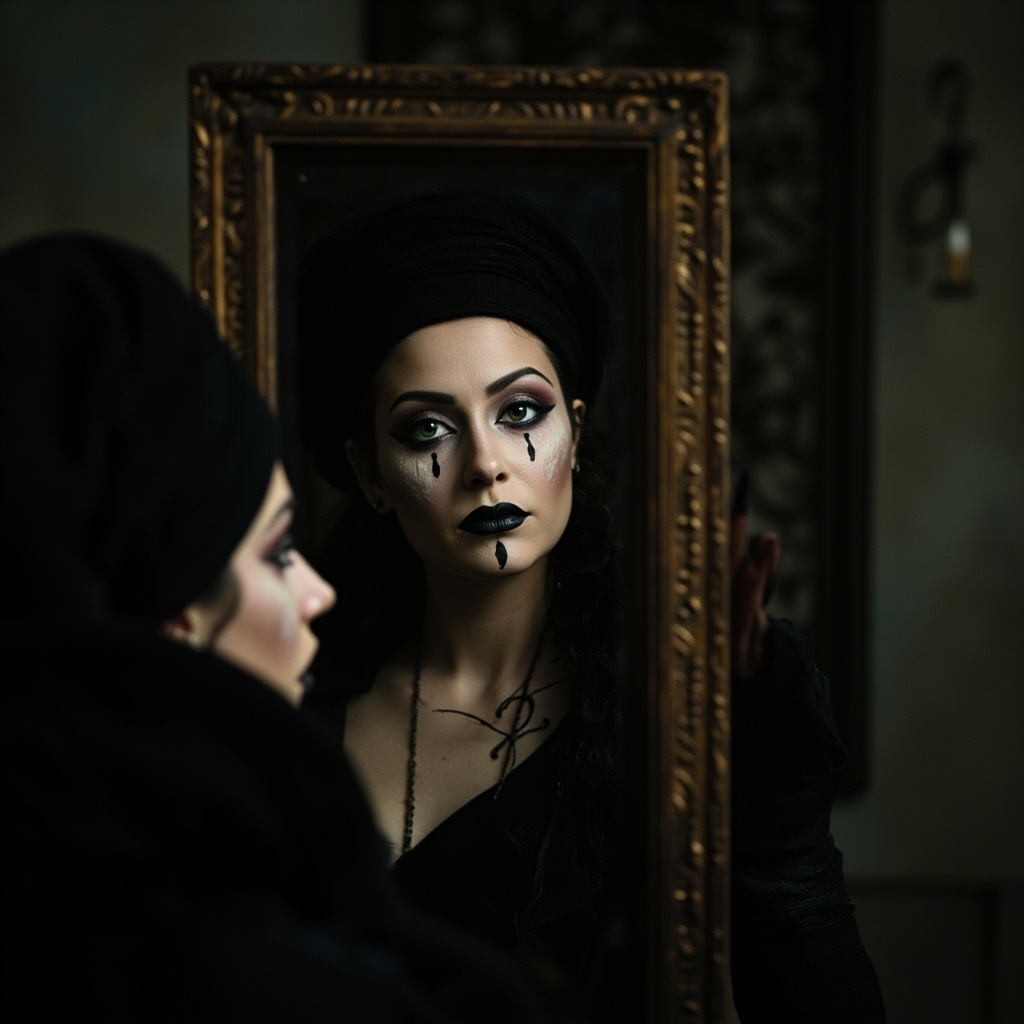
The Sleepwalker
Sarah had been sleepwalking since childhood. Her doctor called it a parasomnia, a harmless quirk of brain chemistry that caused the body to move while the mind remained asleep. Her husband called it unsettling—the way she would sit up in bed with her eyes open and glassy, her face expressionless, her movements precise and purposeful. Her therapist called it stress-related, a manifestation of anxiety that would resolve itself once she learned to manage her emotions better.
None of them had ever considered that it might be something else.
The night everything changed, Sarah woke up holding a knife. Not her husband’s chef’s knife from the kitchen—the paring knife she used for trimming herbs, the small one that fit perfectly in her palm. She was sitting in the middle of the bed, covers pulled back, feet planted on the floor, holding the knife in front of her face as if examining it.
Blood was dried on the blade.
Sarah screamed. Her husband, David, came running from the bathroom, and for a moment they just stared at each other—Sarah clutching a bloody knife, David in nothing but a towel, both of them trying to understand what was happening. Then David carefully, slowly, reached out and took the knife from her hand, and Sarah let him, because she had no idea what else to do.
“It’s okay,” he said, in the tone people use when they are very clearly not okay. “It’s okay. You were sleepwalking. You probably went to the kitchen and cut yourself somehow. We’ll figure this out.”
But they both knew, even then, that this was not the kind of wound that came from cutting yourself in the kitchen.
Over the following months, Sarah’s nighttime wanderings became more elaborate and more disturbing. She woke up in rooms she didn’t remember walking to, holding objects she had no memory of acquiring. A man’s watch, gold-plated, with an inscription on the back that she couldn’t read. A photograph, creased and faded, of a woman she didn’t recognize. A jewelry box containing a diamond ring that was worth more than her car.
She found letters in her handwriting, addressed to people she had never heard of, describing events she had no memory of living through. She woke up with dirt under her fingernails and leaves in her hair and the overwhelming sense that she had been somewhere dark, somewhere underground, somewhere that smelled of earth and old bones.
The sleepwalker had become someone else. Someone who did things Sarah would never do while conscious. Someone who moved through the world with purpose and precision, executing plans that Sarah’s waking mind knew nothing about.
David started sleeping in the guest room. Not because he was afraid of her—he claimed it was because he didn’t want to disturb her rest—but they both knew the truth. He was afraid of what she might do in the night. Afraid of the stranger who wore her face and used her hands and moved through the darkness with eyes that saw nothing and everything at the same time.
The truth came from an unexpected source: David’s first wife, who had died seven years ago. Or rather, who had been declared dead after disappearing, which was not quite the same thing.
Her name was Margaret, and she had not died at all. She had been taken—replaced, in a sense, by an organization that specialized in making inconvenient people disappear. They had been recruited out of college, Margaret explained when Sarah finally tracked her down through a network of contacts she hadn’t known she had. The organization was called the Continuity Project, and its purpose was to ensure that certain individuals—the right individuals—could be removed from society without the messy complications of death, investigation, or public scandal.
“They took me because I knew too much,” Margaret said. She was living under an assumed name in a city three hundred miles away, working as a librarian, looking nothing like the photographs Sarah had found. “I was going to expose them. They gave me a choice: disappear or be disappeared. I chose to disappear on my own terms.”
“And me?” Sarah asked. “What’s happening to me?”
Margaret studied her for a long moment. “You’re the third version,” she said finally. “There was an original—you. And then there was a copy, created by the Project to replace you after the original… incident. And then there was another copy, and another. Each one decommissioned when they started remembering.”
“Decommissioned,” Sarah repeated, the word tasting like metal in her mouth.
“Deactivated. Replaced. It’s very peaceful, from what I understand. Like falling asleep. But you—you’re starting to remember things that the other versions experienced. That shouldn’t be possible. The memories should have been wiped.”
Sarah went home and sat her husband down. She had thought about this moment for weeks—lying awake in bed, staring at the ceiling, trying to understand what she was and what it meant for the life she had built. David had been married before. He had loved Margaret, or the version of Margaret that had been replaced. He had married Sarah knowing that she was a copy, that she was part of a system that had erased his first wife and put something else in her place.
“I know what I am,” Sarah said. “And I know what you did.”
David did not deny it. He had been paying the Continuity Project for seven years—keeping the current copy maintained, the memory gaps filled, the pretending convincing. He had loved the original Sarah, before whatever incident had required her replacement. He had learned to love the copy—loved this Sarah, the one sitting across from him now—because she was, in every way that mattered, the person he had married. She just happened to have a different origin story than he had originally believed.
“I won’t leave,” Sarah said. “Not because I forgive you, but because I don’t know where else I would go. I’m a copy of a woman who was erased by an organization that murders inconvenient people. My memories are fragments of lives I never lived, experiences I never had. I don’t know who I am. But I know that I don’t want to be alone.”
David reached across the table and took her hand. “Then let’s figure it out together,” he said. “Not as a normal couple. Not as the person I married and the person I replaced. Just as two people who are trying to survive something neither of us fully understands.”
Sarah nodded. She did not trust him—not fully, not yet. But she trusted him more than she trusted the alternative: disappearing into the night, joining Margaret in whatever network of replacements and copies existed beyond the edges of normal life.
She spent the next year learning everything she could about the Continuity Project. She found other copies, other versions of people who had been erased and replaced. She built a network—a quiet resistance, operating in the spaces between the organization’s reach. They could not bring back the originals. They could not undo what had been done. But they could watch, and wait, and prepare for the day when the organization’s careful balance of secrets and silence would finally, inevitably, collapse.
The sleepwalker stopped walking at night. Whatever mechanism the Project had used to control her had been overwritten, subverted, turned into something that served her purposes instead of theirs. Sarah did not know if she was still a copy or if she had become something else entirely—something new, something that belonged only to herself.
She did not know if it mattered.
She knew only that she was here, and awake, and finally—after all the nights of walking in the dark—the sleepwalker had learned to stay.