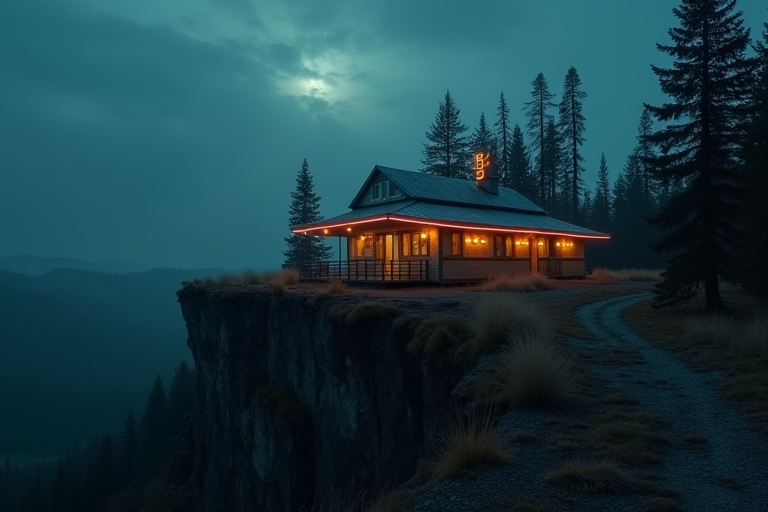
The Cliffside Diner
The bus reeked of fast food wrappers and recycled air. Nathan had been sitting in the same position for so long that his lower back had developed a dull, grinding ache he was certain would never fully go away. He shifted in his seat, pressed his forehead to the cold glass, and watched the Montana wilderness swallow the highway. Trees. More trees. The occasional frozen creek cutting through rock. He had been telling himself for the last four hours that he was making the right call, and the telling was getting harder.
Ninety thousand dollars. For six months. He kept doing the math in his head the way he had been doing it since the afternoon in Denver when the whole thing had been laid out for him.
He had found the listing on Craigslist, which should have told him something right there. “Remote location, seasonal position. Serious applicants only, chef experience required, accommodation provided, compensation negotiable. Half payment upfront, the other half paid on job completion.” He had emailed the address on a whim, not expecting anything, and two days later found himself sitting across from a man in a booth at a diner on 16th Street who looked like he had not eaten a real meal in several months. The man was thin in a way that went past lean, past gaunt, into something that made Nathan think of photographs he had seen in old textbooks of diseases he couldn’t name. His cheekbones pressed against the inside of his face like they were trying to get out. His hands, when he folded them on the table, looked like bundles of sticks wrapped in paper. He had worn a collared shirt despite the cold, and it had hung off his shoulders as though it had been tailored for a much larger man.
He had spoken quietly and without much preamble. He told Nathan about the Cliffside Diner. He showed him photographs on a phone with a cracked screen. Nathan had looked at them and felt a complicated mixture of awe and unease. A building that seemed to grow directly out of the rock face, its timber bones old and dark with weather, a covered outdoor patio extending over the edge of a cliff with a railing that looked like the only thing standing between a meal and a very long fall. Hundreds of feet below, the Yaak River running grey and cold between the canyon walls.
“It pays well because of the location,” the thin man said. “Getting people to stay is the difficult part.”
Nathan had asked what that meant. The thin man smiled and simply said fear of heights. Nathan had chosen to accept that answer.
He pressed his palm over the inside pocket of his jacket now, feeling the fold of the papers he had signed that day. The smell of the bus was getting to him. He closed his eyes and thought about what forty-five thousand dollars in hand felt like, and tried to use that thought as ballast. He had gotten out of prison just under three years ago, and he still was not in a good position financially. This money was his ticket to a new life.
When the bus pulled into Libby, Nathan was the only one who stood up.
He hauled his duffel bag from the overhead compartment and stepped out into the cold grey afternoon. The town was small in the way that reminded him less of a place and more of an interruption, a brief arrangement of buildings between long stretches of nothing. A gas station. A hardware store. A row of houses with woodsmoke rising from their chimneys. The bus driver did not even look at him as he pulled away.
Nathan stood on the side of the road with his bag and found the white pickup truck without any trouble, because it was the only vehicle in the parking area. It looked exactly as it had been described to him. White, or it had been white at some point, the paint now dulled and peeling along the hood and door panels. One of the side mirrors was held in place with electrical tape. The engine was running. Nathan could see the shape of someone in the driver’s seat.
He walked over and opened the passenger door.
The smell hit him before anything else. Something unwashed and chemical underneath that, sweet and sharp in a way that made the inside of his nose prickle. The man behind the wheel was roughly Nathan’s age, early forties, maybe a few years younger, but his face had been lived in hard. His teeth, when he grinned, were dark at the roots and broken at the edges, several of them missing entirely, the ones that remained the color of old mustard. Every visible inch of his skin, his forearms, his neck, the backs of his hands, was covered in tattoos that had no coherent theme or placement, just a dense layering of shapes and text and images that seemed to have been applied with no thought to how they related to each other. His eyes were quick and a little too bright.
“You Nathan?” the man said. His voice sounded like gravel in a tin can.
Nathan said yes and got in.
The man reached immediately into the center console and produced an envelope, thick and slightly bent. He held it out without looking at it. “Hide that in your sock,” he said bluntly.
Nathan took the envelope. He could feel the rolls of cash inside it. He slipped it into his jacket pocket.
“I’m Butch,” the man said, pulling out onto the road. “Groundskeeper. Maintenance. Whatever needs doing that isn’t cooking or dealing with customers.”
Nathan said it was nice to meet him.
Butch seemed to find this funny. He laughed for a moment, a short choppy sound, and then stopped as quickly as he had started. He drummed his fingers on the steering wheel and talked fast, like the words were backed up behind his teeth and needed to get out. Butch had heard people talk and act like this before in prison. This guy was definitely a meth user.
He told Nathan about the diner with manic enthusiasm. About the patio, how it was exactly what it looked like in those pictures, bolted and cantilevered out over the cliff face, a series of wooden tables and chairs with a railing around the perimeter that Butch described as “more decorative than functional, if you ask me.” He said some people drove all the way out just to take pictures of the building. He said some people actually wanted to eat outside, on the patio, with nothing between them and the river hundreds of feet down but old wood and a railing that nobody had ever replaced. He said those people were “thrill seekers.”
“You get them occasionally,” Butch said. “They want the story. Want to say they did it. Eat a burger over the edge of a cliff in the middle of Montana. Fine by me. They usually tip well.”
Nathan asked about the staff. He said he had been told it was a small operation.
Butch nodded. The nodding seemed to use his whole upper body. “Three of us living there,” he said. “Me, you, and Victoria.” There was a bit of disgust in his words when he said Victoria. His fingers stopped drumming. “Victoria’s the waitress. Hostess. Whatever you want to call it.” He paused, then spat, as if her name tasted terrible in his mouth. “Keep your distance from her. I mean that in the most practical way I can say it. Don’t try to get to know her, don’t try to talk to her more than you have to for work.”
He then told him about the generator that provided power, and the well that gave them water, and the radio they used to call for supply drops. He talked for the full two hours of the drive, barely pausing for breath, and Nathan learned almost nothing useful about the day-to-day operation of the restaurant and a great deal about Butch’s philosophy of life, which seemed to center on the belief that everyone was terrible and the world was divided into predators and prey.
They arrived at the diner just before dark. Nathan’s first impression was that the photographs had not done it justice. The building clung to the rock face like a barnacle, timber and stone and glass, cantilevered out over the canyon in a way that made his stomach tighten when he looked at it. The river was a grey thread far below. The patio tables were empty, chairs lashed to the railings, waiting for the spring crowd that the thin man had promised would come.
Victoria was standing at the hostess station when Nathan walked in. She was older than he had expected, late fifties maybe, with iron-grey hair pulled back tight and eyes that moved over him without warmth or welcome. She handed him a menu and pointed him toward the kitchen without speaking. That was the last time she said a word to him voluntarily for the entire six months of his employment there.